


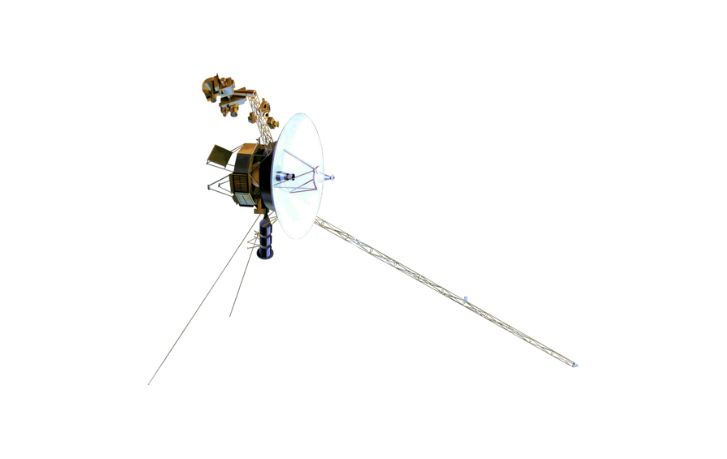
NASA Power Swap Keeps Voyager 2’s Three Science Instruments Running Another Year
Voyager 2 is losing roughly 4 watts of available electrical power every year, but NASA has found enough savings to postpone another science-instrument shutdown. In an Aug. 4 mission update, the agency said a completed power swap should keep all three of the spacecraft’s remaining science instruments operating for at least one extra year.

Without the change, the mission would have needed to turn off another Voyager 2 instrument before the end of 2026. Instead, engineers reduced demand elsewhere while preserving enough heating for the spacecraft to continue functioning and collecting data in interstellar space. The result is not a new power source; it is a tighter allocation of an electrical supply that will continue to decline.
NASA calls the procedure the “Big Bang” because it replaces a group of electrical loads at the same time. Selected powered devices were turned off and lower-power alternatives activated, rather than making a single one-for-one substitution. The combination had to reduce total consumption without removing heating the spacecraft still needs.
That thermal requirement is central to the maneuver. Voyager 2 cannot simply shut down every system that is not a science instrument, because some electrical loads also help maintain workable spacecraft temperatures. The engineering task was therefore to identify a lower-power configuration that retained adequate heat while freeing electricity for the instruments returning science data.
NASA tested the approach before implementing it on Voyager 2 during May and June. The agency’s completed assessment is that the resulting savings can support the three remaining instruments for at least another year. That estimate carries an important boundary: the maneuver delays the next power-driven shutdown, but it does not stop the underlying loss of generating capacity.
Voyager 2 receives electricity from radioisotope thermoelectric generators, which convert heat from decaying plutonium into electrical power. That architecture has no solar panels to depend on at the spacecraft’s enormous distance from the Sun, but its output diminishes over time. NASA says each Voyager probe now loses about 4 watts of available power annually.
After almost five decades, a few watts are operationally significant. Both Voyagers launched with 10 science instruments, although some were later switched off because they were intended for the planetary encounters. Since 2024, dwindling power has forced the mission to shut down two additional instruments on each spacecraft. Voyager 2 is now operating three, making the preservation of the full remaining set a concrete extension of its science capability rather than merely a longer survival date for the spacecraft.
The data also come from a location no other operating spacecraft occupies. Voyager 2 is approximately 143 astronomical units from Earth, with one astronomical unit equal to the average Earth-Sun distance. It is beyond the heliopause, the boundary marking the outer reach of the Sun’s solar-wind influence, and continues to measure the surrounding interstellar environment.
NASA selected Voyager 2 for the first implementation because it is healthier and closer to Earth than Voyager 1. Its twin is nearly 171 astronomical units away and has only two of its original 10 science instruments powered. Voyager 1 experienced an unexpected power drop following a planned deep-space maneuver in February, and another instrument was shut down in April.
The Voyager 2 result now provides a completed spacecraft implementation ahead of NASA’s planned attempt on Voyager 1 within the next few months. The two probes are not in identical condition, so Voyager 2’s outcome does not by itself establish what Voyager 1 will achieve. It does, however, confirm that the grouped load swap can recover a meaningful amount of science time on one of the aging spacecraft.
Voyager 2 launched in 1977 and later became the only spacecraft to fly past Jupiter, Saturn, Uranus and Neptune, completing its Neptune encounter in 1989. If it remains operational, it will reach its 50th anniversary in 2027 with three instruments still gathering data far beyond the heliopause. Before then, the next major test of this power-management strategy will be whether the same approach can preserve Voyager 1’s two remaining instruments as its own 4-watt annual decline continues.
By David Whitaker — Associate editor for AMI’s aerospace and drone systems desk, translating flight systems, aircraft programs, spaceflight, and UAV developments into accessible technical stories.


