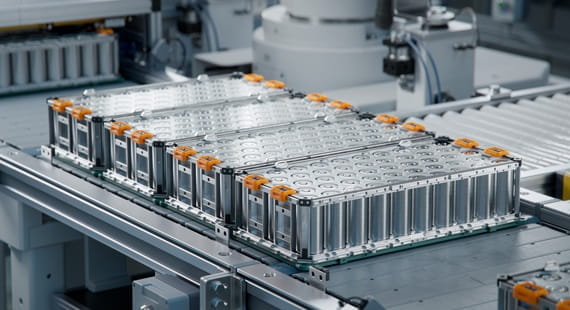
Peak Energy Plans Fortyfold Sacramento Expansion for Grid Battery Storage
Fortyfold is the number that defines Peak Energy’s next manufacturing step. The U.S. startup plans to raise its annual sodium-ion battery-pack capacity from 100 megawatt-hours at its Burlingame, California, pilot operation to 4 gigawatt-hours at a new Sacramento factory. Production and shipments from the 183,000-square-foot facility are scheduled to begin in early 2027.

The expansion would move Peak beyond a relatively manual pilot line and into highly automated pack assembly for power grids, data centers and industrial customers. The company has announced more than $1.1 billion in deals involving Jupiter Power, Energy Vault and RWE Americas. Its Sacramento plan therefore represents more than a larger building: It is a test of whether a U.S. sodium-ion supplier can translate customer commitments into repeatable, cost-competitive production.
Scale is the immediate engineering challenge
Four gigawatt-hours is 40 times Burlingame’s stated annual capacity, but it remains small beside the established lithium-ion supply base and China’s growing sodium-ion industry. Most sodium-based batteries are currently made in China, and the chemistry accounted for less than 1% of battery deliveries in the period described. Peak also currently sources commercial cells from Chinese suppliers, then integrates them into stationary-storage systems in California.
That distinction matters. The Sacramento operation is planned primarily as a battery-pack factory, not a fully domestic cell-material and cell-manufacturing chain. Leasing an existing industrial shell with electrical service already available can shorten the buildout because Peak does not need to install every process associated with cell fabrication. It also means the factory’s initial contribution to supply-chain resilience will come through domestic system assembly, automation and integration rather than complete independence from Chinese cells and processed materials.
General Motors has made a strategic investment in Peak and plans to design and manufacture sodium-ion cells tailored to different applications, while Peak would assemble those cells into stationary systems. That partnership could eventually address the cell-supply gap, but the available plans do not establish when domestic GM-produced cells will enter Peak’s products or at what volume.
Why stationary storage fits sodium
Sodium-ion batteries store less energy per gram than lithium-ion batteries, which puts them at a disadvantage in weight-sensitive electric vehicles. A grid installation has different priorities. Physical mass is less important than installed cost, service life, thermal management, uptime and maintenance over years of cycling.
Peak says its packs can rely on passive air cooling instead of the pumps, fans and liquid loops commonly associated with actively cooled lithium-ion storage. If validated at commercial scale, removing those components could reduce parasitic electricity consumption, plumbing complexity and maintenance exposure. It could also simplify deployments at remote grid sites and data centers, where cooling equipment becomes part of the system’s lifetime operating burden.
Those benefits remain company claims rather than settled fleet results. Peak has not disclosed initial pack prices, and GM Vice President Kurt Kelty has acknowledged that Chinese lithium-ion batteries will remain cheaper until domestic sodium-ion manufacturing reaches greater scale. Peak’s argument consequently depends on total lifetime cost not merely cell price including cooling, degradation, maintenance and replacement requirements.
Safety requires system-level validation
Peak says its cells can burn but are less likely to do so than competing lithium-ion designs. A separate comparative thermal-runaway study ranked a tested sodium-ion chemistry above lithium iron phosphate and high-nickel lithium cells for thermal stability. However, that work examined cylindrical cells under controlled conditions. It does not by itself certify Peak’s prismatic cells, modules or complete storage enclosures.
Commercial safety performance depends on more than chemistry. Cell consistency, electrical isolation, sensing, controls, enclosure design, fault containment and installation standards all affect how a multi-megawatt-hour system behaves. Passive cooling may eliminate components that can leak or fail, but Peak will still need to demonstrate temperature uniformity and predictable operation across changing loads and climates.
The Sacramento factory is intended to begin production in the first quarter of 2027. Reaching that date, ramping automated assembly and delivering consistent packs will determine whether the fortyfold plan becomes dependable U.S. capacity. Until domestic cells arrive at competitive cost, Peak’s central tension will remain intact: American pack production is scaling, while China still leads the manufacturing chain underneath it.
By Thomas Caldwell — AMI’s senior editor for mechanical and mobility engineering, covering vehicle electronics, systems integration, electrification, chassis systems, propulsion, and safety policy.