

Ukrainian Drone Strikes Reportedly Cut Wildberries’ Russian Warehouse Capacity by One-Third
One-third is the upper estimate of how much nationwide warehouse capacity Wildberries reportedly lost after Ukrainian drones struck its Russian logistics network beginning in mid-July. At least 23 hubs were reportedly hit, disrupting a retailer that serves ordinary consumers and independent merchants while also functioning as a commercial channel for drone accessories, control cables and protective equipment used by Russian forces.
The scale is not independently settled. Data Insight analysts cited in coverage estimated that as much as one-third of Wildberries’ capacity was eliminated, and the attacks were attributed with destroying 480 billion rubles, or about $5.79 billion, in merchandise. Wildberries has not publicly confirmed the full damage. Earlier open-source analysis reported by Reuters put damage at approximately 10% of logistics capacity, equivalent to 552,000 square meters of warehouse space. Those estimates may measure different stages or categories of loss, but the available information does not reconcile them.
Why losing warehouse capacity affects a much larger network
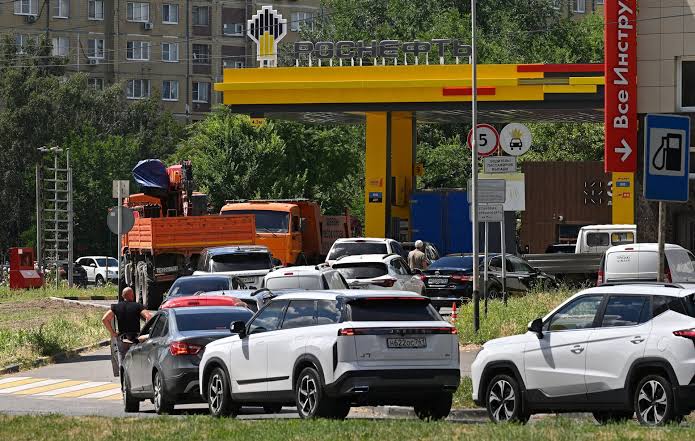
Wildberries reportedly handles 6 trillion rubles, or $74 billion, in annual sales and accounts for 10% of Russian retail activity. Its nearly 100,000 pickup points make the network look highly distributed from a customer’s perspective, but pickup locations are the final nodes in a system dependent on much larger facilities for receiving, sorting, storing and routing goods.
That distinction matters. A retailer can retain thousands of functioning pickup points while losing the upstream capacity needed to replenish them. When a major warehouse closes, orders must be canceled, delayed or reassigned to another building. The surviving facilities then absorb more inventory and sorting demand, while transportation routes become longer or less efficient. The reported departure of some sellers for competing platforms is therefore more than a short-term sales reaction: it can reduce the merchandise available inside the network even after physical capacity returns.
Wildberries has more than 1 million sellers, according to Reuters. Independent merchants bear part of the warehouse risk because their inventory can be held at the affected facilities. The Kremlin acknowledged losses for Wildberries and small and medium-sized businesses, while CEO Tatyana Kim said the company needed time to assess damaged goods at one facility. Government work on a possible financial support package has also been reported, although no approved or implemented bailout has been established.
A civilian marketplace with a military-adjacent supply role
The logistics consequence extends beyond consumer fulfillment. Wildberries officially prohibits weapons sales, and the Kremlin denies that the company handles military supplies. However, the marketplace reportedly carried first-person-view drones, fiber-optic control cables, tactical body armor and related products purchased by people supporting Russian forces.
Before the strikes, direct sales of such equipment reportedly generated roughly $20 million every three months. Sales of drone accessories subsequently fell 39%, while body-armor sales declined 24%. These figures indicate commercial disruption, not a measured change in battlefield capability. They do not establish how much equipment buyers obtained through other marketplaces, direct suppliers or existing inventories.
That boundary is important for assessing readiness. Commercial platforms can supplement formal procurement by aggregating products from many vendors and moving them through familiar payment and delivery systems. Removing warehouse throughput creates friction in that channel, but it does not prove that the underlying manufacturing base has disappeared. The practical effect depends on whether goods were destroyed, diverted to competing networks or merely delayed.
Redundancy comes with distance and delay
Kim announced emergency work to restructure the logistics network. Wildberries has also reportedly explored additional warehouse space in Kazakhstan. Geographic diversification could reduce dependence on damaged Russian facilities, but overseas storage is not an immediate substitute for domestic capacity. Available warehouse space is reportedly limited, border processing can delay trucks, and two Wildberries facilities under development near Almaty and Astana are not expected to be ready before 2027.
The conflicting 10% and one-third capacity estimates remain the key unresolved engineering and logistics question. Capacity can refer to floor area, storage volume, order throughput or temporarily unavailable operations, and those measures are not interchangeable. A reliable assessment will require confirmed facility status, reopening timelines and evidence of how much order volume the surviving network can sustain. Until then, the strongest supported conclusion is narrower: repeated drone attacks have forced Russia’s largest online retailer to redesign a national logistics system that serves both civilian commerce and a disputed military-adjacent equipment channel.
By Stephen Wallace — Editor for AMI’s aerospace integration and unmanned mobility coverage, focused on drone manufacturing, VTOL systems, autonomous networks, and air-ground mobility links.