


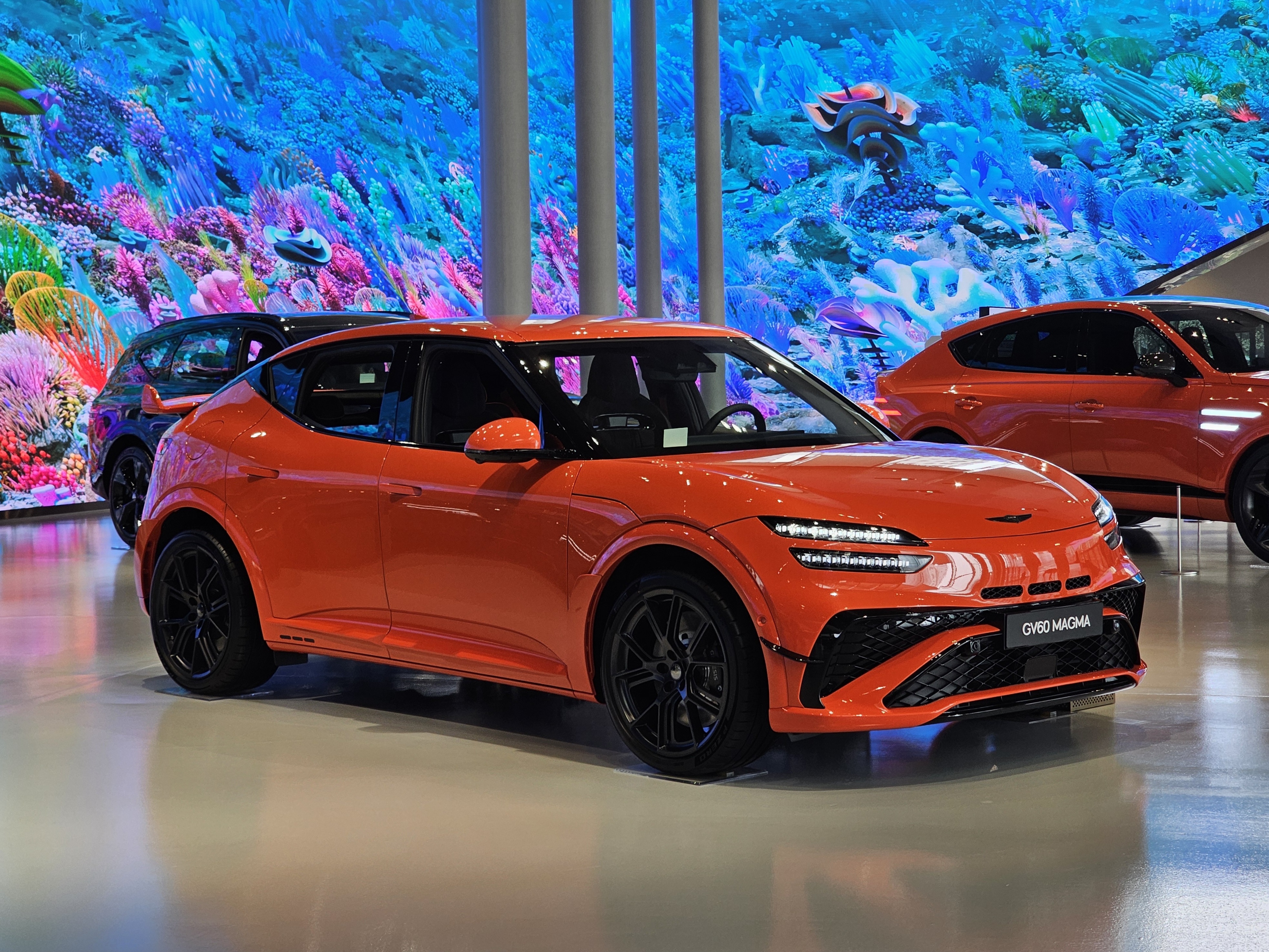
Genesis GV60 Magma Controls 641 Horsepower With Integrated Torque Allocation
The defining mechanism in the 2027 Genesis GV60 Magma is not its accelerator mapping or synthesized soundtrack. It is a coordinated control chain connecting two high-speed electric motors, front-to-rear torque allocation, a rear electronic limited-slip differential, stability control and the braking system. Together, those elements determine whether the vehicle’s 641-horsepower peak can be translated into predictable motion rather than treated as an isolated output figure.

Genesis detailed that integration as it prepares to introduce its first high-performance model in the United States. The company’s U.S. announcement lists a starting manufacturer’s suggested retail price of $69,950, excluding destination charges and other fees, with initial availability expected through selected retailers in California and New York. U.S. peak output is rated at 641 horsepower and 583 pound-feet of torque in Boost Mode.
Torque management extends beyond the two motors
The upgraded motors spin beyond 20,000 rpm. Genesis reports that the resulting all-wheel-drive powertrain can accelerate the GV60 Magma from zero to 62 mph in 3.4 seconds, reach 124 mph in 10.9 seconds and continue to a top speed of 164 mph. Those figures establish the scale of the propulsion demand, but the torque-vectoring architecture explains how the vehicle is intended to use it.
The control system can direct as much as 65 percent of available torque to either the front or rear axle, depending on the selected mode and operating conditions. That axle-level allocation works alongside the rear electronic limited-slip differential, which apportions drive between the inside and outside rear wheels as cornering loads change. Brake-based torque vectoring and stability control add further corrective authority.
This layered approach gives the controller several ways to influence vehicle behavior. Motor output can alter the front-to-rear balance, the rear differential can manage side-to-side traction, and individual brake intervention can help translate steering input into the intended path. Genesis has not published enough control-calibration detail to quantify how those layers are prioritized under every condition, but their integration is more consequential than any one component specification.
Drift Mode deliberately changes that objective. It uses a dedicated acceleration map and torque-vectoring logic to induce and sustain oversteer. That feature is a specialized operating mode, not the basis of the broader chassis strategy, which Genesis describes as emphasizing controllability, precision and driver confidence.
Mechanical revisions support the software
Control software cannot compensate fully for imprecise suspension geometry or a flexible body structure. Genesis redesigned the lower arms, hub carriers and link structures while substantially lowering the suspension’s roll centers. The vehicle also receives 275-section fifth-generation Pirelli P-Zero tires mounted on forged 21-inch wheels.
Body reinforcement includes another 0.65 meter of structural adhesive, 20 additional welding points and L-brackets in the wheel housings. Genesis claims those changes increase torsional rigidity by 9.7 percent. A stiffer body gives suspension loads a more consistent structural path, reducing the degree to which body deformation complicates steering and damper calibration.
Braking is similarly divided between electrical and friction systems. The GV60 Magma combines regenerative braking at both axles with 400-millimeter discs, monoblock calipers and anti-lock control. Genesis reports a stopping distance of 33.8 meters from 62 mph. The company also says regenerative braking remains active during hard braking and anti-lock operation, reducing the burden placed on the friction brakes. Sport Mode increases high-speed braking power by approximately 15 percent and changes the pedal response relative to Comfort Mode.
Virtual feedback is synchronized, but optional
Electric Active Sound Design and Virtual Gear Shift software coordinate sound, tactile responses and displayed gear behavior with the vehicle’s operation. Drivers can select an electric soundscape or a combustion-engine-inspired soundtrack. These features do not create additional mechanical ratios or propulsion output; their engineering role is to provide repeatable cues tied to acceleration and simulated shifts.
The U.S. specification lists an 84-kilowatt-hour battery and front and rear motors rated at 166 and 282 kilowatts, respectively, under the normal output listing. Boost Mode temporarily raises combined output to the stated 641-horsepower peak. However, Genesis has not provided a U.S. driving-range rating in the supplied launch information, nor has it detailed how often full output can be repeated across different battery temperatures and states of charge.
Those operating limits will matter more than the initial acceleration number when deliveries begin. The GV60 Magma’s hardware shows how Genesis intends to control high output; U.S. range figures, thermal limits and repeat-performance data will establish how broadly drivers can use it.
By Robert McKinney — Editor-in-Chief for AMI’s automotive and mobility coverage, with a mechanical engineering background and a decade reporting on powertrain systems, EV innovation, and global vehicle manufacturing.


