

NASA Cuts Rocket Thrust Chamber Weight Over 40% by Eliminating Joints
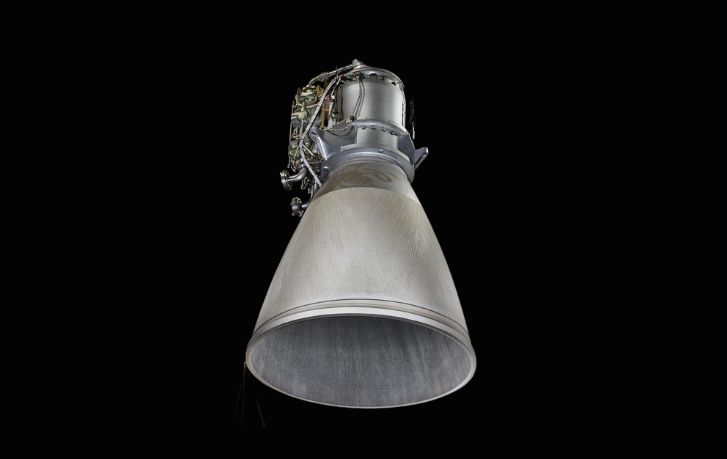
More than 40% is an unusually large mass reduction for mature rocket propulsion hardware. NASA achieved that reported reduction in a one-piece, regeneratively cooled liquid-rocket thrust chamber by combining multi-material additive manufacturing with a load-bearing composite overwrap. Just as importantly, the architecture removes complex joints that can become failure points.

The hardware, developed through NASA’s Rapid Analysis and Manufacturing Propulsion Technology project, integrates the combustion chamber and nozzle rather than manufacturing them as separate structures that must later be bolted or welded together. NASA’s technology description for the thrust chamber assembly says the resulting structure is more than 40% lighter than conventionally manufactured hardware.
Mass was removed by putting each material where it works best
The reduction did not come from printing a conventional design in one metal. NASA started with an additively manufactured copper-alloy combustion chamber containing integral coolant passages. Copper alloys provide the thermal conductivity needed to draw heat away from the chamber wall, where combustion produces severe temperature and pressure loads.
A bimetallic interface is built onto the chamber, providing the transition to a freeform regeneratively cooled nozzle. Directed-energy deposition then constructs the nozzle and its coolant-channel geometry. An integral manifold closes the cooling circuit, while a composite overwrap supports the pressure and temperature loads that would otherwise require a heavier solid-metal jacket.
This is material placement as a system-level design tool. The copper alloy handles heat transfer, the deposited nozzle material supports the larger hot structure, and the composite carries load at lower mass. Additive manufacturing also permits cooling passages and interfaces to be incorporated during the build instead of assembled through multiple downstream operations.
NASA has reported substantial testing at the development level. A subscale nozzle accumulated more than 200 starts in hot-fire testing, while the broader thrust-chamber work cut production time and cost by at least two-thirds. Those results support the manufacturing concept, but they do not establish that every full-scale configuration has completed qualification or entered routine flight production.
Joint elimination reduces complexity but raises process-control demands
Removing joints can reduce seals, welds, fasteners and inspection points. It can also eliminate tolerance accumulation between separately manufactured parts. For propulsion hardware, fewer interfaces mean fewer locations where dimensional error, sealing performance or local stress concentration must be controlled.
A monolithic multi-material assembly does not remove manufacturing risk; it moves more of that risk into deposition control, material interfaces, thermal history and inspection. Bond quality at the copper-to-nozzle transition, coolant-channel integrity, composite-overwrap consistency and dimensional accuracy all become part of the qualification case. A defect buried inside an integrated build may be less accessible for repair than a problem found in a replaceable conventional component.
That distinction explains why precision diagnostics remain relevant even as aerospace manufacturing adopts additive processes. BAE Systems uses wireless ballbar diagnostics to maintain the accuracy of five-axis computer numerical control machines producing titanium airframe parts. When the workpiece is expensive and geometrically complex, small machine-tool errors can consume material, machining time and inspection capacity before a nonconformance is discovered.
The same production discipline applies to large near-net-shape parts. At Oak Ridge National Laboratory, Jason Mayeur and Soumya Nag are integrating wire-arc additive manufacturing, hybrid processing and computational modeling with powder metallurgy followed by hot isostatic pressing. Their work targets nonuniform shrinkage and other obstacles to scalable domestic manufacture of very large metal components. The laboratory’s Manufacturing Demonstration Facility is intended to help U.S. industry adopt additive and composite processes using shared infrastructure and expertise.
Qualification remains specific to the material and process
Aerospace qualification cannot be transferred from the generic label of 3D printing. Final properties depend on the alloy, feedstock, machine, deposition parameters, geometry, post-processing and inspection route. Changing one of those elements can require new supporting data, even when the component looks identical in a digital model.
That boundary also applies to NASA-developed printable heat-shield formulations and to mission-critical interconnects manufactured with radiation-hardened materials and multi-point contacts. Promising formulations or manufacturing methods still need requirements-based testing and controlled production records. AirBorn’s use of military and NASA qualification protocols illustrates the controls expected when electrical connections must survive demanding service environments.
NASA’s thrust chamber shows what integrated manufacturing can purchase: a weight reduction above 40%, fewer complex joints and substantially shorter reported production time. The next decisive step is not another geometric demonstration, but configuration-specific qualification proving that the material interfaces, cooling passages and composite structure can be reproduced with flight-hardware consistency.
By Edward Collins — Senior editor for AMI’s performance systems and mechanical design coverage, focused on powertrains, drivetrain systems, manufacturing precision, materials, and high-performance engineering.