Onshape Turns Text Prompts Into Reusable CAD Features With Traceable Changes
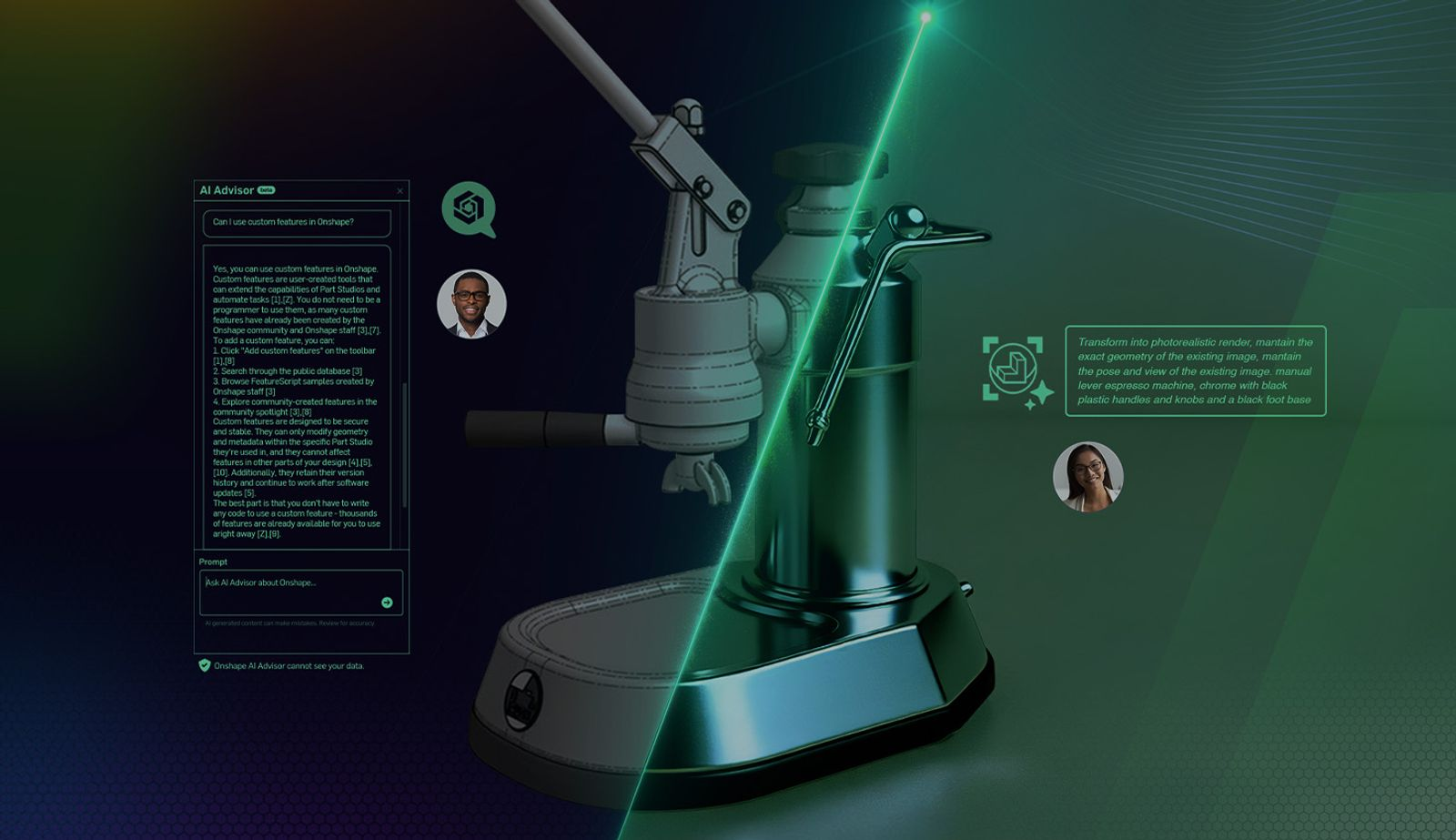
The useful output of Onshape’s latest artificial-intelligence workflow is not a single piece of generated geometry. It is code that defines how geometry should be created repeatedly. An engineer describes a desired modeling operation in natural language, an AI system helps produce FeatureScript code, and that code becomes an editable, parametric command that can be reused like a built-in CAD feature.
Onshape demonstrated this “text-to-code-to-CAD” mechanism as a way to package recurring mechanical-design practices into company-specific tools. A sequence that normally requires several features and inputs could, for example, be consolidated into one controlled command and distributed to other designers. Bearings and fasteners were cited as possible applications, although the concept can extend to other standardized parts and modeling routines.
The enabling layer is FeatureScript, the programming language Onshape introduced in May 2016. It underpins standard operations such as extrudes, fillets and shells, while also allowing users to define custom commands with their own inputs and controls. Onshape’s Feature Studio documentation explains how the language works with parametric models and how custom features are developed inside the CAD environment.
The new element is an Onshape Labs server based on Model Context Protocol, an open standard for connecting AI applications with external systems. Rather than asking a language model merely to discuss a design problem, the connection gives compatible AI clients access to tools for generating, running and refining FeatureScript. According to Onshape’s technical description of the experimental workflow, the resulting feature can be shared and subsequently run without returning to the AI for every new model.
Reusable code still requires engineering control
For manufacturers, the potential advantage lies in capturing a repeatable process rather than automating one isolated part. A company could encode approved inputs, design rules or recurring geometry in a custom feature, then make the same command available across a design team. This could reduce variation in how routine geometry is constructed and make internal modeling practices easier to distribute.
That does not make the generated code self-validating. Engineers must review and test AI-assisted features before release, and they remain responsible for the design decisions embodied in the tool. A custom command can reproduce an incorrect assumption just as consistently as a correct one. Geometry regeneration, parameter limits, failure behavior and manufacturing intent therefore still require conventional engineering verification and release authority.
No measured productivity gains, validation results or implementation timetable were provided for the demonstrated workflow. Its practical value will depend on how reliably generated features handle the range of inputs encountered in production work, not simply whether they produce acceptable geometry in an initial example.
Branching separates experimentation from the primary design
Onshape placed the AI-assisted feature workflow inside its existing cloud-native collaboration system. In the demonstration, a second user joined the same live model, and changes became visible to both participants without exchanging downloaded copies. That shared data environment matters because the generated tool, its geometry and the surrounding design remain available for review in one system.
Branches provide a second control boundary. Designers can create a separate branch to test an alternative without changing the primary workspace, then merge selected work after review. Onshape records edits as they occur, permits comparisons between versions and can restore an earlier design state. Together, those functions preserve a reviewable record of who changed the design and how it evolved.
An AI agent working independently in its own branch has been proposed as a future use of this architecture, but the demonstration did not establish a released autonomous-agent capability. Today’s supported engineering value is narrower: people can isolate experiments, compare results and decide what is allowed back into the main design.
PTC is also extending the cloud-native model into model-based definition, placing geometric tolerances, weld symbols, datums and other manufacturing annotations in the three-dimensional model. That broadens the control problem beyond shape creation. If reusable features are to carry company practice into production, their outputs must remain consistent with the dimensions, tolerances and annotations that communicate manufacturing intent.
Onshape’s workflow therefore offers a credible route for turning natural-language requests into reusable CAD automation, but its strongest safeguard is not the prompt interface. It is the combination of editable code, isolated branches, automatic history and a mandatory human decision before generated logic becomes an approved engineering tool.
By Jonathan Barrett — Editor for AMI’s future mobility and autonomous systems section, with two decades covering robotics, e-mobility, drone-vehicle convergence, and transport mechanical systems.