FCC Blocks New Foreign-Produced Robots, but Existing Models Stay Authorized
The Federal Communications Commission has drawn a firm market-access line around where a connected mobile robot is produced, but not around every robot presenting similar technical dependencies. Under the agency’s July 28, 2026 Covered List update, new foreign-produced advanced robotic devices cannot obtain the equipment authorization generally required for importation, marketing or sale in the United States. Previously authorized models can remain in the market.
That split creates the central engineering-policy tension. The restriction responds to officially determined supply-chain and cybersecurity risks, yet it does not establish a uniform device-level security standard for every connected robot operating on a U.S. network. Market access now depends heavily on production origin and authorization status, while questions involving software integrity, component provenance, cloud services and support over the product lifecycle remain broader than the listing itself.
Which robots fall within the restriction
The FCC definition covers a mechanical mobile device that can navigate or move on the ground, operates at a distance from its human supervisor through commands or sensor data, and weighs more than 4.4 pounds when its docking or ground station is included. It must also contain an environmental sensor, wired or wireless network connectivity of at least 200 kilobits per second in either direction, and local or remote software controlling functions such as navigation, perception, data collection or remote command.
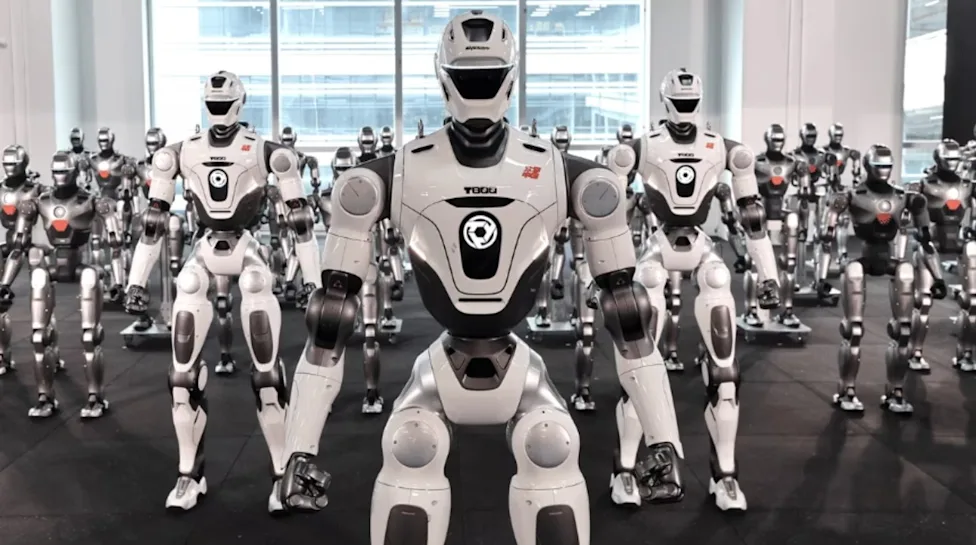
That definition can include autonomous mobile robots, humanoids and quadrupeds. Depending on whether they meet all the thresholds, it can also reach consumer devices such as robotic vacuums and lawn mowers. The rule is not limited to a particular corporate nationality: “foreign-produced” turns on whether the product qualifies as a domestic end product, not where its manufacturer is headquartered.
Several important categories are excluded. Connected road vehicles, rail-only vehicles, uncrewed aircraft, unmanned underwater vehicles, regulated medical devices and fixed industrial robots are outside this particular robotics listing. A stationary robotic arm on a production line therefore is not treated the same way as a network-connected mobile robot moving through a warehouse.
Existing models retain a separate status
The FCC’s implementation guidance says the action does not prohibit continued use of lawfully purchased devices or the importation, marketing and sale of models that already received equipment authorization. Basic software and firmware changes needed to maintain usability also remain possible under a waiver.
For operators, that means an installed fleet is not automatically grounded or disconnected. For product teams, however, the distinction between an existing model and a new one becomes consequential. Hardware revisions and next-generation platforms may require a new authorization that a covered foreign-produced device cannot receive. Small batches of unauthorized products may still be imported solely for development or testing under existing FCC regulations, provided they are not marketed or sold.
A conditional-approval route also exists. An entity involved in producing a covered robot may request a determination that a specific device or class does not pose the identified unacceptable risk. The FCC says applicants may be evaluated on national-security risk, supply-chain resilience and plans for trusted U.S. manufacturing. Filing does not guarantee approval.
Origin is a control, not a complete assurance architecture
The national-security determinations behind the action identify several potential consequences from compromised network-connected robots: collection of sensitive data, surveillance, manipulation of physical operations and remote commandeering. Those risks are more consequential in cyber-physical equipment than in a conventional connected appliance because software commands can produce movement in shared human workspaces.
Industry specialists agree that those dependencies warrant scrutiny but disagree about whether production origin is an adequate primary test. Matt Wyckhouse, founder and CEO of Finite State, argues that “security is a property of engineering, not geography,” and calls for origin to be considered alongside device assessment and software and hardware bills of materials. His statement is an argument for a different assurance model, not a finding that origin carries no risk.
Donald McFarlane, an advisory board member at Xcape, points to another boundary: a robot’s safety and availability can depend on cloud connectivity, identity services, communications paths and vendor-operated infrastructure. A device may pass an inspection at delivery yet acquire a different risk profile as software, credentials, remote services and suppliers change.
Seemant Sehgal, founder and CEO of BreachLock, similarly argues that leaving previously authorized equipment in operation does not resolve comparable update and remote-access dependencies. John Strand, owner of Black Hills Information Security, advocates manufacturer-neutral validation and resilient design. Jacob Krell of Suzu Labs takes the countervailing view that hardware assurance reaches a practical limit when evaluators cannot inspect or control the fabrication process.
Those positions frame the work still ahead. Origin-based exclusion can reduce exposure to supply chains that authorities have determined present unacceptable risk, but a durable robotics assurance system must also address what is inside the machine, which services remain outside it, how updates are authenticated and what happens when a vendor or network becomes unavailable. The immediate FCC decision blocks new covered models; the longer-term test is whether production provenance and lifecycle engineering become parts of one coherent standard.
By Thomas Caldwell — AMI’s senior editor for mechanical and mobility engineering, covering vehicle electronics, systems integration, electrification, chassis systems, propulsion, and safety policy.