Infinite Composites Adds Automation for Larger, Faster-Built Space Tanks
Building a large composite propellant tank starts with controlling thousands of meters of reinforcement, resin and barrier material as one pressure-bearing structure. In May 2026, Albuquerque-based Infinite Composites announced an equipment expansion designed to automate more of that process, adding filament winders, robot rail systems and polymer-metering machines for larger tanks, rocket motor casings, tubes and related structures.
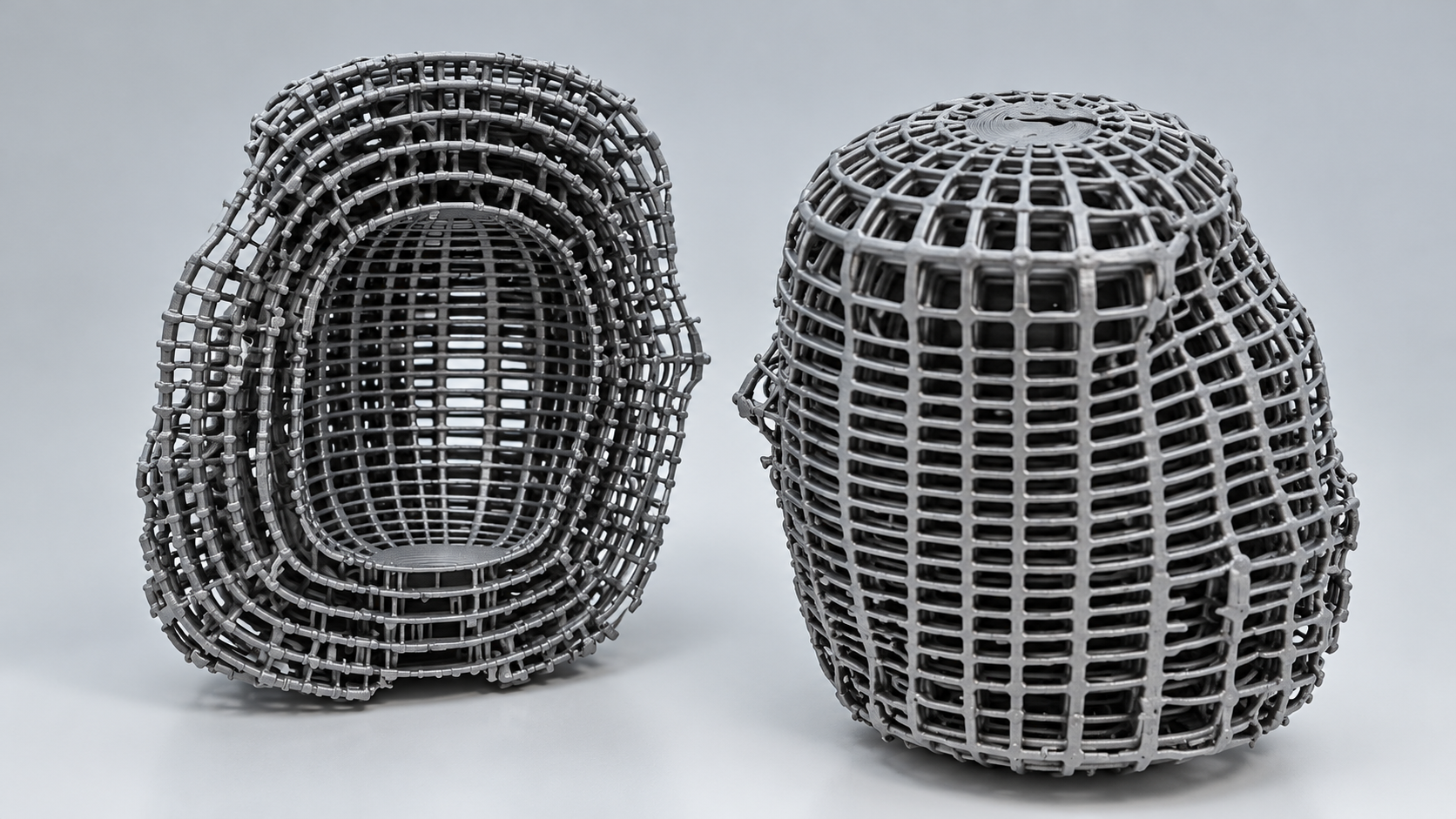
The new production equipment includes two four-axis filament winders capable of handling structures up to 72 inches in diameter and 45 feet long. Two six-plus-axis robots operate on 20- and 45-foot rail systems, extending their working envelope along large cylindrical parts. Three hydraulic fixed-ratio metering machines provide heated, high-pressure application of high-viscosity polymer coatings.
Together, those systems address three different production constraints. Winders regulate fiber placement around pressure-vessel geometry. Rail-mounted robots maintain a controlled tool path over structures too long for a stationary robot cell. Metering machines manage the ratio and delivery of coating constituents, where inconsistency can undermine barrier performance or create unnecessary rework.
Cryogenic service raises the material burden
Space tanks cannot be treated as enlarged industrial pressure vessels. Liquid oxygen, liquid methane and liquid hydrogen expose structures to severe temperature changes while the tank must also carry pressure and launch loads. Liquid hydrogen reaches approximately -253 degrees Celsius, only about 20 degrees above absolute zero. At that temperature, material contraction, joint integrity and resistance to permeation become central design requirements.
Carbon fiber-reinforced polymers offer a route to lower structural mass, but the fibers are only one part of the tank. The resin system, interfaces, coatings and any liner or barrier must remain compatible through manufacturing, fueling and service. Hydrogen is especially demanding because its small molecules can permeate through very small discontinuities. Automation can improve placement and process repeatability, but it does not by itself establish cryogenic suitability; that still depends on material selection, design and qualification testing.
Infinite Composites is known for linerless Type 5 pressure vessels, in which the composite structure carries the pressure without a separate load-bearing metallic or polymer liner. The company has also secured a subcontract to develop two main cryogenic propellant tanks for a commercial lunar lander. That program connection gives the added machinery a practical U.S. space-manufacturing role rather than leaving it as a general capacity expansion.
Automation is spreading across tank and structure production
The same manufacturing shift is visible outside the United States. In June 2026, Canada’s NordSpace installed large-scale robotic automated fiber-placement equipment in its aerospace manufacturing laboratory. It plans to bring production of flight tanks and primary structures for its Tundra light-lift launch vehicle in-house while developing capacity for the larger Titan platform.
NordSpace’s research agenda includes linerless Type 5 tanks, cryogenic-propellant compatibility and structures as long as 15 meters and several meters in diameter. Those dimensions and material goals remain development targets, not demonstrated production results. Even so, the installation shows why automated placement is attractive: larger structures require repeatable fiber orientation and consolidation over long tool paths, while in-house equipment gives the vehicle developer more direct control over manufacturing changes.
Sonaca Spain reached a different milestone in June, completing an integrated Type 5 tank demonstrator under the European Space Agency-supported CRETAN project. Its architecture combines fuel and liquid-oxygen containment around a shared cryogenic bulkhead. The project claims weight savings of up to 30% compared with conventional tank approaches, but that figure is a program claim tied to the demonstrator rather than a universal result for composite tanks.
Automation is also moving into the plumbing and assembly surrounding tanks. Germany’s Herone uses tape braiding and press molding to make carbon-fiber and low-melt polyaryletherketone cryogenic tubes. Its process co-consolidates fittings and flanges into the tube and adds a metallic permeation barrier within a double-wall, vacuum-insulated design. The company projects a 50% to 60% weight reduction against conventional metallic fuel lines.
Fraunhofer IFAM’s Airbus-led HYTANK research project, completed in June, addressed another difficult stage: joining and sealing large double-walled liquid-hydrogen structures. The work produced surface-pretreatment, barrier-coating and automated assembly processes rather than a claim that the entire tank-production problem is solved.
For U.S. space suppliers, Infinite Composites’ expansion illustrates where production investment is concentrating: larger working envelopes, controlled fiber placement and repeatable barrier application. The machinery can increase the size and rate of parts moving through a factory, but qualification under pressure and deep cryogenic cycling remains the decisive boundary between manufacturing capacity and flight-ready hardware.
By Edward Collins — Senior editor for AMI’s performance systems and mechanical design coverage, focused on powertrains, drivetrain systems, manufacturing precision, materials, and high-performance engineering.