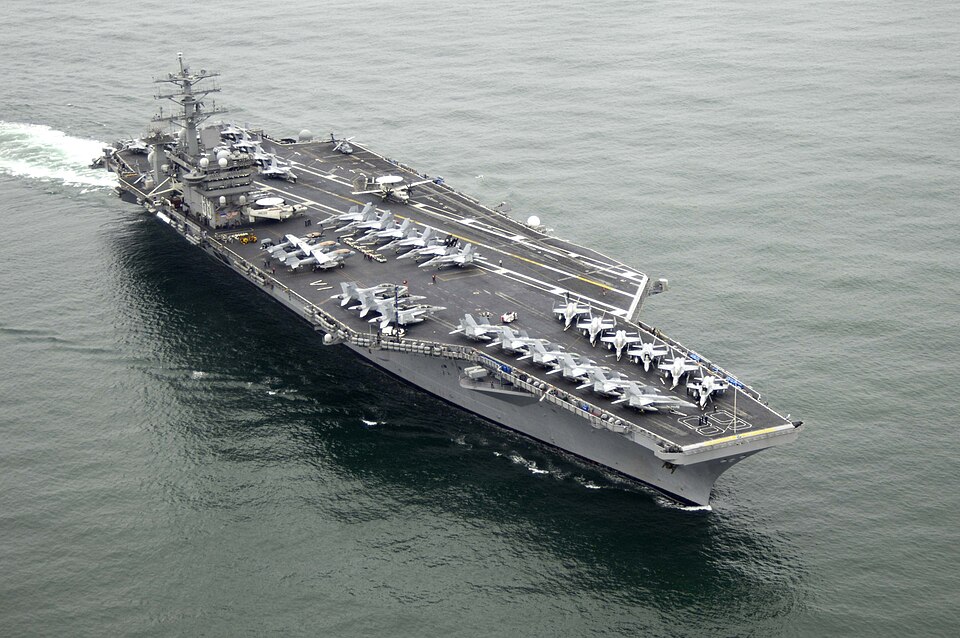
Navy Budgets $562 Million as USS Nimitz Leaves Frontline Service
USS Nimitz can still sail and conduct flight operations, but the Navy will not send the 51-year-old nuclear-powered aircraft carrier through another frontline deployment cycle. Instead, it will remain commissioned for carrier qualifications and training until inactivation begins in March 2027. The service has placed $562 million in its fiscal 2027 plan for the opening retirement phase, after awarding another $96 million for planning and long-lead material.

That apparent contradiction retiring a functioning ship at substantial public cost comes down to what would be required to make Nimitz deployable for another full cycle. Operational capability today does not establish that its reactors, 1,092-foot hull, steam plant, aircraft systems and supporting equipment can economically clear several more years of maintenance, training and certification demands.
A working carrier is not necessarily a deployable carrier
Nimitz completed its last deployment certified for national tasking in December 2025. Its strike group recorded more than 8,500 sorties and 17,000 flight hours over nine months. The carrier later sailed from Washington state around South America to Naval Station Norfolk, arriving July 9, 2026, but that voyage did not return it to the frontline deployment rotation.
Preparing it for another such rotation would be a different engineering proposition. The Navy would have to assess remaining reactor life, inspect a half-century-old hull and steam plant, replace age-driven failures, modernize systems and then complete another maintenance, training and certification sequence. Reactor-fuel status is classified, so public claims about the condition of the core cannot settle that decision. What is confirmed is that the Navy plans to defuel the ship rather than refuel it.
There is also no official price estimate for a second Nimitz life-extension overhaul. The available assessment is broader: returning the carrier to frontline service would take years, cost billions of dollars and occupy scarce nuclear-qualified industrial capacity. The $562 million retirement allocation therefore should not be compared with the cost of simply keeping the ship fueled and crewed for a few extra months. The real alternative would be a major program covering inspection, repair, modernization and recertification with uncertain findings once deep work began.
The shipyard slot is part of the cost
Newport News Shipbuilding is the only U.S. yard able to design, build and refuel nuclear-powered aircraft carriers. Work assigned to Nimitz would consequently compete with construction and maintenance elsewhere in the carrier fleet. That opportunity cost matters even if an extension were technically possible.
Past performance shows why the Navy cannot treat maintenance time as an elastic resource. The Government Accountability Office found that 10 of 18 carrier maintenance periods completed at public shipyards from fiscal 2015 through 2019 ran late, with an average delay of 113 days. Extending an old carrier would not just expose taxpayers to its direct repair bill; it could also add pressure to a maintenance system already prone to schedule overruns.
Nimitz itself illustrates the scale involved. Its midlife refueling and complex overhaul, completed in 2001, required five years of planning and three years of execution. A new extension would not necessarily duplicate that exact work, but the history shows that nuclear-carrier lifecycle decisions are measured in years, specialized labor and facility access not in whether the ship can get underway this month.
The replacement schedule shaped the retirement date
The Navy originally planned to inactivate Nimitz in May 2026, then moved the date to March 2027 after delivery of USS John F. Kennedy slipped. Federal law requires at least 11 operational aircraft carriers, and the fiscal 2027 force-structure plan identifies Kennedy as the replacement for Nimitz.
Kennedy completed acceptance trials on August 15, 2026, but that did not mean it was ready to take over immediately. According to the Navy’s published program update, preliminary acceptance, testing of ship-specific systems and additional construction work remained, with final delivery planned for spring 2027. Keeping Nimitz available for training helps bridge that transition without committing it to another deployment package.
The $562 million is also not the carrier’s total disposal cost. Initial inactivation includes shutting down systems, removing equipment, draining fluids, demilitarizing spaces and preparing both reactors for defueling. Later dismantlement and disposal will require separate appropriations and years of nuclear-qualified work. The Navy’s budget retains 2,705 officers and enlisted personnel associated with the retirement process in fiscal 2027, declining to 600 in fiscal 2030 an indication that taking a nuclear carrier apart is itself a long-duration fleet activity.
Nimitz is therefore leaving frontline service not because it suddenly stopped functioning, but because another deployment would purchase limited additional service at the cost of extensive inspections, modernization, certification time and a uniquely constrained shipyard slot. Its last months as a training carrier preserve near-term utility while the Navy waits for Kennedy, but March 2027 begins only the first funded stage of a much longer nuclear retirement.
By David Whitaker — Associate editor for AMI’s aerospace and drone systems desk, translating flight systems, aircraft programs, spaceflight, and UAV developments into accessible technical stories.