


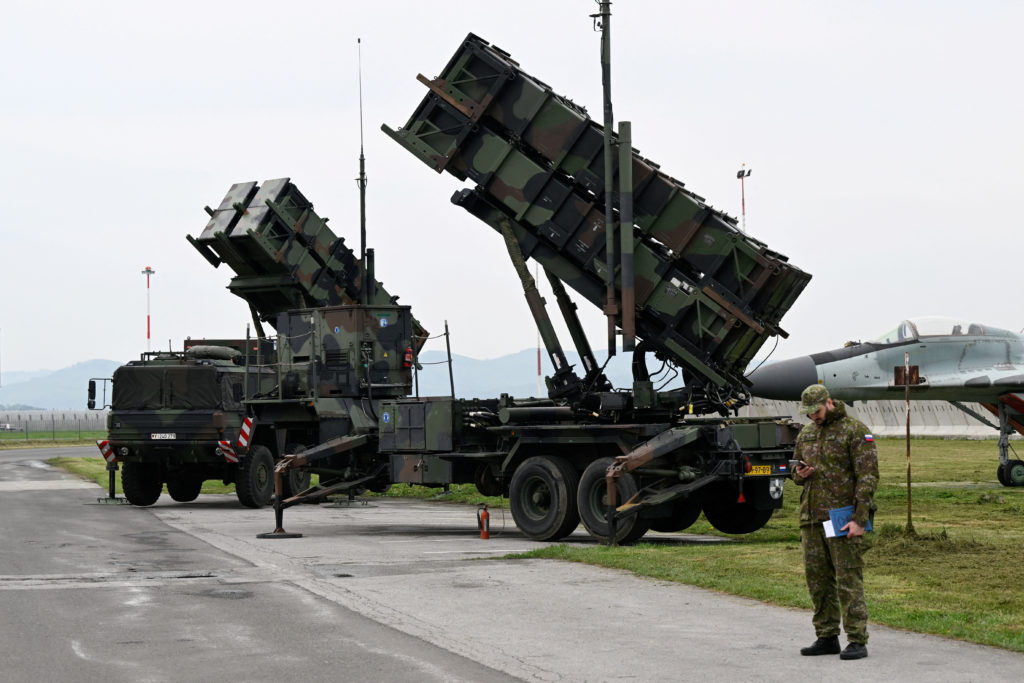
Ukraine Needs Patriot Missiles Before Winter, but New Production Could Take Years
Ukraine’s need for additional Patriot interceptors is measured in months, but the proposed industrial remedy is measured in years. Kyiv is seeking more missiles before anticipated winter attacks, while U.S. and European operators must balance those requests against their own air-defense requirements. A licensed Ukrainian production line cannot close that immediate gap.

The mismatch leaves Ukraine dependent on limited Western inventories for protecting cities, energy infrastructure and other critical targets. U.S. Ambassador to NATO Matthew Whitaker has said a long-term production agreement will not be completed before winter. Discussions are continuing, but the Pentagon has described the licensing work as an early-stage process involving decisions about the interceptor variant, production location and supply chain.
A license is only the beginning
Permission to manufacture an interceptor does not provide a qualified factory, trained workforce or certified supplier network. Ukraine reportedly wants to produce Lockheed Martin’s PAC-3, a hit-to-kill interceptor designed to destroy an incoming ballistic missile through direct impact. Earlier Patriot interceptor variants are associated with Raytheon production.
Before a new line can deliver usable rounds, manufacturers and government authorities would need to determine which design can be transferred and how sensitive technology will be protected. Suppliers must then be selected, qualified and certified. Production equipment has to be installed, processes validated and completed missiles tested against the required reliability standard.
That work cannot be compressed simply by funding construction. Missile production depends on specialized engineering knowledge and components made by a relatively narrow supplier base. Boeing-made seeker technology has been identified as one significant constraint. The seeker is central to the interceptor’s ability to guide toward its target, making it a component that must meet demanding performance and quality requirements rather than one that can be substituted casually.
Japan demonstrates the limits of licensed manufacturing. It is identified as the only foreign country currently licensed to produce the PAC-3, yet its output is approximately 30 interceptors annually. That does not mean a Ukrainian line would necessarily operate at the same rate, but it shows that transferring production does not automatically create high-volume capacity.
Higher U.S. output will take time to reach the field
Lockheed Martin delivered 620 PAC-3 missiles in 2025, 20% more than in the previous year. Boeing has separately said it aims to produce 850 Patriot seekers in 2026, up from 650 in 2025. Those increases matter, but they also illustrate how interceptor output is governed by the pace of multiple suppliers rather than the final assembly plant alone.
The U.S. government is trying to address that wider chain. In July, it announced seven-year framework agreements with L3Harris and Lockheed Martin to expand production of propulsion and other components for the PAC-3 Missile Segment Enhancement. The effort follows agreements involving prime contractor Lockheed Martin, seeker manufacturer Boeing and supplier Honeywell.
Lockheed has outlined plans to raise PAC-3 production capacity to 2,000 interceptors annually by the end of 2030. L3Harris says its framework could nearly triple production for several PAC-3 propulsion products. Both plans point toward substantially greater capacity, but neither changes the near-term reality: factories, tooling and qualified suppliers must be expanded before higher promised rates become delivered missiles.
Europe’s new factory already has a customer queue
A Raytheon-MBDA Patriot missile facility under construction in Schrobenhausen, Germany, could provide another source. Construction began in November 2024, with completion expected in the fall. Unconfirmed plans cited for the plant envision output of roughly 240 missiles per year, so that figure should not yet be treated as an established production rate.
Even if the facility reaches that level, it would not represent unallocated capacity waiting for Ukraine. Existing contracts could cover as many as 1,000 missiles ordered by Germany, Spain, the Netherlands and other customers. Those orders reflect the same readiness pressure constraining transfers from current inventories: allied governments are rebuilding or expanding their own air defenses while supporting Kyiv.
Ukrainian President Volodymyr Zelensky has asked the United States to sell Ukraine 5% of its missile arsenal. He also claimed that access to 10% would allow Ukraine to destroy all Russian ballistic missiles, but that projection has not been independently substantiated and should not be treated as a verified performance estimate.
The immediate decision is therefore an allocation problem, not a factory-opening problem. Additional production can improve long-term supply, but technology-transfer reviews, constrained seekers, supplier certification and an existing order backlog mean licensed manufacturing cannot provide Ukraine with Patriot interceptors before this winter.
By David Whitaker — Associate editor for AMI’s aerospace and drone systems desk, translating flight systems, aircraft programs, spaceflight, and UAV developments into accessible technical stories.



