USS Doris Miller Steam-Catapult Plan Puts Half-Built $1.2 Billion Contract at Risk
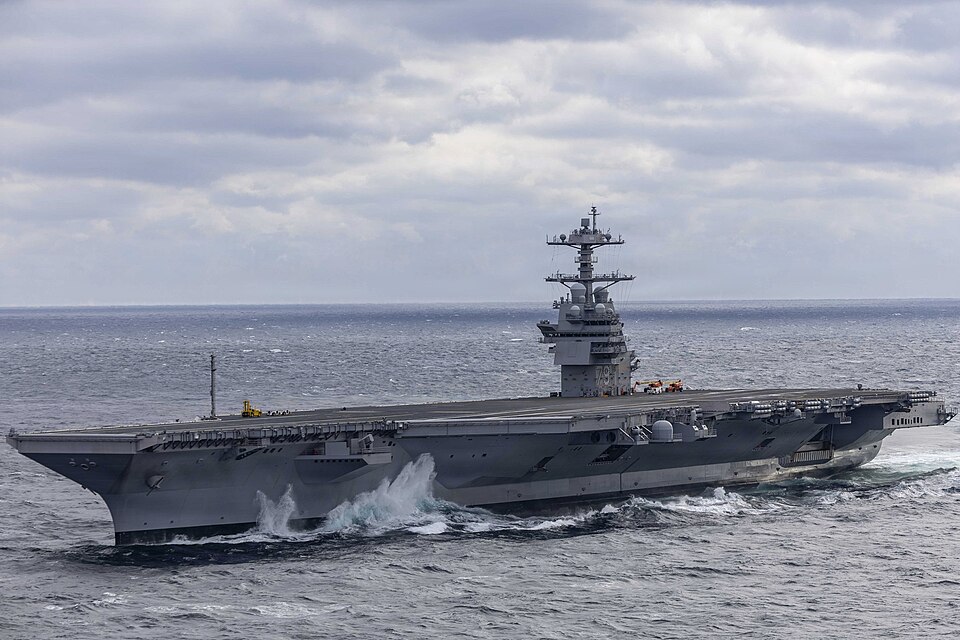
A reliability-driven policy change could force the Navy to discard substantial completed work on the future USS Doris Miller. General Atomics says production is nearly 50% complete under its $1.2 billion contract for the carrier’s electromagnetic aircraft-launch and landing-recovery equipment, just as the Pentagon begins preparing a plan that could replace the launch system with steam machinery.

The White House memorandum gives the Pentagon 60 days to identify the measures, resources and schedule needed to replace the Electromagnetic Aircraft Launch System, or EMALS, and the carrier’s Advanced Weapons Elevators with steam and hydraulic systems. It applies first to Doris Miller, designated CVN-81 and currently scheduled for delivery in 2034. The directive requires a plan; it does not establish that a conversion has been approved, funded or started.
A carrier-wide integration decision
Replacing a catapult after production has begun is not equivalent to exchanging one flight-deck component for another. EMALS was incorporated into the Ford-class carrier’s electrical architecture, machinery spaces, controls and construction sequence. Steam catapults need a different supporting network, including steam distribution and associated mechanical equipment that the Ford-class design was not built around.
That distinction turns a reliability policy into a systems-integration problem. Engineers would have to determine how the steam equipment affects existing spaces, structural arrangements, power and utility routing, controls, construction zones and testing. Manufacturing plans and installation sequences would also need revision while other carrier work continued. General Atomics warns that changing course now would introduce significant cost, schedule and integration risks, although that is the contractor’s assessment rather than a completed Navy estimate.
The $1.2 billion contract also requires careful interpretation. It covers both EMALS and the Advanced Arresting Gear used when aircraft land. The memorandum specifically names EMALS and the Advanced Weapons Elevators, which move munitions within the ship; those elevators are separate from the arresting gear. The final Pentagon plan will therefore need to clarify the exact scope of any recovery-system changes rather than treating catapults, arresting equipment and weapons elevators as one interchangeable system.
Reliability concerns are real, but so are the tradeoffs
EMALS and the Advanced Arresting Gear have experienced documented reliability, maintenance and software-integration problems. An operational-testing assessment quoted in the available reporting said their reliability and maintainability continued to impede sortie generation and flight operations. The Ford-class requirement is 160 sorties per day, with surges to 220, making launch-and-recovery availability central to whether the carrier meets its design mission.
Steam catapults, meanwhile, are proven equipment used by the Navy’s older Nimitz-class carriers. That operating history supports the policy goal of examining mature, repairable technology. But a mature design does not automatically become the lower-risk choice when its production base has been dormant for roughly two decades and the receiving ship was designed around a different system.
Electromagnetic launch also buys capabilities that would be surrendered or require another way to reproduce. It provides finer control over launch force, allowing a wider range of aircraft weights to be accelerated with less airframe stress. The system is described as smaller and lighter than steam equipment and designed to support 25% more sorties than older catapults. Those are important benefits for a carrier expected to operate different aircraft over a service life measured in decades.
Personnel and maintenance costs create another public-cost tradeoff. Hudson Institute analyst Bryan Clark estimates that Ford-class electromagnetic equipment saves approximately $100 million annually in staffing and maintenance. That figure is an outside estimate, not a confirmed Navy accounting result, but it illustrates why acquisition price alone cannot determine affordability. Lifecycle labor, spare parts, maintenance infrastructure and aircraft wear also belong in the comparison.
The cost and delay remain projections
Clark has projected that a change could cost billions and push Doris Miller’s completion toward the end of the next decade. Those consequences have not yet been established by a Navy cost analysis. They depend on the conversion’s final scope, redesign requirements, the amount of completed equipment abandoned and how quickly steam-catapult production could be restarted.
Taxpayers face costs on both sides of the decision: retaining equipment with unresolved reliability concerns or paying to redesign a partly built carrier around machinery no longer in production. The Navy also faces a schedule question because a delay beyond the planned 2034 delivery would affect when the fleet receives its replacement carrier capacity.
The 60-day study must therefore do more than compare whether steam or electromagnetic catapults are easier to maintain. It must establish what equipment would actually be replaced, how much completed work would be written off, whether suppliers can restart steam production, and what the redesign would do to delivery. Until those figures are produced, the clearest confirmed number is also the central constraint: a $1.2 billion launch-and-recovery contract is already nearly halfway through production.
By Thomas Caldwell — AMI’s senior editor for mechanical and mobility engineering, covering vehicle electronics, systems integration, electrification, chassis systems, propulsion, and safety policy.