Five-Foot Lake Mead Drop Could Cut Hoover Dam Power 70%
Five feet is the distance separating Lake Mead’s latest record low from a potentially severe constraint on Hoover Dam. Southern California water officials warn that a projected decline of roughly that amount could reduce the dam’s power generation by about 70%. The decline and resulting power loss remain forecasts, not completed reductions.

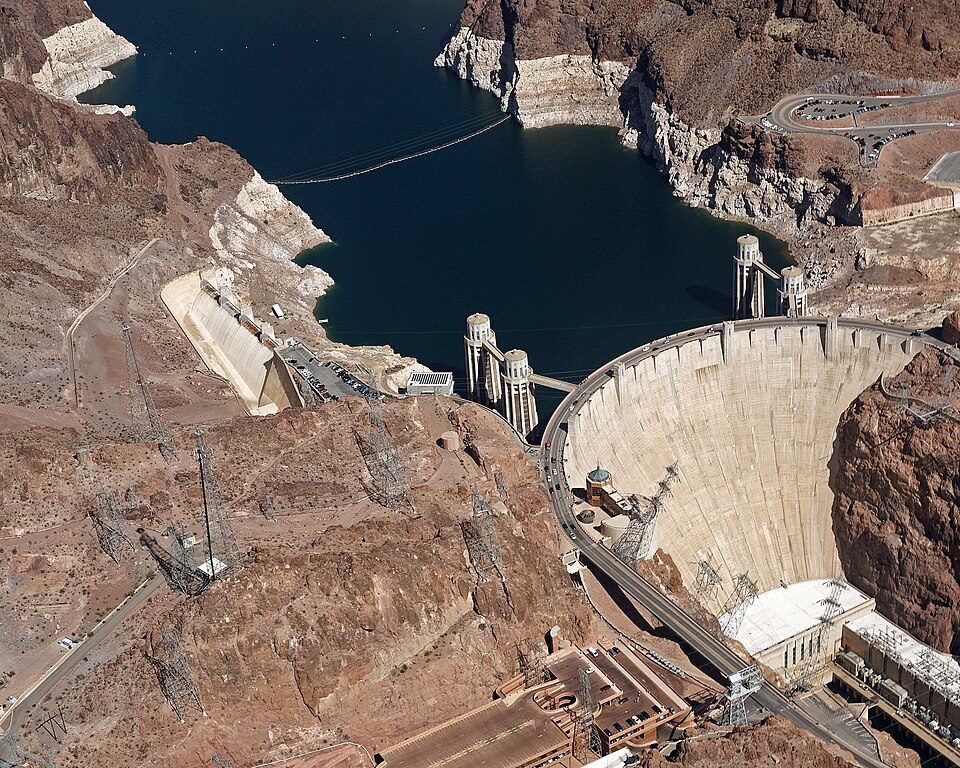
Lake Mead’s elevation reached 1,040.50 feet, narrowly below the previous record of 1,040.58 feet set in July 2022. The Bureau of Reclamation’s official Lake Mead elevation records show how the reservoir’s temporary improvement during 2023 reversed through 2025 and 2026. Officials expect it could approach 1,035 feet, where a large portion of Hoover Dam’s generating equipment would have to stop operating.
Why five feet can have an outsized effect
The projected 70% reduction is not based simply on losing five feet out of the reservoir’s total depth. It reflects the interaction between water elevation and machinery designed for a particular operating range.
Hoover Dam generates electricity by routing water through large pipes called penstocks and into Francis turbines. The vertical distance through which the water acts on those turbines is known as hydraulic head. As Lake Mead falls, that head declines, reducing the water pressure available to turn the machinery and generate electricity.
The Bureau of Reclamation’s Hoover Dam hydropower specifications list a maximum operating head of 590 feet, a minimum of 304 feet and an average of 510 to 530 feet. The plant contains 17 main turbines and has a nameplate capacity of about 2,080 megawatts, although low reservoir levels already prevent it from delivering that full rating.
The sharp projected loss near 1,035 feet comes from an operating boundary rather than a smooth, proportional decline. Twelve older turbines are not designed for the anticipated low-head conditions and would be shut down at that reservoir elevation, according to information attributed to Reclamation. Five newer low-head units could continue operating. That equipment split is why a seemingly modest additional decline could remove most of the dam’s remaining generating capacity.
Operating a hydraulic turbine outside its intended range is not merely an efficiency issue. Low-pressure conditions can contribute to cavitation, in which vapor bubbles form and collapse in the water, potentially damaging turbine surfaces. Keeping unsuitable units offline protects machinery, but it also turns a hydrological shortage into a discrete electrical-capacity loss.
Hoover Dam supplies flexibility as well as energy
Hoover Dam produces less electricity than the largest power systems serving the Southwest, but its operational role is broader than its annual energy total. Hydroelectric units can be brought online quickly as demand changes. That flexibility is useful during high-demand periods and when grid operators must balance other generating sources.
Replacing lost Hoover generation would therefore involve more than purchasing an equivalent number of kilowatt-hours over a year. Regional utilities could also need replacement resources available at the right hours and capable of responding quickly. Depending on market conditions, that replacement power could cost more, potentially affecting Southern California customers. No specific customer-rate increase has yet been established.
The exposure extends across several states and public power systems. Reclamation lists Arizona and Nevada among the recipients of Hoover Dam’s firm energy, along with the Metropolitan Water District of Southern California, Los Angeles, Southern California Edison and numerous California cities. Metropolitan alone is allocated 28.5393% of the firm energy, while Los Angeles receives 15.4229%. The exact effect on each recipient would depend on its allocation, contracts and available replacement supply.
Water conservation and power planning are now linked
The same reservoir decline is tightening Southern California’s water outlook. The Colorado River provides roughly half of the Metropolitan Water District’s water, and officials project that the agency’s allocation could be cut by more than 30% through conservation measures. Imperial Valley growers, who use 75% of California’s Colorado River water, could also leave some fields unplanted if deeper reductions are imposed.
Above-average snowfall and runoff improved conditions temporarily in 2023, according to Bill Hasencamp, Metropolitan’s manager of Colorado River resources. Upper-basin snowpack subsequently fell short of expectations, erasing that breathing room and returning attention to conservation across urban landscaping and agriculture.
The next critical measure is not simply whether Lake Mead sets another record. It is whether federal forecasts place the reservoir at or below the operating boundary where 12 of Hoover Dam’s 17 main turbines could no longer run. At that point, five feet of water-level loss would become a roughly 70% power constraint and utilities would have to replace not only electricity, but one of the region’s quickly available balancing resources.
By Thomas Caldwell — AMI’s senior editor for mechanical and mobility engineering, covering vehicle electronics, systems integration, electrification, chassis systems, propulsion, and safety policy.