Palm Beach Airport’s New Name and Code Carry $5.5 Million Cost
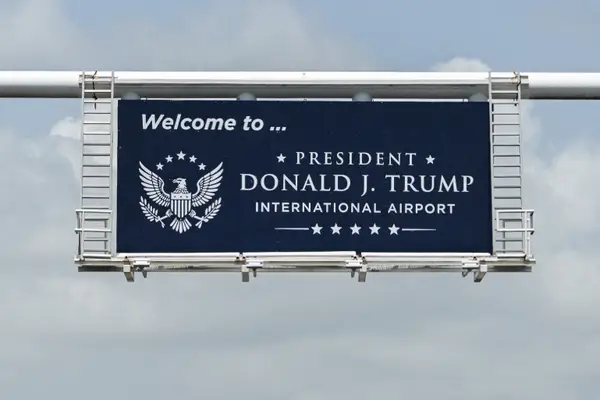
A $5.5 million estimate now sits behind Palm Beach County’s completed airport identity change. The former Palm Beach International Airport became President Donald J. Trump International Airport on July 9, and its three-letter code changed from PBI to DJT on August 18. The change was required by a Florida law signed March 30, rather than initiated as a conventional airport modernization project.
State funding covers $2.75 million, or half the estimated total. The Palm Beach County Department of Airports says it will pursue available funding sources for the balance. What remains missing is an itemized account showing how much is assigned to signs, digital systems, contractors or other transition work. That gap makes it difficult to determine which parts of the project drive the estimate or how much work remains unfunded.
The code change reaches beyond airport signs
The visible work includes updated highway and terminal signs, new wording on arrival and departure displays, and a gold-colored airport logo resembling the presidential seal. Workers began installing signs in early July, including along Interstate 95 and inside the terminal.
The switch from PBI to DJT is more consequential operationally than replacing a name above an entrance. The International Air Transport Association code is used in flight searches, reservations, check-ins, baggage tracking and flight-information displays. Passengers must now use DJT when searching for the airport or making travel arrangements.
That does not mean the airport itself has changed ownership, governance or operating control. Palm Beach County continues to oversee its policies, finances and strategic decisions. Nor is the code change evidence of a change to runways, terminal capacity or airline service. Airport officials said the transition was coordinated with airlines, federal agencies and airport partners, and that the code change had no effect on flights, services or passenger operations.
The distinction matters because the $5.5 million figure describes an identity transition, not a documented expansion of transportation capacity. The available information identifies signage and passenger-facing information changes, but it does not attribute any portion of the estimate to added gates, improved baggage equipment, safety upgrades or other physical operating capability.
A mandate divided between state and local systems
The policy structure is unusual in practical terms. Florida preempted authority to name major commercial-service airports and directed Palm Beach County to pursue the approvals and agreements needed to implement the new identity. The county, however, still owns and operates the airport. The state therefore mandated the change while the local airport organization carries out much of the work across its facilities and information channels.
That division makes the unresolved $2.75 million important. The state allocation is sufficient to finance half the current estimate, but the Department of Airports has not identified a finalized source for the other half. Its statement that it will continue to pursue all available funding sources establishes an intention, not a completed financing plan.
For taxpayers and airport users, the central accountability question is not whether a mandated name can be placed on a building. It is whether the eventual funding arrangement clearly separates the transition’s costs from money intended for normal airport operations and capital improvements. No conclusion about diversion can be drawn without a final funding plan and an itemized cost record, neither of which has been disclosed.
The absence of a breakdown also prevents a fair comparison between necessary system changes and optional branding work. Updating the code wherever passengers book flights, check bags or read departure information serves a functional purpose once DJT becomes the active identifier. More extensive decorative or permanent branding may involve a different scope and priority, but the published estimate does not separate those categories.
The airport’s new identity and DJT code are now in use, while officials say their operating focus remains a safe, reliable and welcoming passenger experience. The remaining test is financial rather than operational: $2.75 million of the estimated $5.5 million transition still lacks a publicly identified, finalized funding source, and the public has not received an itemized bill.
By Thomas Caldwell — AMI’s senior editor for mechanical and mobility engineering, covering vehicle electronics, systems integration, electrification, chassis systems, propulsion, and safety policy.