GM’s 30-Vehicle Bolt Batches Cut Paint Changes and Simplify Assembly
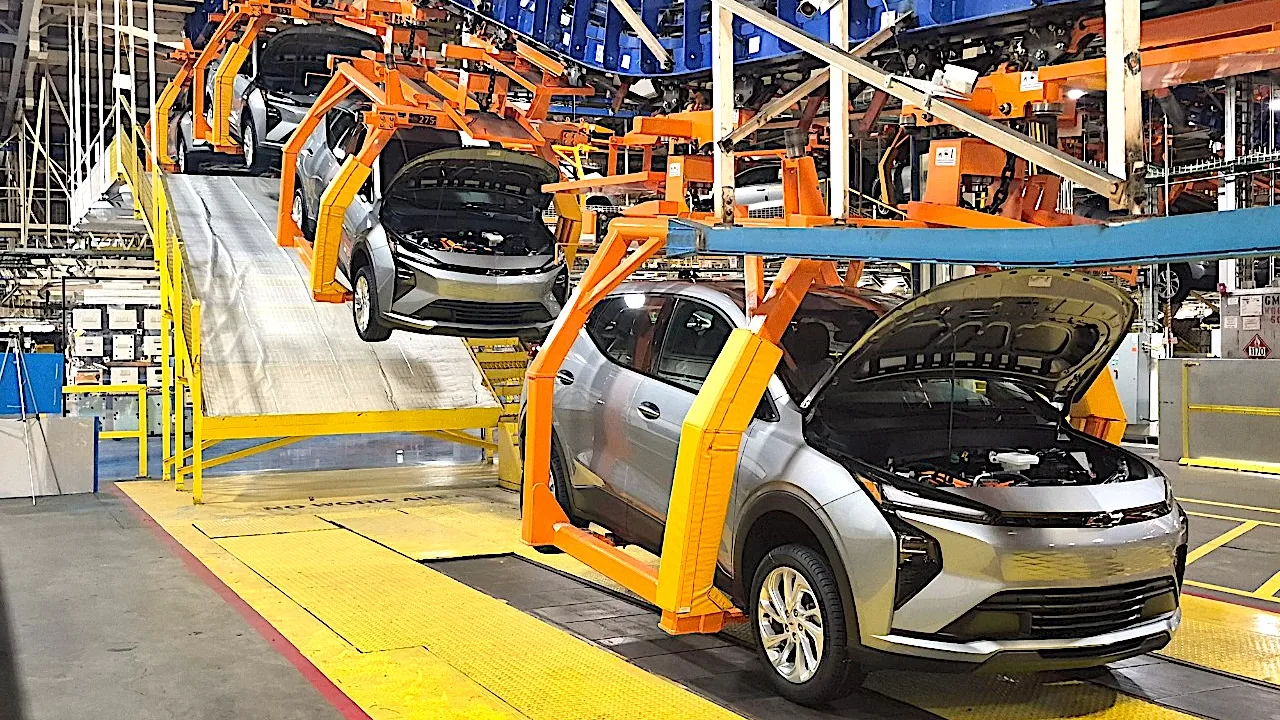
A vehicle paint shop pays a production penalty whenever it changes colors: equipment must be purged and cleaned before the next finish can run. General Motors is reducing how often that happens at Fairfax Assembly & Stamping in Kansas City by building Chevrolet Bolt EVs in fixed groups of 30 similarly equipped, same-color vehicles.
The batch-build system extends well beyond paint. Suppliers work from a fixed seven-day production schedule and deliver corresponding components in groups of 30. Assembly employees then repeat substantially the same work across an entire batch instead of adapting to a different configuration with each passing vehicle. GM identifies Fairfax as its first North American assembly plant to adopt the method.
Color sequencing sets the production rhythm
Paint provides the clearest reason to group vehicles. A conventional mixed sequence can require frequent changes among exterior colors, with each transition adding a purge-and-cleaning cycle. Running 30 Bolts in one color does not eliminate those procedures, but it spreads each changeover across more completed bodies.
That sequencing decision becomes the organizing rule for upstream material flow. Once the plant fixes the order of upcoming batches, suppliers know which parts Fairfax will need and when. Components can arrive in the same 30-vehicle quantities rather than in a constantly changing mix intended to cover many possible builds.
GM says this reduces the need for kit cells, specialized racks, storage equipment and floor space. Those benefits have not been quantified, so the important engineering point is the reduction in simultaneous variation rather than a claimed percentage improvement. Fewer active part combinations should make staging more straightforward, but the available figures do not establish how much space or labor Fairfax has saved.
The same principle applies at individual workstations. An operator seeing 30 similar vehicles can repeat a task before the next batch introduces a configuration change. Fairfax communications lead Craig Hover described the effect directly: Complexity is streamlined, so they do not have to change their process each time a vehicle passes their station.
Reserve bodies protect the batch sequence
A rigid production sequence creates its own risk. If one body must leave the line to address a possible defect, the missing vehicle could break the planned parts sequence and disrupt the 30-unit run. Fairfax addresses that issue with reserve bodies GM calls “clones.”
The plant holds back two Bolt bodies for every configuration, covering the vehicle’s three roof configurations and seven exterior colors. If a body is removed, a matching clone can enter the line and preserve the schedule. This is the system’s continuity mechanism: Fairfax gains repeatability from fixed batches while keeping a limited buffer for exceptions.
The clone strategy also shows that batch building does not remove manufacturing variation or quality holds. It manages their effect on line flow. Maintaining reserve bodies carries its own inventory and coordination requirements, but GM has not disclosed those costs or compared them with the disruption avoided.
Quality results are encouraging but incomplete
GM connects the repetitive build sequence with quality performance. One cited measure is electrical first-time quality, which tracks how many vehicles pass a key electrical-system check on the assembly line. The company says Fairfax was consistently meeting its monthly targets three months after launch.
That result indicates the plant was achieving its internal threshold, but GM has not provided the pass rate, the target percentage or a before-and-after comparison. It therefore does not establish the size of any quality gain attributable specifically to batching. Paint savings, cycle-time improvement and overall cost reductions likewise remain unquantified.
Fairfax now gives GM a production-scale test of whether lower configuration variability can simplify a modern vehicle plant without sacrificing continuity. Plant Director Michael Youngs said lessons from the Bolt program could inform other GM factories. The next immediate test will be local: Fairfax plans to add the 2027 Chevrolet Equinox and later a next-generation Buick compact SUV, giving the plant an opportunity to determine whether its 30-vehicle discipline transfers cleanly beyond one electric model.
| More aerospace and engineering stories, right in your MSN feed. Follow AMI on MSN |
By Robert McKinney — Editor-in-Chief for AMI’s automotive and mobility coverage, with a mechanical engineering background and a decade reporting on powertrain systems, EV innovation, and global vehicle manufacturing.