S301’s 8.7-Year Orbit Could Measure the Milky Way Black Hole’s Spin
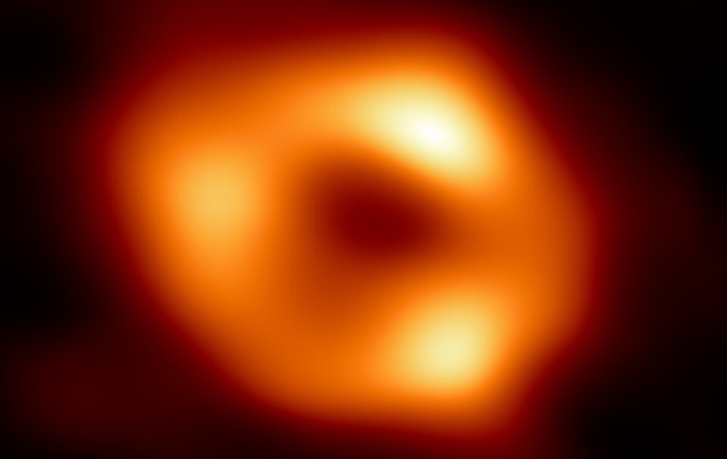
Eight-point-seven years is the number that makes S301 unusually valuable. That is how long the faint star takes to circle Sagittarius A*, the supermassive black hole at the center of the Milky Way. Astronomers reported the discovery in an August 19 Nature paper, describing the shortest confirmed stellar orbital period yet measured around the galaxy’s central black hole.

The compact orbit creates a prospective path toward measuring Sagittarius A*’s spin directly. That measurement has not been made. Researchers hope continued tracking can detect the small orbital distortion caused by a rotating black hole within roughly the next 10 years, although the result will depend on observing precision, orbital geometry and the ability to separate competing gravitational effects.
A Sun-like star moving at 8% of light speed
S301 follows a highly elongated path. At its closest approach, it passes within roughly 136 to 142 Schwarzschild radii of Sagittarius A*, a black hole with an estimated mass of 4.3 million Suns. The star then reaches about 25,000 kilometers per second, more than 8% of light speed.
Those figures matter because the effect astronomers want to measure grows rapidly closer to the black hole. General relativity predicts that a rotating mass drags the surrounding spacetime, an effect known as frame dragging or Lense Thirring precession. For S301, that distortion should slightly alter the orientation of the orbit from one revolution to the next.
S301 is not an exotic stellar heavyweight. Its faintness is consistent with a compact, main-sequence star of roughly 1.1 to 1.5 solar masses. That makes it broadly Sun-like in mass, but its location turns it into a precision probe of gravity. As the research team put it, stars near Sagittarius A* act as test particles tracing the gravitational field around the central black hole.
Finding the star required more than one observation
Astronomers first identified S301 in spring 2023 with GRAVITY, an instrument on the European Southern Observatory’s Very Large Telescope Interferometer. GRAVITY combines observations from multiple telescopes to resolve extremely faint objects in the crowded Galactic Center.
The team did not establish the orbit from that detection alone. Researchers followed the star’s motion and worked backward from its emerging trajectory, locating earlier appearances in data from 2021 and 2017. The Nature analysis used 19 datasets spanning more than eight years, providing coverage of most of one 8.7-year circuit.
That retrospective identification is important because orbital measurements improve with time and coverage. A short arc can fit multiple possible trajectories; observations across much of a revolution constrain the period, eccentricity and closest approach more tightly. Even now, however, the data permit two nearly equivalent three-dimensional orientations because the researchers do not yet have radial-velocity measurements for S301.
Spin is the smaller signal
The black hole’s mass already produces a much larger relativistic shift called Schwarzschild precession. That effect changes the direction of S301’s closest approach by about 1.9 degrees per orbit. The additional frame-dragging contribution associated with spin could be less than 0.11 degree per circuit.
Extracting the smaller motion will therefore require sustained, high-precision astrometry rather than simply watching the star complete another lap. The team’s simulations considered observations through 2035, including future radial-velocity measurements. Their optimistic case assumed favorable alignment and a rapidly spinning black hole, so it is a performance scenario rather than a guaranteed forecast.
Nearby stars and unseen compact objects add another complication. Their gravity can also perturb S301’s orbit and produce precession that could be confused with the spin signature. Researchers propose comparing S301 with other stars that travel through a similar outer region but remain much farther from the black hole. Those reference orbits can help characterize the surrounding mass while S301 supplies the stronger frame-dragging sensitivity near its closest pass.
The star’s origin remains unresolved as well. One proposed explanation is that Sagittarius A* disrupted a binary system, capturing S301 while ejecting its companion at high speed. Its extreme eccentricity is compatible with that Hills mechanism, but the connection has not been confirmed.
S301’s immediate achievement is the orbit itself: a faint, roughly Sun-mass star traced around the Milky Way’s central black hole in just 8.7 years. The next challenge is substantially harder measuring a tiny, repeatable twist in that orbit strongly enough to distinguish the rotation of spacetime from every other source of precession.
| More aerospace and engineering stories, right in your MSN feed. Follow AMI on MSN |
By David Whitaker — Associate editor for AMI’s aerospace and drone systems desk, translating flight systems, aircraft programs, spaceflight, and UAV developments into accessible technical stories.