SpaceX Now Operates Nearly Two-Thirds of Active Satellites, Raising Traffic Demands
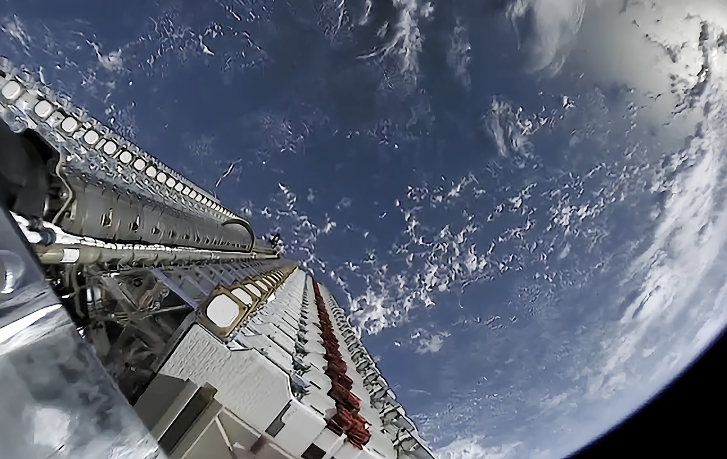
10,365 out of 15,711. Those figures, reported for June 2026 by French orbital-monitoring company Look Up, put SpaceX’s Starlink network at nearly two-thirds of the world’s active satellites. The milestone demonstrates an industrial ability to manufacture, launch and manage spacecraft by the thousands, but it also makes collision avoidance, orbital surveillance and dependable disposal core infrastructure rather than supporting functions.

SpaceX reportedly added almost 3,320 satellites over one year. That pace matters as much as the fleet total. A low-Earth-orbit communications constellation requires continual production because satellites must be added, replaced and eventually removed while the network keeps operating. SpaceX’s scale therefore reflects an integrated system extending from factory output and launch capacity to ground control, propulsion and software-driven fleet management.
The nearest fleets remain much smaller. China reportedly had 1,286 active satellites as of June, up from 1,025 a year earlier. Its Qian Fan and GuoWang communications constellations had 126 and 168 active spacecraft, respectively, despite stated long-term targets of 12,000 and 13,000. Eutelsat OneWeb operated 651 active satellites, with no notable recent additions reported. Those planned totals should not be confused with spacecraft already operating in orbit.
Scale turns collision avoidance into a continuous operation
The engineering burden does not increase only when two satellites are on an actual collision course. Tracking systems must first maintain accurate orbital estimates, screen large numbers of possible close approaches and determine which warnings justify action. Look Up tracks more than 33,000 objects, including active satellites, rocket stages and catalogued debris.
That is one view of a larger and continuously changing tracking problem. The U.S. Space Force’s 19th Space Defense Squadron says its operators task a worldwide network of radar sensors and optical telescopes to maintain orbital parameters for more than 40,000 human-made objects. Different catalog totals can reflect timing, tracking criteria and the objects included, but both figures illustrate why orbital awareness depends on distributed sensors and extensive data processing.
Manual coordination does not scale cleanly to constellations containing thousands of maneuverable spacecraft. According to SpaceX regulatory filings cited by Aerospace America, Starlink satellites performed 144,404 collision-avoidance maneuvers between December 2024 and May 2025. A maneuver count is not a collision count, and it does not by itself establish that orbit has become unsafe. It does show the volume of decisions that a large fleet’s software, propulsion hardware and ground systems must handle.
Automation carries its own design requirements. A satellite needs sufficiently accurate position data, a functioning command path, available propulsion and rules for deciding when a warning is credible enough to justify moving. Each maneuver can consume propellant and alter later orbital predictions. Operators also need coordination methods that prevent two maneuverable spacecraft from responding to the same warning in conflicting or unpredictable ways.
The European Space Agency’s CREAM work is one example of efforts to automate parts of collision avoidance. Look Up is pursuing the same broader traffic-management problem through its SYNAPSE orbital-data platform and planned SORASYS radar-monitoring network. These systems address different layers of the process: observing objects, refining their trajectories, identifying conjunctions and supporting a decision about whether to maneuver.
Disposal reliability becomes a fleet-level requirement
End-of-life behavior is equally important. A functioning satellite can receive commands or maneuver autonomously; a failed spacecraft may become an uncontrolled object that remains in orbit. At Starlink’s scale, disposal performance must be judged statistically across thousands of vehicles. Even a low failure percentage can leave multiple satellites unable to complete their intended deorbit sequence.
That puts a premium on propulsion reliability, power availability, fault management and early detection of degraded spacecraft. Operators must preserve enough capability to lower a satellite safely at the end of service, rather than using every remaining resource for communications. The same fleet scale also magnifies concerns about sunlight reflected into astronomical observations, making spacecraft shape, surface materials and orientation relevant beyond the communications mission.
Starlink’s 10,365 active satellites show that mass-produced orbital infrastructure is no longer a proposal. The unresolved test is whether surveillance networks, automated coordination and disposal performance can expand fast enough to support several fleets seeking Starlink-like scale not merely one.
| More aerospace and engineering stories, right in your MSN feed. Follow AMI on MSN |
By David Whitaker — Associate editor for AMI’s aerospace and drone systems desk, translating flight systems, aircraft programs, spaceflight, and UAV developments into accessible technical stories.