USS Kennedy Completes Trials as Ford-Class Deliveries Stretch to 2034
One U.S. shipyard launched 50 Casablanca-class escort carriers in roughly 14 months during World War II. Today, one specialized shipyard builds the Navy’s nuclear-powered Ford-class carriers, with the next three deliveries spread across seven years. The contrast is real, but it is not a like-for-like measure of American shipbuilding productivity.

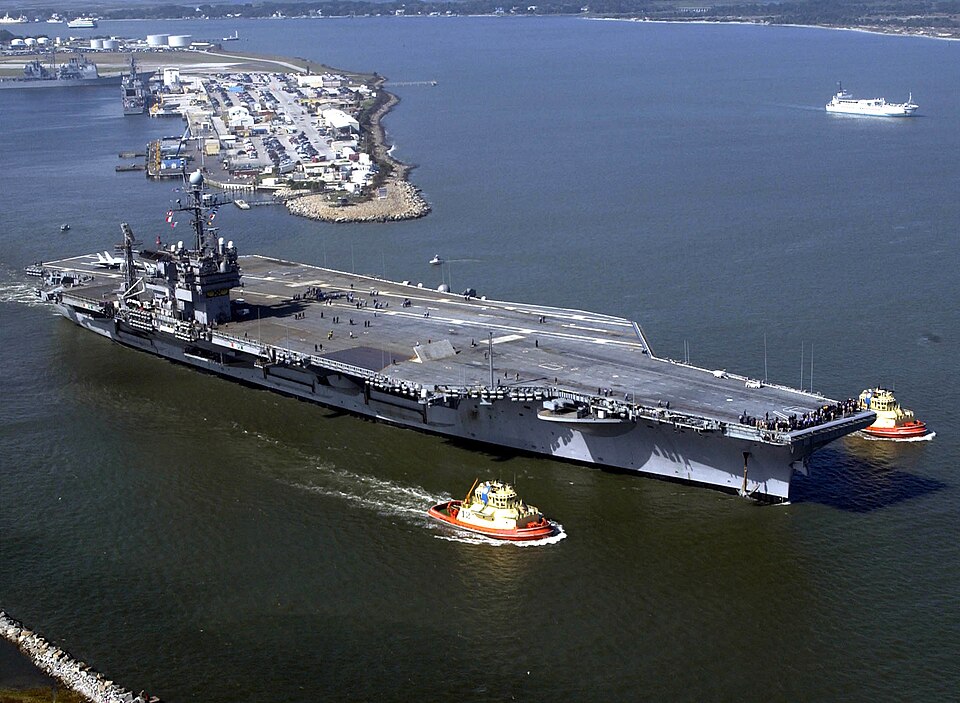
The future USS John F. Kennedy completed acceptance trials on August 15, 2026, after four days underway off the Atlantic Coast. The Navy describes the ship as 98% complete. Its current schedule places delivery in March 2027, followed by the future USS Enterprise in March 2031 and the future USS Doris Miller in February 2034.
Acceptance trials test whether a ship meets its contract specifications and whether its crew can operate it at sea. Kennedy’s next step is preliminary acceptance, which will allow additional testing while the prime contractor finishes the remaining four of its 11 advanced weapons elevators. Earlier schedule delays were attributed to certification work on the Advanced Arresting Gear and continued elevator work.
Why 50 wartime carriers are not the modern benchmark
Kaiser Shipbuilding launched USS Casablanca at Vancouver, Washington, on April 5, 1943. The same yard launched USS Munda, the 50th and final ship in the class, on May 27, 1944. That works out to approximately one launch per week.
These were purpose-built escort carriers rather than converted cargo ships, but their engineering scope was far removed from that of a modern fleet carrier. A Casablanca-class ship was 512 feet long and displaced 7,800 tons by Navy figures, although specialist references put full-load displacement near 11,000 tons. It carried 27 aircraft and used two reciprocating engines producing about 9,000 horsepower.
A Ford-class carrier displaces about 100,000 tons. Its plant includes two A1B nuclear reactors, while its aviation systems include electromagnetic catapults, Advanced Arresting Gear and software-controlled weapons elevators. The ship must also support the electrical, cooling, control and safety infrastructure associated with those systems.
The tenfold difference in displacement is only the visible part of the gap. Nuclear construction requires specialized facilities, regulated processes and a workforce qualified for work that did not exist on a conventionally powered Casablanca. Modern carrier production must also integrate complex hardware and software across propulsion, aviation and ship-control systems before delivery.
Kaiser’s wartime approach benefited from a frozen design, extensive prefabrication and repeated construction of the same relatively simple ship. The plan called for the first carrier in eight months and later deliveries at a rate of eight per month. Repetition allowed workers and suppliers to move quickly down a production curve without continually absorbing major first-of-class integration work.
The Ford class has not enjoyed that same degree of design maturity. Kennedy is only the second ship in the class, and completion of its arresting equipment and weapons elevators illustrates how a specialized subsystem can govern the schedule even after the hull and most of the ship are substantially complete. Hiring more workers does not by itself remove certification work, equipment dependencies or limits on where large modules can be assembled.
One nuclear-carrier yard sets a physical ceiling
Industrial concentration adds another constraint. Huntington Ingalls Industries identifies Newport News Shipbuilding as the only U.S. yard capable of designing, building and refueling nuclear aircraft carriers. That makes its dry docks, assembly areas, cranes and qualified labor force national production bottlenecks rather than interchangeable commercial capacity.
The limitation is visible in the sequencing of Enterprise and Doris Miller. In November 2024, Newport News moved Enterprise’s mid-body to create room for Doris Miller assembly in the same dry dock. The Navy attributed Doris Miller’s two-year delivery shift to “shipbuilder construction footprint constraints” that limited module work.
That wording matters because it describes a physical production limit, not simply a labor shortage. Carrier modules occupy large areas and must move through a specific sequence of fabrication, outfitting, lifting and dock assembly. More personnel cannot create another suitable dry dock or duplicate the yard’s nuclear-production infrastructure on short notice.
Building many smaller conventionally powered carriers would therefore be a different fleet and industrial strategy, not a faster way to manufacture Ford-class ships. Such vessels would have different aviation capacity, endurance, support requirements and mission limits. No such alternative is presented here as an adopted Navy plan.
Kennedy’s completed trials move the second Ford-class carrier closer to delivery, but the schedule behind it remains governed by specialized systems and one constrained nuclear yard. Enterprise is due four years after Kennedy, and Doris Miller three years after Enterprise the clearest measure of how far modern carrier construction has moved from Kaiser’s weekly launch rhythm.
| More aerospace and engineering stories, right in your MSN feed. Follow AMI on MSN |
By David Whitaker — Associate editor for AMI’s aerospace and drone systems desk, translating flight systems, aircraft programs, spaceflight, and UAV developments into accessible technical stories.