GJ 523b Has 23 Earth Masses but Very Little Atmosphere
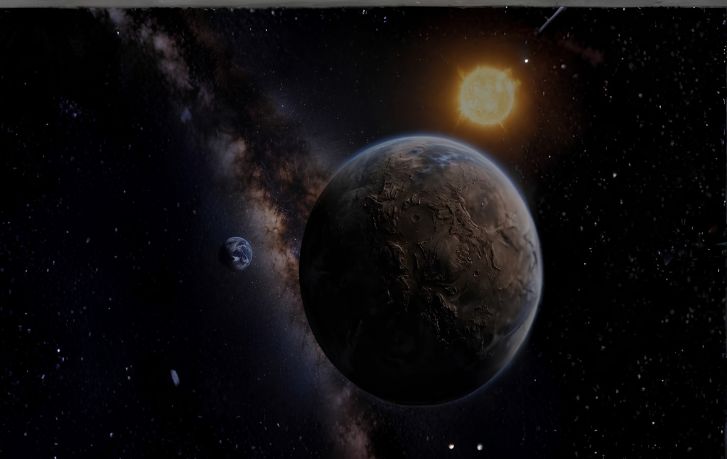
GJ 523b presents an awkward combination for conventional planet-formation expectations: It has approximately 23 times Earth’s mass but very little atmosphere. Researchers at the University of Wisconsin-Madison characterize the young exoplanet as mostly dense material surrounding a massive core, rather than a smaller version of the gas-rich giants familiar from our solar system.
The mismatch is substantial. GJ 523b is more than 2.5 times Earth’s radius, about 60 percent the size of Neptune and roughly 170 million years old. Yet the measurements indicate that its bulk is dominated by dense rock instead of the large hydrogen-rich envelope scientists generally expect around a core this massive.
A planet beyond the usual rocky scale
Planet size alone does not reveal composition. A relatively large radius can come from a thick, low-density atmosphere, while a high mass packed into a modest radius points toward denser material. Establishing both values is therefore central to determining whether an exoplanet is primarily rocky or enveloped in gas.
GJ 523b sits well beyond the dimensions usually associated with terrestrial worlds. NASA’s overview of terrestrial exoplanets notes that such planets generally have bulk compositions dominated by rock or iron, while larger rocky worlds are commonly grouped as super-Earths. The boundaries remain imperfect because classifications such as super-Earth, mini-Neptune and “Mega-Earth” can describe size or composition without defining one universal physical cutoff.
That uncertainty is precisely why GJ 523b matters. Thomas Beatty, a University of Wisconsin-Madison astronomy professor, said astronomers have used “Mega-Earth” for more than a decade without having a planet that allowed the category to be defined concretely. This object could become a useful benchmark because its measured mass, radius and limited atmosphere place unusually strong constraints on what such a world can be.
Three observatories built the measurement
NASA’s Transiting Exoplanet Survey Satellite, better known as TESS, first identified GJ 523b as a candidate. TESS looks for periodic reductions in a star’s brightness when a planet crosses in front of it. Those transits help researchers estimate the planet’s radius and orbital behavior, but they do not by themselves provide the full physical picture.
Lead author Max Kroft followed up with the WIYN telescope in Arizona. The team then used James Webb Space Telescope data to investigate the planet’s density and atmosphere. Together, the space- and ground-based observations allowed the researchers to move beyond detecting a candidate and characterize a world with about 23 Earth masses squeezed into a radius only a little more than 2.5 times Earth’s.
The resulting density is the critical engineering-style constraint on the interpretation. A massive rock-and-metal core should exert enough gravity to accumulate surrounding gas while a planetary system is forming. Jupiter and Saturn, by comparison, developed enormous atmospheres after their cores reached masses on the order of 20 Earths. GJ 523b reached a comparable mass regime without retaining a similarly dominant envelope.
The missing gas remains unexplained
The observations establish the planet’s unusual mass-atmosphere combination, not its history. One proposed scenario is that GJ 523b previously orbited close enough to its star for extreme heat to remove much of an earlier atmosphere. That would make the planet the exposed dense remnant of a formerly more gas-rich world.
A second possibility is a collision between two planets. Such an impact could combine dense planetary material while generating enough heat to strip away surrounding gas. Neither scenario has been established as the cause, and the available findings do not settle where GJ 523b formed or exactly how its atmosphere evolved.
Further work will need to connect astronomical measurements with models from geology and atmospheric science. The immediate result is narrower but significant: GJ 523b demonstrates that a planet can reach roughly 23 Earth masses while remaining dominated by dense material and carrying far less gas than expected. Explaining how it crossed the usual threshold toward giant-planet mass without becoming a conventional gas-rich world is now the next test.
| More aerospace and engineering stories, right in your MSN feed. Follow AMI on MSN |
By David Whitaker — Associate editor for AMI’s aerospace and drone systems desk, translating flight systems, aircraft programs, spaceflight, and UAV developments into accessible technical stories.