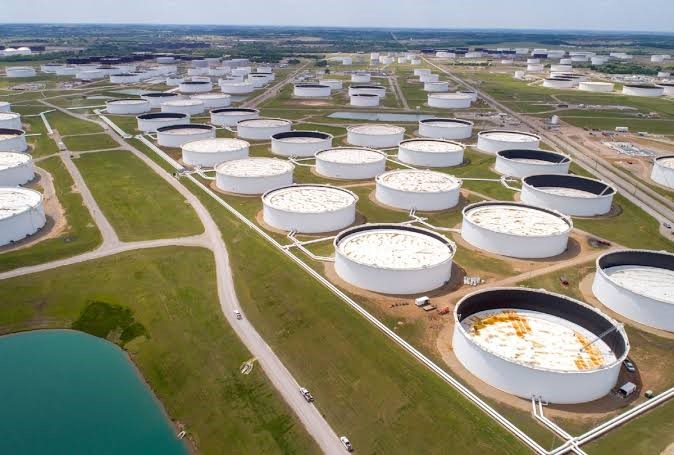
U.S. Strategic Petroleum Reserve Heads Toward 243 Million Barrels, Limiting Fast Delivery
The U.S. Strategic Petroleum Reserve is projected to fall to about 243 million barrels as the continuing withdrawal runs its course. That remains a substantial inventory, but the headline number on the Energy Department’s official reserve inventory page does not fully describe how much crude the system can deliver quickly during another emergency.
The distinction is between stored volume and deliverable flow. As the oil layer in a storage cavern becomes thinner, pumping rates decline, extraction equipment must remain submerged, and accumulated material near an intake can complicate rapid withdrawal. Construction outages and unavailable caverns can further separate total inventory from the amount ready for immediate delivery.
The reserve works by displacing oil with water
Established in 1975, the reserve stores crude in 60 underground salt caverns in Louisiana and Texas. During a withdrawal, operators inject water into the bottom of a cavern. Because oil is less dense than water, the incoming water pushes the crude upward through extraction wells and into the reserve’s surface distribution system.
This process means the caverns do not become empty underground chambers as oil is removed. Energy Department spokesman Ben Dietderich described the operating principle directly: “The caverns are always full. All that changes is the ratio of oil and water that is filling them.” No cavern collapse has been reported during the current drawdown.
Oil still has to remain above the water and keep the extraction pipes submerged. According to the Energy Department and Texas A&M petroleum engineering professor Siddharth Misra, approximately 70 million barrels must remain for that purpose. That is a physical minimum associated with the extraction configuration, not a promise that the system can maintain its maximum emergency flow rate until it reaches that level.
Misra estimates that the reserve’s practical operating floor is between 250 million and 300 million barrels. The projected 243 million barrels would fall below that range, but his estimate is an attributed engineering judgment not an official Energy Department threshold. Misra said operation below the range places “cavern integrity and overall operational capability” at elevated risk.
Maximum pumping capacity is not constant
The Energy Department lists a nominal maximum withdrawal rate of 4.4 million barrels per day. Its reserve guidance says that rate can be sustained for up to 90 days before declining as the caverns are emptied. At lower inventory, reduced pressure and a thinner oil layer can make the effective rate materially lower than the nameplate figure.
Sludge accumulated within a cavern is another operating consideration. As the oil-water boundary moves upward, that material can approach extraction intakes and constrain how aggressively operators pump. The relevant readiness measure is therefore not simply barrels underground, but barrels that can move through available wells, pumps, pipelines and surface equipment at the required rate.
The injected fresh water also changes the storage structure over time because it dissolves salt the same basic solution-mining process originally used to create the caverns. A Government Accountability Office assessment found that each drawdown cycle expands cavern volume and reduces spacing between caverns within a salt dome. It also found that most caverns examined after the 2022 drawdown were in very good condition.
The system was designed for five complete drawdown-and-refill cycles and has been tapped dozens of times over four decades, although those withdrawals were not all complete cycles. That history does not establish imminent structural failure, but it makes cavern geometry, equipment condition and maintenance availability important alongside the inventory total.
A legal threshold adds another boundary
At about 243 million barrels, the reserve would also sit below the 252.4 million-barrel statutory threshold for a limited drawdown. Federal guidance says a limited drawdown cannot be ordered below that inventory level. Separate authority still applies to a full drawdown ordered in response to a severe energy-supply interruption, so 252.4 million barrels is not a universal prohibition on further emergency use.
The reserve’s projected level would be below 300 million barrels for the first time since 1983. The consequential number in the next emergency, however, may be the achievable daily flow not merely the 243 million barrels recorded underground.
| More aerospace and engineering stories, right in your MSN feed. Follow AMI on MSN |
By Thomas Caldwell — AMI’s senior editor for mechanical and mobility engineering, covering vehicle electronics, systems integration, electrification, chassis systems, propulsion, and safety policy.