Air Force Weighs Faster B-21 Production and Fleet Beyond 100 Bombers
Northrop Grumman is adding B-21 Raider manufacturing capacity before the Air Force decides how much of that capacity it will use. The service is reviewing both faster production and a fleet larger than its current plan for at least 100 stealth bombers, creating a consequential choice between earlier fielding and a potentially larger, longer public-spending commitment.

The decision has not been made. Northrop Grumman CEO Kathy Warden said the company is participating in the analysis and expects the Air Force to reach a conclusion by the end of 2026. The review follows a one-time $4.5 billion funding increase that accelerated the acquisition effort by roughly 25%, according to Gen. Dale White. An official Air Force update similarly says the added funding boosted B-21 industrial capacity by 25%.
Capacity is expanding ahead of the fleet decision
The production question is not simply whether Northrop Grumman can assemble more aircraft. A bomber ramp requires tooling, specialized labor, supplier throughput, quality controls and facilities that can support aircraft as they move from manufacturing into testing and operational service. Those elements must grow together; otherwise, spending on one bottleneck can leave another limiting output.
Northrop Grumman expects $1.85 billion in capital expenditures during 2026 and spending equal to about 4.5% of sales in both 2027 and 2028. Executives have identified B-21 production infrastructure as one reason for that investment. Warden said the company has been “investing in capacity,” and that its agreement with the Air Force permits analysis of accelerated production within a larger program of record.
That language establishes an option, not an order. The publicly disclosed eventual production expectation remains seven operational B-21s per year. Nothing in the current review confirms a higher annual rate, how quickly a higher rate could be reached or how many aircraft above 100 the Air Force might seek.
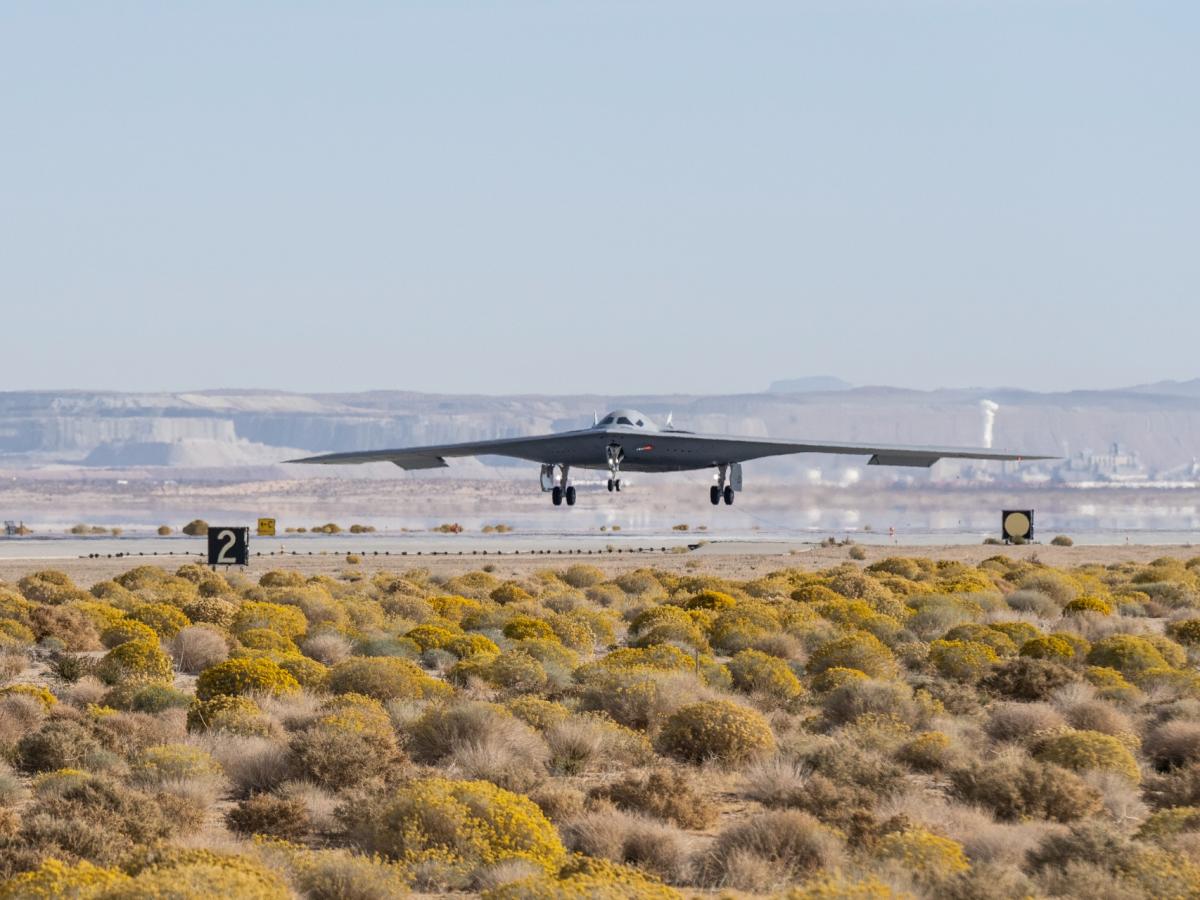
A second B-21 has also joined flight testing at Edwards Air Force Base in California. Adding another test aircraft increases capacity for flight evaluations and weapons integration, helping the program gather results without placing the full workload on one aircraft. That matters to the production ramp because manufacturing speed cannot responsibly outrun the testing needed to validate the design and its systems.
Faster production and a larger fleet are separate choices
The Air Force could decide to obtain its planned aircraft more quickly without increasing the final fleet size. It could also retain the existing production profile while extending manufacturing to buy more than 100 bombers. Doing both would create the broadest demand for factory capacity, suppliers, testing and base infrastructure, but it would also bring spending forward while increasing the program’s total scope.
The Pentagon has requested $6.1 billion for the B-21 in fiscal 2027. For taxpayers, the central issue is therefore not only the total number of aircraft but the timing and purpose of added expenditure. A faster ramp can place aircraft into service sooner and may give the industrial base a steadier production signal. It can also require earlier commitments to facilities, personnel and components before the Air Force has completed its fleet-size analysis.
The first operational B-21 is expected at Ellsworth Air Force Base in South Dakota in 2027. Infrastructure there is part of the fielding constraint: aircraft need parking, maintenance, training and support facilities when they leave the factory. That base-level work illustrates why production output alone does not determine how quickly an operational fleet can grow.
The B-21 is designed to carry conventional and nuclear weapons and eventually replace the B-1 Lancer and B-2 Spirit while operating alongside modernized B-52 bombers. That makes the fleet review a force-structure decision extending well beyond Northrop Grumman’s factory. The Air Force must balance the desired bomber inventory against testing progress, fielding infrastructure, annual budgets and the capacity of the broader supplier network.
By the end of 2026, the service is expected to say whether the added capacity supports another acceleration, a fleet beyond 100 aircraft, both or neither. Until then, seven operational bombers per year and at least 100 aircraft remain the disclosed planning benchmarks not an approved ceiling that has already been lifted.
| More aerospace and engineering stories, right in your MSN feed. Follow AMI on MSN |
By David Whitaker — Associate editor for AMI’s aerospace and drone systems desk, translating flight systems, aircraft programs, spaceflight, and UAV developments into accessible technical stories.