James Webb Telescope Finds Possible Solar-System-Size Star Powered by Black Hole
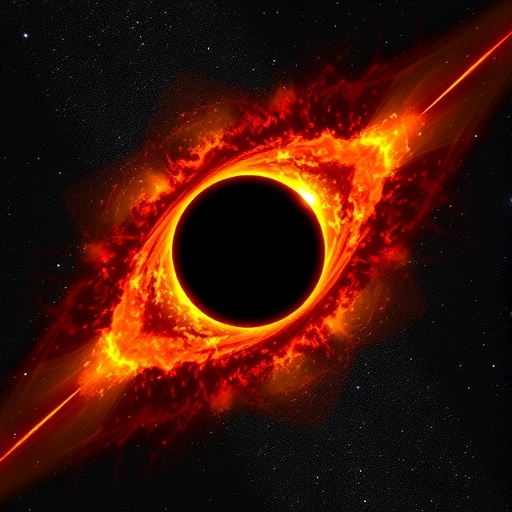
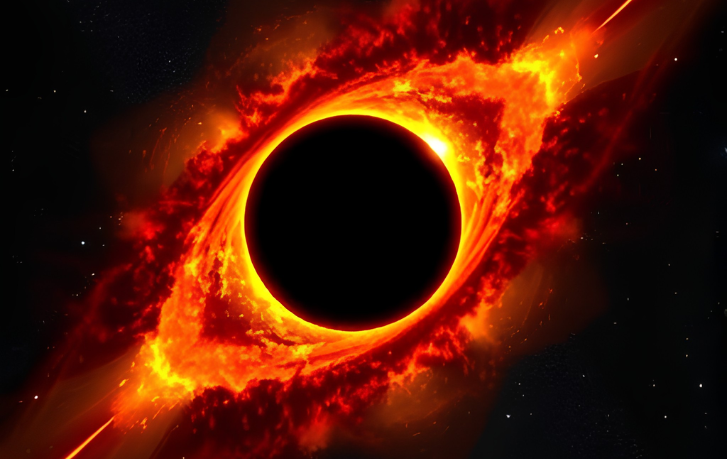
The James Webb Space Telescope has detected star-like light from an object roughly the size of the solar system, but its reported output is far too intense for a normal star. Researchers propose that MoM-BH*-1 instead contains a feeding black hole approximately 100,000 times the Sun’s mass, wrapped in an enormous envelope of dense gas.

The interpretation, detailed in a Nature study, would make MoM-BH*-1 a candidate “black hole star”: not a star powered by nuclear fusion, but an accreting black hole whose radiation is processed by a star-like gaseous exterior. The model could help explain some of the compact, unusually red objects Webb has found in the early universe, although it does not yet establish a definitive new class or account for every such object.
Why starlight cannot explain the energy
MoM-BH*-1’s spectrum contains a particularly strong Balmer break, a sharp change at wavelengths associated with hydrogen absorption. That feature is commonly linked to stellar atmospheres and populations of stars, making the object initially look more star-like than a conventional active black hole.
Its energy output creates the central contradiction. MoM-BH*-1 reportedly emits about 100 billion times more energy than any known star could physically produce. Nuclear fusion therefore cannot plausibly supply the observed power at that scale, while matter falling toward a black hole can release enormous amounts of energy.
In the proposed mechanism, the central black hole consumes surrounding material through an accretion flow. Radiation from that process must then travel through an extremely dense, turbulent gas envelope before escaping. Hydrogen in the envelope absorbs, scatters and redistributes the radiation, giving it spectral characteristics normally associated with starlight.
This filtering is also important because the preferred model is nearly dust-free. Astronomers often explain a red astronomical source as an intrinsically brighter object viewed through dust, but the longer-wavelength measurements for MoM-BH*-1 do not favor a thick dust screen. Here, extreme hydrogen opacity not dust is proposed as the main reason the object appears red and shows such a deep spectral break.
A rare view of the central engine
Separating a black hole’s light from its host galaxy is a recurring problem in early-universe observations. Stars, gas and an active galactic nucleus can all contribute to the same unresolved point of light, making mass estimates and spectral interpretation difficult.
MoM-BH*-1 appears to offer an unusually clean case. Lead author Rohan Naidu said the candidate black hole star essentially outshines its surrounding host galaxy, leaving astronomers with what is close to an undiluted signal from the central object. Webb observations also constrain the source to a compact region, consistent with the proposed black-hole-dominated interpretation.
The object’s light was emitted about 13 billion years ago, approximately 660 million years after the Big Bang. That timing matters because astronomers have struggled to explain how some black holes became so massive so early. A dense gas envelope could support rapid growth, providing one possible stage between an initial black-hole seed and the supermassive black holes that later powered bright quasars.
The model still has demanding assumptions
The fit is not a direct image of a black hole inside a gaseous sphere. It is a physical model constructed to reproduce Webb’s measured spectrum, including broad hydrogen emission, deep absorption and the unusually strong Balmer break. The researchers caution that the relevant parameter space is complex and degenerate, meaning different combinations of gas conditions and central-source properties can produce overlapping observational effects.
The model also requires exceptionally dense gas and strong turbulence. Whether that turbulence can be maintained throughout such a large envelope remains unresolved. The spectral lines may also be altered by scattering inside the gas, potentially complicating black-hole mass estimates that assume line width directly traces material moving near the black hole.
Alternative explanations for the wider population of Webb’s “little red dots” remain under study, including models involving supermassive stars. MoM-BH*-1 therefore supplies a compelling test case rather than a universal answer.
Further measurements will target the candidate’s mass, atmospheric properties, variability and detailed gas physics. Those tests must determine whether Webb has exposed a brief growth phase shared by other early black holes or one exceptionally unusual object whose star-like light conceals a far more powerful engine.
| More aerospace and engineering stories, right in your MSN feed. Follow AMI on MSN |
By David Whitaker — Associate editor for AMI’s aerospace and drone systems desk, translating flight systems, aircraft programs, spaceflight, and UAV developments into accessible technical stories.