


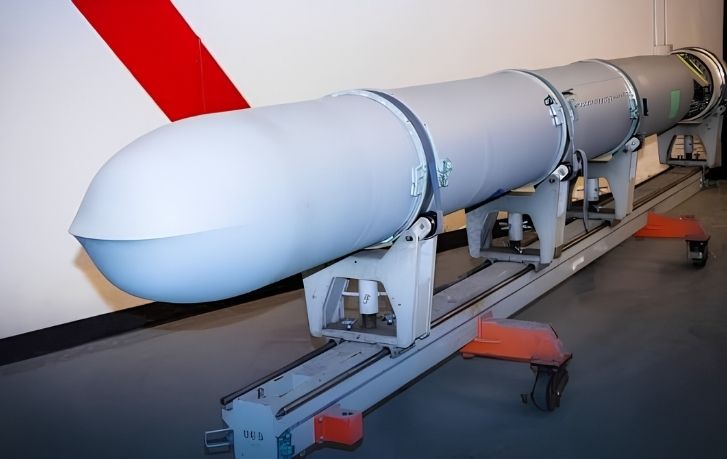
Pentagon’s $22.9 Billion Tomahawk Deal Targets 16-Fold Production Increase
The Pentagon has placed a large bet on time and predictability: a $22.9 billion Navy contract with Raytheon, an RTX business, is intended to raise Tomahawk missile production from roughly 60 per year to more than 1,000. That is an increase of more than 16 times the current annual rate under a seven-year commitment but it is a production target, not capacity that exists today.
The distinction matters for taxpayers, military forces and allied users of U.S. defense systems. A contract can provide manufacturers with enough demand certainty to hire workers, order tooling and expand facilities. It cannot instantly produce qualified suppliers, trained employees or synchronized component lines. The practical test is whether appropriations, suppliers and factory investments remain aligned for most of the seven-year period.
Why seven years changes the factory calculation
Missile manufacturing has historically been exposed to shifting annual orders. When demand falls or changes from one budget cycle to the next, contractors have limited reason to maintain excess floor space, specialized labor or supplier capacity. Smaller companies deeper in the chain face the same calculation, often with less ability to absorb an idle production line.
A multiyear agreement changes that risk equation. Predictable orders can justify capital spending that would be difficult to recover from a one-year purchase. It can also give suppliers a clearer basis for adding shifts, modernizing equipment and securing materials over longer periods.
That certainty is what the government is purchasing in addition to the missiles themselves. The $22.9 billion figure should therefore be viewed as a long-term industrial commitment, not merely the price of a single batch. The fairness question for the public is whether that commitment ultimately produces measurable throughput, shorter delivery timelines or lower unit costs not simply larger contractual ceilings.
Several production lines must rise together
Tomahawk is the most dramatic stated increase, but it is part of a wider Pentagon effort involving seven-year arrangements with major contractors and component suppliers. Other annual targets include 1,900 air-to-air missiles and more than 500 SM-6 missiles. Patriot PAC-3 interceptor production is targeted to rise from 600 to 2,000 per year, while THAAD interceptor capacity is intended to climb from 96 to 400.
Those numbers provide useful benchmarks, but final assembly is only one part of the constraint. Missile output depends on propulsion, electronics, structural hardware and other specialized components arriving at compatible rates. Expanding one contractor’s assembly operation accomplishes little if a qualified supplier remains stuck at its previous output.
The Pentagon has consequently been working directly with selected component suppliers. For Patriot and THAAD, the reported approach includes investment signals for tooling, facility modernization and workforce development. Adding another qualified source for a component can improve resilience, but qualification and production expansion still require time. For THAAD in particular, the planned rise from 96 to 400 interceptors cannot be achieved by expanding Lockheed Martin’s final integration operation alone; supporting suppliers must scale alongside it.
Congress controls whether the signal remains credible
Seven-year authority does not remove the federal budget cycle. Congress must continue providing money for the agreements to reach completion, leaving suppliers to judge how much investment they can safely make before every future appropriation is secured.
A House Appropriations Committee report on the 2027 defense bill supports multiyear authority for Tomahawk, PAC-3 and THAAD, describing stable demand, private investment, lower unit costs and shorter production timelines as intended benefits. But the committee also identifies uncertainty in the funding structure. More than $43.4 billion for critical munitions was requested through mandatory funding outside the normal annual appropriations process, and the committee said supporting budget details were incomplete or absent in some areas.
That creates a direct tradeoff. Early commitments can encourage manufacturers to invest before every production order is finalized, accelerating a ramp that would otherwise start later. Conversely, funding interruptions or poorly aligned budget accounts can leave facilities, workers and suppliers prepared for orders that arrive late or at reduced levels.
The stated rates now give Congress and the public concrete measures for judging progress: more than 1,000 Tomahawks, 2,000 PAC-3 interceptors and 400 THAAD interceptors annually. Until factories demonstrate those rates and appropriations sustain them, they remain markers for an industrial expansion still under construction.
| More aerospace and engineering stories, right in your MSN feed. Follow AMI on MSN |
By David Whitaker — Associate editor for AMI’s aerospace and drone systems desk, translating flight systems, aircraft programs, spaceflight, and UAV developments into accessible technical stories.



