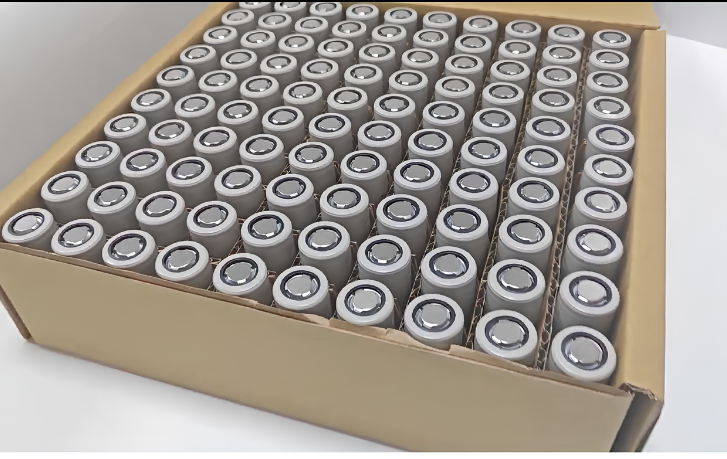
Molicel P70X Targets Hybrid Power Pulses With 900-Watt Five-Second Output
Hybrid batteries do not spend their working lives simply charging to full and discharging toward empty. They repeatedly absorb and release short power pulses as the vehicle accelerates, cruises and recovers energy through regenerative braking. Molicel designed its newly introduced INR-21700-P70X cell around that rapid, shallow-cycling duty rather than the deeper cycles commonly associated with battery-electric vehicles.
The P70X is the first cell in Molicel’s new PX series. According to the company’s technical and product announcement, the cylindrical 21700-format cell can deliver 900 watts of peak power for five seconds and transition to peak output in less than 200 microseconds. Molicel says that combination supports immediate current delivery during overtaking as well as power absorption under heavy regenerative braking.
Those two operating events pull the battery in opposite directions. Acceleration requires the pack to supply a high current without excessive voltage drop, while regenerative braking sends current back into the cells. A hybrid pack may alternate between these conditions frequently, making power acceptance, heat generation and cycle durability at partial states of charge central design concerns.
Molicel is positioning the P70X between conventional energy-focused lithium-ion cells and supercapacitors. Its stated capacity is 7,000 milliamp-hours, with specific energy of 340 watt-hours per kilogram and a continuous-discharge rating of 30C. In battery terminology, the C-rate expresses current relative to rated capacity; a higher figure indicates that the cell is designed to move its stored charge more quickly. Actual pack output would still depend on cell count, electrical configuration, cooling, control limits and the operating state of each cell.
A million-cycle claim built on shallow pulses
To represent hybrid operation, Molicel tested the PX series with what it calls a supercapacitor-like profile: discharge at 10C for 10 seconds, charge at 2C for 110 seconds and stop at an 83-degree Celsius temperature cutoff. The company reports 96% capacity retention after one million cycles under that profile.
That is a notable claimed result, but its boundary conditions matter. One short pulse is not equivalent to a full charge-discharge cycle, and the disclosed profile does not establish performance under every vehicle temperature, state-of-charge window or pack-control strategy. Molicel has not provided independent validation, complete test conditions or a production schedule. Automakers and suppliers would need cell-level characterization and pack-level durability work before translating the result into warranty or service-life assumptions.
The sub-200-microsecond response claim also should not be confused with the response of a complete hybrid propulsion system. The cell may be able to change output quickly, but pack contactors, busbars, current sensors, inverters, battery-management software and thermal limits all shape how much power reaches or returns from the electric machine. For U.S. vehicle integration, repeatable behavior across temperature and aging would matter at least as much as the headline peak figure.
Thermal behavior remains a pack-level engineering task
Molicel also says the P70X passed a UL 9540A thermal-runaway evaluation. UL 9540A is a test method used to examine thermal-runaway behavior and propagation in energy-storage systems; passing such an evaluation should not be treated as an automotive homologation or as proof that a finished vehicle pack meets every applicable safety requirement.
The company attributes nearly 50% lower exothermal heat release, compared with conventional polycrystalline materials, to its use of a single-crystal material. It further says its cells smoke rather than venting all at once, behavior intended to delay and isolate thermal spread. These are manufacturer claims, but the underlying material choice has a relevant engineering basis: Pacific Northwest National Laboratory has described how polycrystalline cathode particles can fracture during repeated cycling, exposing additional material to the electrolyte. Single-crystal structures can reduce some of that degradation, although they are not immune to microcracking or high-voltage instability.
Cell behavior is only one layer of vehicle safety. Module spacing, cooling plates, barriers, pressure management, electrical isolation and pack structure determine whether heat from one cell can be contained. The P70X’s claimed thermal characteristics could give pack engineers more time and a lower heat load to manage, but Molicel has not disclosed a vehicle-level installation or validation program.
The prospective U.S. application is substantial: hybrids approached 20% of American new-vehicle sales in 2025. Yet the P70X’s relevance will ultimately be decided less by market share than by integration data especially how its 900-watt pulse capability, regenerative-charge acceptance and shallow-cycle durability hold up inside an automotive pack across temperature, aging and repeated real-world transients.
| More aerospace and engineering stories, right in your MSN feed. Follow AMI on MSN |
By Robert McKinney — Editor-in-Chief for AMI’s automotive and mobility coverage, with a mechanical engineering background and a decade reporting on powertrain systems, EV innovation, and global vehicle manufacturing.