ORNL Prints Three-Arm Nuclear Vessel, but Qualification Remains the Hard Part
Printing the shape is not the same as proving the pressure boundary. Oak Ridge National Laboratory has built a roughly three-foot-by-five-foot, nuclear-relevant demonstration vessel with three coordinated robotic arms, but qualification for years of high-pressure, high-temperature service remains unresolved. The next phase is therefore centered on material consistency, process traceability and long-term structural integrity not simply whether a robot can deposit enough metal.
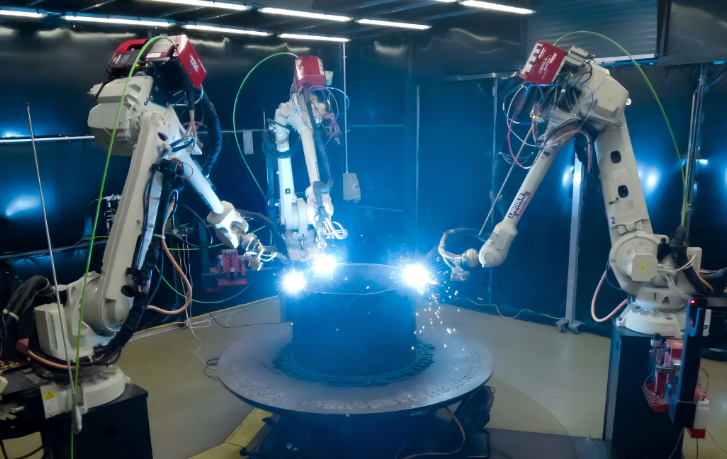
The Department of Energy laboratory completed the enclosed vessel in July using MedUSA, its large-scale wire arc additive manufacturing platform. According to the Oak Ridge and Idaho national laboratory collaboration announcement, the build used a steel alloy relevant to nuclear applications. The laboratories announced their joint qualification effort on August 19.
Three robots turn welding into coordinated manufacturing
MedUSA uses three robotic arms to melt steel wire with electric arcs and deposit the material along programmed paths. In mechanical terms, the process scales established arc-welding principles into layer-by-layer manufacturing. Wire feedstock and a high deposition rate make the method suited to large structures that would be impractical for finer powder-bed printers.
The three-arm arrangement is important because a large enclosed vessel demands coordinated access and deposition across a much wider working envelope than a conventional single-arm cell. ORNL’s demonstration confirmed that MedUSA could produce the vessel’s overall closed geometry at this scale. It did not establish that the deposited steel has the repeatable properties, inspection record or service life required of an operating nuclear pressure vessel.
That distinction defines the engineering program now beginning with Idaho National Laboratory. ORNL brings large-format additive manufacturing and printed-part characterization, while INL contributes nuclear-materials, digital-engineering and data-science expertise. Their plan is to monitor geometry and material properties during deposition, then use the manufacturing record to evaluate the component rather than relying only on post-production testing.
Arc deposition introduces a complex thermal history
Wire arc manufacturing repeatedly melts, solidifies and reheats adjacent material. Current, voltage, wire-feed rate, shielding-gas stability, toolpath and the sequence of deposited layers can all affect heat input and interlayer bonding. For thick sections, that thermal history can influence distortion, residual stress, grain structure and directional variation in mechanical properties.
Those variables are especially consequential in a pressure boundary. Excessive heat input can promote geometric distortion or coarser microstructures, while inadequate energy can produce incomplete bonding between layers. Oxidation, porosity and inclusions are also recognized process risks when shielding or deposition conditions are not adequately controlled. These are general characteristics of arc-based additive manufacturing, not findings of defects in ORNL’s vessel.
Real-time monitoring is intended to make those process conditions traceable. The laboratories want to compare the evolving shape and material indicators against a digital engineering model while the part is being made. ORNL describes the longer-term objective as a “born-qualified” pressure vessel: one whose production data can support an assessment of fitness for harsh service.
That remains an objective rather than an achieved qualification method. Nuclear service would still require evidence that the process is reproducible and that the resulting material retains sufficient toughness and integrity over the intended operating life. Inspection methods must also be capable of finding relevant internal discontinuities despite the component’s thick walls, deposited microstructure and potentially complex geometry.
A possible alternative to constrained forging capacity
The manufacturing incentive is substantial. Large pressure vessels are conventionally associated with forging, ring rolling and extensive welding, all of which depend on specialized heavy industrial equipment. Limited domestic forging capacity has been identified as a potential constraint for new U.S. nuclear projects. Additive manufacturing could diversify that supply base and reduce dependence on a small number of large-component producers, provided it can meet the same demanding performance requirements.
ORNL has already used MedUSA and the same material system to make neutron-sensor brackets for Antares Nuclear’s R1 Mark-0 microreactor, which reached criticality at INL in June. That prior application demonstrates continuity in the printer and material platform, but a reactor bracket and a pressure-retaining vessel carry different structural and qualification burdens.
The three-arm build has moved the work beyond a small coupon or open wall and into a complete, enclosed geometry. The decisive milestone will be whether monitoring data, material characterization and long-duration performance testing can connect every deposited layer to a defensible service assessment. Until that evidence exists, the vessel is a manufacturing demonstration and a demanding test case for whether large-scale additive production can become a credible U.S. alternative to nuclear forgings.
| More aerospace and engineering stories, right in your MSN feed. Follow AMI on MSN |
By Edward Collins — Senior editor for AMI’s performance systems and mechanical design coverage, focused on powertrains, drivetrain systems, manufacturing precision, materials, and high-performance engineering.