Beehive’s 40-Part Frenzy Engine Faces a 10,000-Unit Manufacturing Test
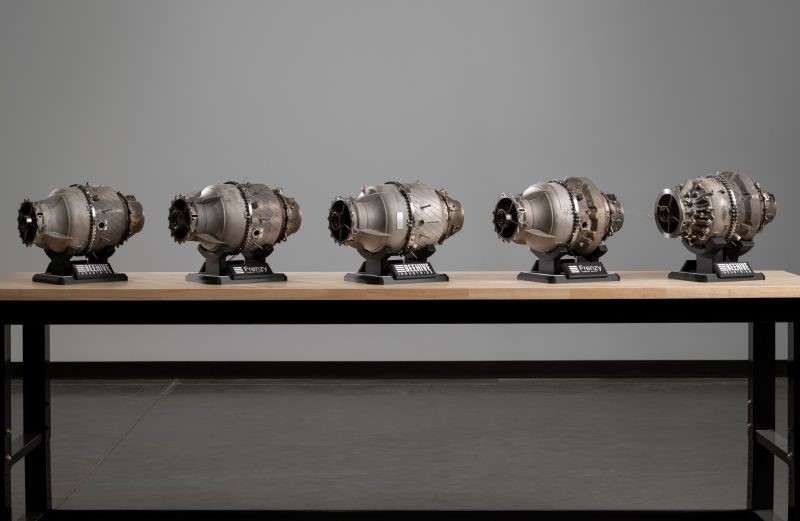
Beehive Industries has reduced its Frenzy turbojet to roughly 40 parts, including bolts and washers, but consolidation alone does not establish a production system. The U.S. company expects to manufacture hundreds of the engines in 2026, several thousand in 2027 and potentially 10,000 in 2028. That ramp will test whether an additive-first design can repeatedly deliver controlled dimensions, material properties and assembly quality across thousands of small gas turbines.
The central tension is between speed and repeatability. Chief Product Officer Gordie Follin said Beehive took its first engine from a clean-sheet design to initial testing in seven months after building and testing several demonstrators. The company has also run short manufacturing exercises in which it practiced producing many engines over one- or two-week periods. Neither achievement, however, provides a disclosed sustained production rate, yield figure or independent durability result.
Consolidation shifts the manufacturing problem
Frenzy was designed around additive manufacturing rather than converted from a conventional engine architecture. Follin estimates that a conventionally manufactured equivalent would contain about 400 parts. He said Frenzy’s turbomachinery uses five parts instead of approximately 200.
The most consequential example is a printed center frame combining the compressor diffuser, combustor case, combustor liner, bearing housings, first-stage turbine nozzle, fuel nozzles and fuel manifold. Combining those functions can remove joints, fasteners, separate tooling operations and assembly steps. It also concentrates manufacturing risk: a dimensional defect or material nonconformance in one region may affect a component carrying several critical functions rather than one replaceable piece.
Part count therefore matters less than process control. A consolidated engine still requires repeatable powder handling, build parameters, thermal management, post-processing and inspection. The information available does not specify Frenzy’s alloys, printing equipment, acceptance limits, production yield or inspection regime, leaving the repeatability of the proposed ramp unconfirmed.
Printed metal is only one route
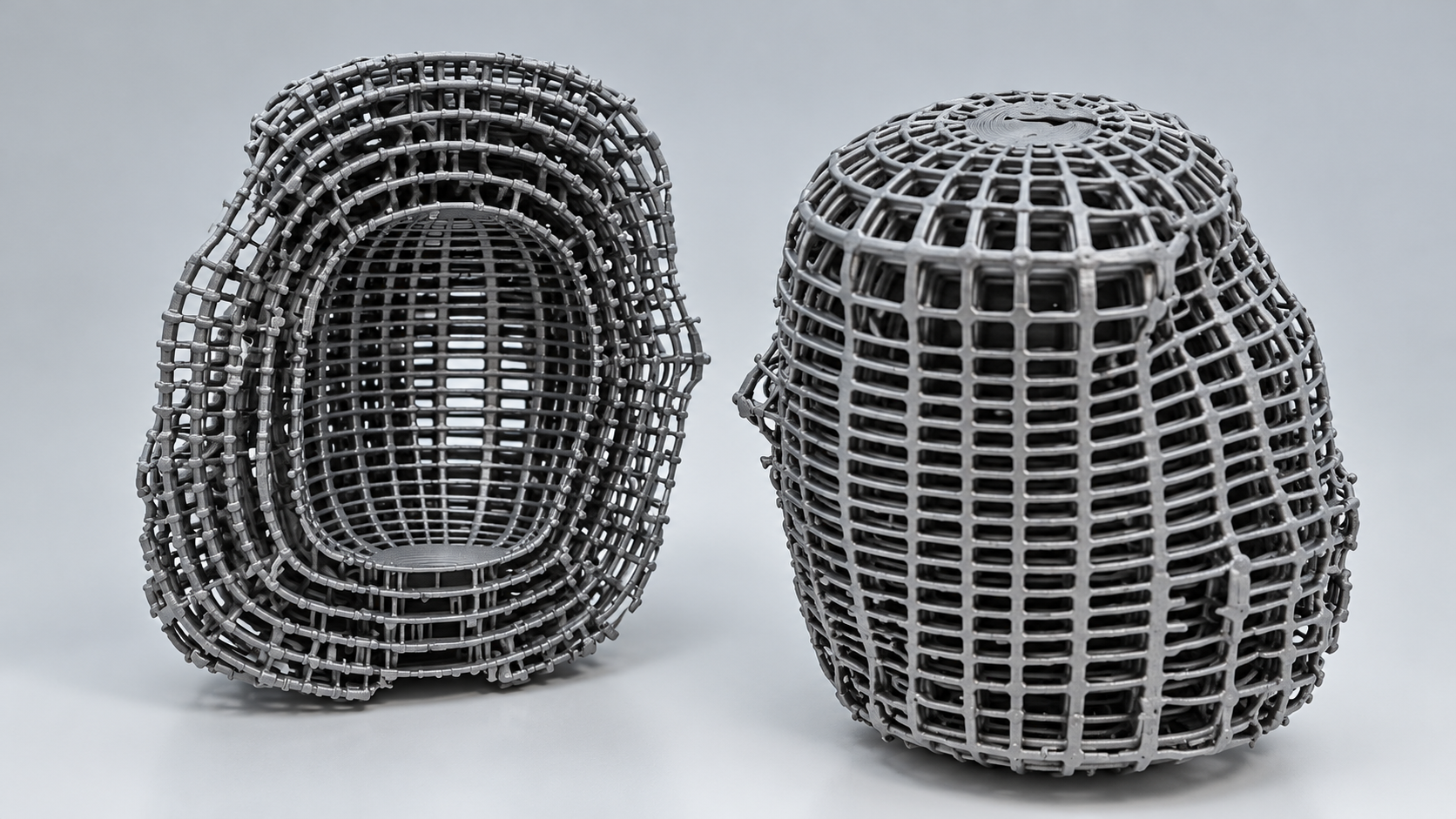
Beehive uses powder-bed fusion for direct metal components, but its production plan is not based on printing every feature. The company also prints ceramic casting molds directly, bypassing the conventional sequence in which wax patterns are produced before the ceramic mold is built. It recently added in-house metal-pouring capability, giving the manufacturing team a choice between direct printing and casting as volumes increase.
Follin said printed and cast turbine units currently cost Beehive approximately the same internally and perform the same. Those are company statements, not independently verified comparisons. No supporting cycle-life data, test conditions, cost breakdowns or material-property results have been disclosed.
The dual-route approach is nevertheless mechanically significant. Direct metal printing can support rapid design changes and highly integrated internal geometry, while directly printed ceramic molds provide a route to casting components without returning to traditional pattern tooling. If both processes can be held to equivalent requirements, Beehive could allocate parts according to machine availability, throughput and geometry rather than committing the entire engine to one manufacturing method.
Machining remains at the tolerance boundary
Frenzy also illustrates why additive manufacturing does not eliminate conventional finishing. Beehive still machines regions with extremely tight tolerances or high stresses, including turbine-blade tips and shaft interfaces. These surfaces influence rotating clearances, alignment and mechanical load transfer, making controlled finishing essential regardless of how the near-net-shape component is formed.
Machinists participate in Beehive’s design reviews, an arrangement intended to keep printable geometry compatible with later fixturing, tool access and precision finishing. Follin described the boundary between engineering and manufacturing as “essentially zero.” In practical terms, the production challenge is to preserve that feedback loop when output moves from short demonstrations to continuous manufacturing.
Qualification is another unresolved boundary. Applicable requirements will depend on the engine’s customer, installation and intended use, and no Frenzy certification or qualification status has been provided. As a broader indication of the rigor involved in U.S. military engine programs, the Defense Logistics Agency’s engine control and accessory qualification standard describes formal planning and testing needed for preliminary flight and production-release ratings for covered components. It should not be read as confirmation that Frenzy is subject to that particular standard, but it demonstrates that manufacturing readiness and flight qualification are separate milestones.
Beehive’s proposed 2028 output of as many as 10,000 engines is consequently more than a capacity target. Reaching it would require the company to show that its 40-part architecture, printed ceramic molds, in-house pouring and selective machining can produce conforming hardware at sustained rates. Until production yields, material specifications, qualification results and independent performance data are available, the most important Frenzy result remains ahead: proving that a design built quickly can also be built repeatedly.
| More aerospace and engineering stories, right in your MSN feed. Follow AMI on MSN |
By Edward Collins — Senior editor for AMI’s performance systems and mechanical design coverage, focused on powertrains, drivetrain systems, manufacturing precision, materials, and high-performance engineering.