NASA Launches Roman Telescope to Survey Cosmos 1,000 Times Faster Than Hubble
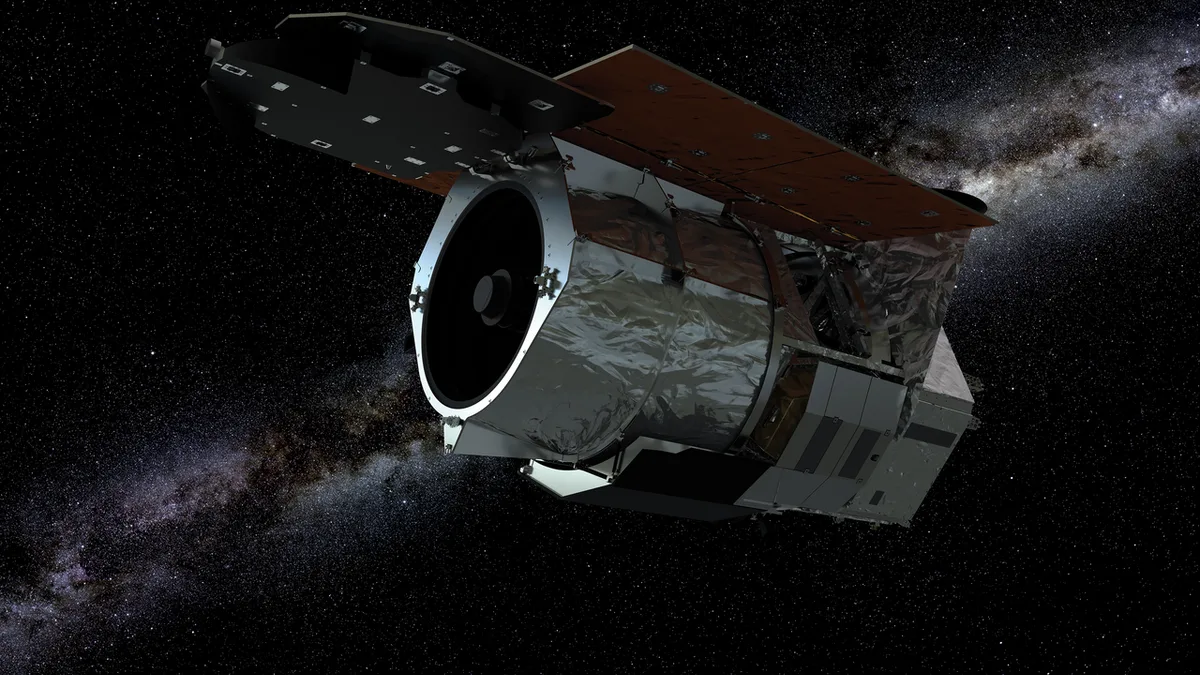
NASA has launched the $4.3 billion Nancy Grace Roman Space Telescope, beginning a mission expected to survey broad regions of the cosmos about 1,000 times faster than Hubble. The observatory lifted off aboard a SpaceX Falcon Heavy from Kennedy Space Center at 7:26 a.m. EDT on August 30, according to NASA’s launch update.

That speed is projected, not yet demonstrated in space. Roman is traveling roughly 1 million miles toward the second Sun-Earth Lagrange point, or L2, where it must complete three to four months of subsystem checks and instrument calibration before science operations begin. NASA anticipates releasing the telescope’s first images in early 2027.
A wide-angle counterpart to Hubble
Roman and Hubble have primary mirrors of the same 7.9-foot diameter, but they are configured for different jobs. Hubble specializes in detailed observations of comparatively narrow targets. Roman is designed to retain similar sharpness at near-infrared wavelengths while capturing a much larger section of the sky in each exposure.
The difference comes from Roman’s shorter focal length, three-mirror optical arrangement and large focal plane. Its 300-megapixel Wide Field Instrument uses 18 detectors and covers a field approximately 200 times larger than Hubble’s infrared camera while providing comparable spatial resolution. In practical terms, Hubble needed 432 pointings to cover roughly the same area Roman is designed to capture in two.
This is why the 1,000-times-faster figure should be understood as survey performance, not simply a claim that Roman takes an individual picture 1,000 times faster. Its advantage comes from covering far more sky per pointing, moving efficiently between observations and transmitting the resulting data at high rates. Hubble remains better suited to some narrow-field work, including higher-resolution spectroscopy and ultraviolet observations.
A reconnaissance-era mirror adapted for astronomy
Roman’s primary mirror was donated by the National Reconnaissance Office after being built for a classified project that was later canceled. The 410-pound mirror could not simply be installed unchanged. NASA had to modify the optical hardware for Roman’s instruments, thermal conditions and operating environment.
That adaptation gave NASA a large, lightweight mirror around which to build a survey observatory, but the camera and spacecraft systems ultimately determine how effectively Roman can exploit it. The Wide Field Instrument incorporates internal calibration hardware to monitor detector response over the mission, an important requirement when subtle differences in galaxy shapes and brightness are used to study dark matter and cosmic expansion.
Roman also carries a coronagraph equipped with deformable mirrors. It is intended to suppress stellar glare and demonstrate imaging of reflected light from Jupiter-size planets around nearby stars. This is a technology demonstration rather than Roman’s primary survey instrument, and its performance will also have to be established during commissioning.
The data system is part of the telescope
Roman’s planned output makes it as much a high-throughput data mission as an optical one. NASA expects the observatory to downlink about 2,500 terabytes during its five-year primary mission. By comparison, Hubble returned about 172 terabytes over its first 30 years. NASA expects Roman to transmit approximately 1.4 terabytes per day once fully operational.
That volume supports a different scientific purpose. One planned wide-area survey will cover 12% of the sky and catalog at least 1 billion galaxies over 520 observing days. Other programs will repeatedly monitor selected regions for short-lived events and examine the crowded central bulge of the Milky Way.
Those repeated, wide observations are intended to provide large statistical samples for studying dark energy, dark matter, galaxy formation and planets beyond the solar system. Roman is expected to discover more than 100,000 exoplanets during 18 months of observations, but those discoveries remain a mission projection rather than a completed result.
The launch removed one major source of program risk and placed Roman on its planned journey to L2. The next test is quieter but just as consequential: cooling and stabilizing the observatory, activating its instruments, calibrating 18 detectors and proving that repurposed optics and a high-volume spacecraft can produce the broad, sharp cosmic atlas the mission was built to deliver.
| More aerospace and engineering stories, right in your MSN feed. Follow AMI on MSN |
By David Whitaker — Associate editor for AMI’s aerospace and drone systems desk, translating flight systems, aircraft programs, spaceflight, and UAV developments into accessible technical stories.