NOAA Says Northern Lights May Reach Parts of 10 States Thursday
The northern lights may be visible from parts of 10 states Thursday night, even though NOAA is not forecasting a strengthening geomagnetic storm. The agency’s predicted Kp index of five creates a possible viewing window across the northern edge of the contiguous United States, while much of Alaska has better odds.

The forecast is not a promise that everyone in those states will see an aurora. NOAA’s mapped lower-48 viewing area covers northern Washington, the northern tip of Idaho, northern Montana, a portion of Wyoming near the Montana border, North Dakota, northern South Dakota, northern Minnesota, the northern tip of Wisconsin, Michigan’s Upper Peninsula and northern Michigan. Alaska brings the total number of potentially affected states to 10.
Why a Kp-five forecast matters
The Kp index measures disturbances in Earth’s magnetic field on a scale running from zero to nine. As the number rises, the auroral oval generally becomes brighter, more active and capable of extending farther from the poles.
At Kp levels from three through five, NOAA says the aurora can move farther from the poles, brighten and show more motion and structure. For observers in a suitable location, the result can be “quite pleasing.” NOAA’s aurora-viewing guidance cautions that the relationship between Kp and the display’s latitude is approximate rather than exact.
That uncertainty is central to Thursday’s forecast. A Kp value describes broad geomagnetic activity; it does not determine whether clouds, haze, city lighting or local geography will block the view. At the southern edge of the predicted area, any aurora may also sit low on the northern horizon rather than appear directly overhead.
No geomagnetic storm is forecast for Thursday. Such storms can inject additional energy into Earth’s magnetic environment and produce stronger, more geographically extensive auroras. This forecast instead points to mild activity that may become visible from properly positioned northern locations without developing into a major space-weather event.
When and where to look
The usual best viewing period is approximately 10 p.m. to 2 a.m. local time. Observers should seek a dark location away from streetlights and other sources of light pollution, preferably with a clear view toward the northern horizon. A higher vantage point can help where trees, buildings or terrain would otherwise obstruct that view.
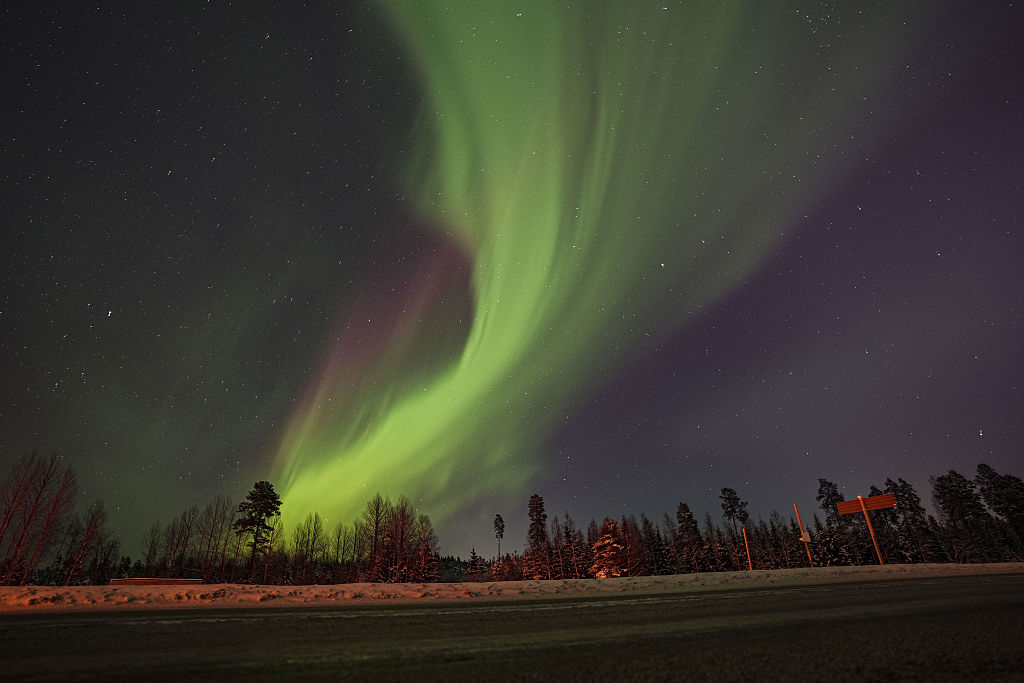
Darkness and at least partially clear skies remain essential. Even if the aurora is present, cloud cover can hide it completely, while ambient light can wash out a faint display. The human eye may initially perceive a weak aurora as a pale or grayish structure rather than the saturated green and purple commonly seen in long-exposure photographs.
Cameras can collect more light than the eye over a longer exposure. A wide-angle lens, low aperture setting and tripod can improve the chances of recording the display without excessive blur. Smartphone users can try night mode, brace the phone or place it on a stable surface, and keep the flash off; a flash illuminates nearby objects but does not help capture an aurora high in the atmosphere.
A second possible window Friday
Auroras form when particles from the sun interact with Earth’s magnetic field and upper atmosphere. The shape and reach of a display can change as those incoming conditions and Earth’s magnetic response evolve, which is why forecast boundaries should be treated as possible viewing zones rather than hard lines.
NOAA has also issued a Kp-five forecast for Friday, creating a second potential opportunity if Thursday’s clouds, lighting or timing prove unfavorable. Activity is expected to taper as the sun moves farther from the peak of its roughly 11-year cycle, making each favorable combination of geomagnetic activity, darkness and clear weather increasingly important for lower-48 observers.
For Thursday night, geography is the firmest limitation: Alaska offers the stronger probability, while viewers in the named northern sections of the lower 48 will need a dark sky, a clear northern horizon and favorable local weather to turn NOAA’s Kp-five forecast into an actual sighting.
| More aerospace and engineering stories, right in your MSN feed. Follow AMI on MSN |
By David Whitaker — Associate editor for AMI’s aerospace and drone systems desk, translating flight systems, aircraft programs, spaceflight, and UAV developments into accessible technical stories.