


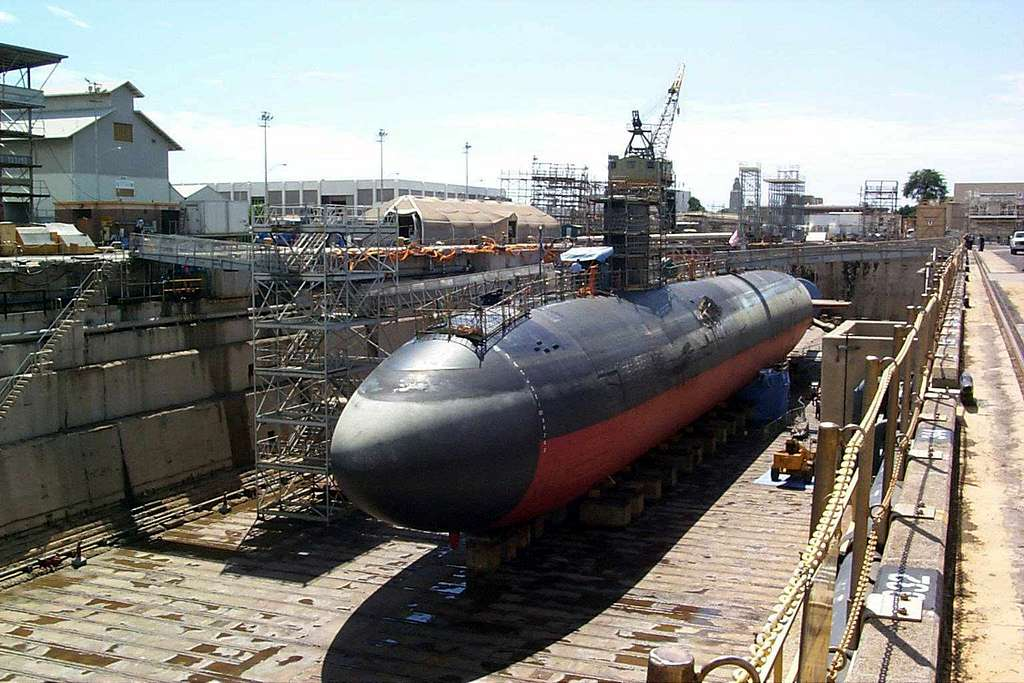
Navy Could Spend $3.1 Billion Supporting 15 Idle Submarines
$3.1 billion is the projected cost of operating and supporting 15 U.S. Navy attack submarines that could sit idle while awaiting retirement through fiscal 2030. The Government Accountability Office said on August 27 that, without mitigation, those boats could accumulate more than 14,000 additional days of inactive idle time from fiscal 2026 through 2030.

The projection does not mean the money has already been spent, nor that the submarines have completed decommissioning. It identifies the potential bill for keeping crews and nuclear-powered vessels supported after they have been designated for retirement but before a shipyard dry dock can accept them for inactivation.
Retirement still requires scarce industrial capacity
A submarine removed from operational plans cannot simply be tied to a pier and abandoned. Its inactivation remains a controlled engineering and maintenance job, including the eventual defueling of its nuclear reactor. Under the Navy’s current process, that work depends on dry-dock access the same broad category of constrained infrastructure needed to maintain and repair the service’s 44 active attack submarines.
That creates the central capacity tradeoff. Assigning dock time, skilled labor and planning resources to a retiring boat can compete with work on submarines expected to return to operations. Delaying retirement work avoids that immediate demand, but it leaves the Navy paying to support a vessel that provides no operational capability. Either path consumes resources unless the inactivation process or available capacity changes.
GAO distinguishes this inactive idle time from active idle time. An inactive boat has been designated for decommissioning but cannot enter a dry dock for inactivation. Active idle time applies to an operational submarine waiting for maintenance. The distinction matters because only the latter is intended to return to service, although both can generate support costs and place demands on personnel and waterfront facilities.
A decade of delays shows the cost pattern
GAO analyzed Navy maintenance data covering fiscal 2016 through 2025. Across that period, maintenance delays and idle time cost the active attack-submarine fleet more than 15,000 operational days. Sustaining crews and submarines that provided no operational capability produced an estimated $3.4 billion in costs.
The new five-year projection is therefore not an isolated accounting estimate. More than 14,000 additional inactive-idle days by fiscal 2030 would approach the operational time lost across the preceding decade, although the two figures measure different categories. The comparison shows how retirement scheduling can become a fleet-management burden rather than a narrow disposal task.
For taxpayers, the fairness issue is straightforward: support spending continues even when the vessel cannot contribute operational availability. For sailors and shipyards, however, reducing that spending is not as simple as removing people or accelerating nuclear work by directive. Crewing levels, reactor defueling and inactivation sequencing have safety, technical and workforce implications that require evaluation and risk controls.
GAO wants alternatives evaluated, not assumed
GAO found that the Navy had not fully evaluated alternative decommissioning methods or developed and implemented an inactivation plan capable of reducing inactive idle time. It recommended that the service examine options that could preserve shipyard capacity for operational submarines. Potential concepts included defueling submarines outside dry docks and reducing crews aboard boats awaiting decommissioning.
Those are options for study, not approved technical changes. Any workable approach would need to show that it can reduce cost and dock demand without transferring unacceptable risk to personnel, nuclear operations or the remaining maintenance system. GAO also called for an inactivation plan with objectives, implementation steps, timeframes, monitoring and risk-mitigation measures.
Infrastructure work can return individual facilities to service, but it does not by itself resolve fleetwide scheduling and process constraints. The Navy recently completed a $517 million seismic and operational modernization of Dry Dock 4 at Puget Sound Naval Shipyard. That project restored capacity with added structural resilience, while the broader submarine workload still requires decisions about which vessels enter limited docks and when.
Both GAO recommendations remained open. The Navy verbally concurred but did not submit written comments. The public document, GAO-26-109256, is a declassified version of a classified report issued July 16; operational-availability data and comparisons with strategic competitors were omitted. The next consequential step is a written, executable inactivation plan showing whether retirement work can be reorganized before 15 submarines turn more than 14,000 projected idle days into a $3.1 billion support bill.
| More aerospace and engineering stories, right in your MSN feed. Follow AMI on MSN |
By David Whitaker — Associate editor for AMI’s aerospace and drone systems desk, translating flight systems, aircraft programs, spaceflight, and UAV developments into accessible technical stories.



