


Velana Airport Reportedly Routes Restricted Aircraft Parts to Russian Airlines
An aircraft component can cross several borders without changing what it is, but each transfer can make its destination and end user harder to verify. That traceability problem is now centered on Velana International Airport in Malé, where aviation spare parts, electronics and other Western-restricted goods are reportedly being transferred for onward carriage to Moscow.

The reported route could ease maintenance pressure on Russian airlines operating Western-built aircraft after losing direct access to many parts and services. Cargo originating in the United States, Europe and China is reportedly processed through local intermediaries before being placed on Aeroflot’s regular commercial flights from the Maldives to Russia. S7 Airlines and affiliated maintenance businesses are identified as recipients of some products, although no underlying customs records or shipment-by-shipment documentation have been made public.
For an airline, access to spare parts is a fleet-availability issue rather than a simple purchasing concern. Aircraft already in service require a continuing flow of replacement hardware and electronic components. If an approved item is unavailable, the practical consequences can include longer maintenance intervals on the ground, reduced access to serviceable equipment and greater pressure on the operator’s existing component inventory.
That helps explain why indirect aviation supply chains matter even when their total volume is modest compared with broader trade routes. The Maldives channel is described as smaller than the principal flows through China, Turkey and the United Arab Emirates, which reportedly account for about $15 billion in restricted goods entering Russia annually. Yet specialized aircraft parts can carry operational value disproportionate to their size or weight because one unavailable component may prevent an aircraft from returning to service.
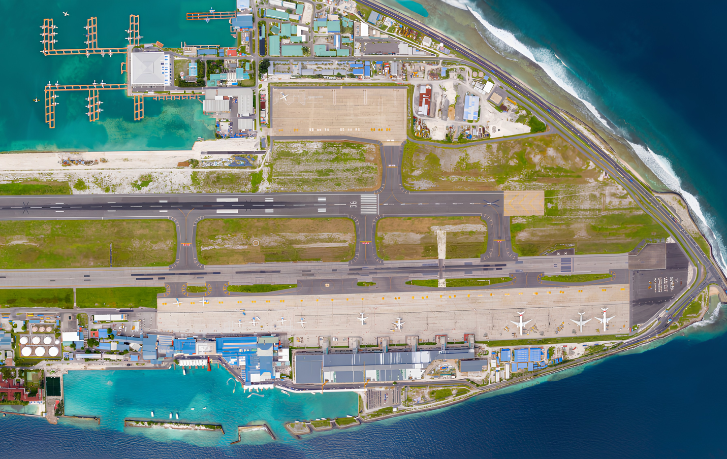
Velana also has the physical cargo operation needed to function as a transfer point. Figures released by Maldives Airports Company Limited and reported locally show that the airport handled 18,457 metric tons of cargo in the second quarter of 2026. That included 3,650 metric tons of transshipment cargo, with most of it moving through air-to-air transfers. Those totals establish that Velana has a substantial and growing transfer business, but they do not independently identify restricted Russian-bound shipments.
The larger enforcement challenge is documentation. Export controls depend on accurate declarations of the buyer, destination, item classification and intended end use. When cargo passes through another country and changes handlers, authorities and manufacturers must reconcile records across multiple companies and jurisdictions. A transit airport’s involvement alone does not establish that its operator knew a shipment was restricted or that every item in a mixed cargo stream violated a particular rule.
A recent U.S. prosecution illustrates why declared destinations receive scrutiny. A federal jury convicted a Florida resident on 12 counts in a scheme involving more than $900,000 in aircraft parts sent to Russia and Aeroflot. According to the Justice Department’s case summary, U.S. suppliers were led to believe that parts were destined for other countries. That conviction is separate from the reported Maldives activity, but it confirms that aviation components and inaccurate destination information are active U.S. export-enforcement concerns.
The value of goods said to have moved through Malé remains less certain. The route has been credited with handling hundreds of millions of dollars in products, but that figure is an estimate rather than an audited total. No precise amount, customs dataset or itemized accounting has been released. A separate estimate that Russia spent roughly $130 billion more from 2022 through 2025 to obtain prohibited Western products also lacks a disclosed methodology and should not be treated as a verified aviation-parts figure.
Claims about military relevance require similar restraint. Some electronics and other products may have both civilian and military applications, but no specific dual-use component or ultimate military use has been documented for the reported Malé shipments. The confirmed industry question is narrower: whether the route is supplying sanctioned commercial airlines and maintenance organizations with parts that are difficult to purchase directly.
Neither the Maldivian government nor Velana International Airport’s operator commented on the allegations. Without customs declarations, serial or part-number records, consignee documents and official findings, the reported scale and recipients cannot be independently confirmed. Those records are also what would determine whether Velana was merely a transfer location or part of a supply chain knowingly moving restricted aviation hardware to Russian operators.
| More aerospace and engineering stories, right in your MSN feed. Follow AMI on MSN |
By David Whitaker — Associate editor for AMI’s aerospace and drone systems desk, translating flight systems, aircraft programs, spaceflight, and UAV developments into accessible technical stories.




