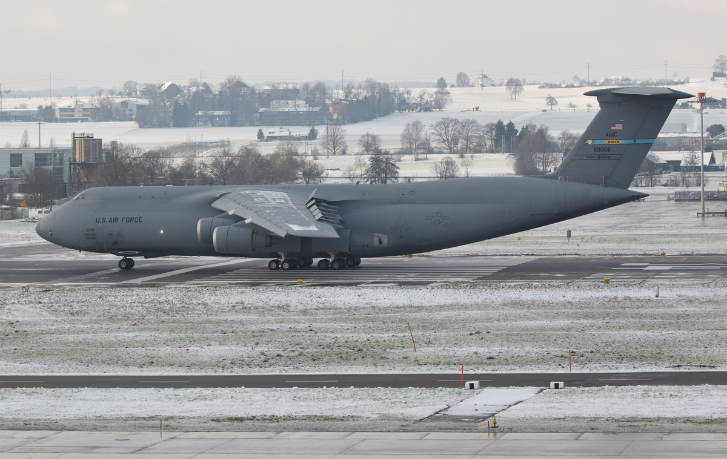
Dover’s C-5M Engine Tool Could Cut Rigging Labor From 200 Hours to 16
Two hundred labor-hours versus 16: that is the potential maintenance reduction behind a six-gauge engine-rigging set developed at Dover Air Force Base for the C-5M Super Galaxy. The comparison comes from Senior Master Sgt. Chad Bryant, who said the existing technical-order procedure requires five maintainers working about 40 hours, while the prototype could let two maintainers finish during one eight-hour shift.

That projected reduction from roughly 200 combined labor-hours to 16, and from about 40 elapsed hours to eight has not yet been validated as a fleetwide result. The tooling still requires further testing, and the Air Force Reserve Command’s Aug. 28, 2026, update did not report its approval for inclusion in the applicable maintenance technical orders.
Bryant and Master Sgt. Tyler Dickson of the 512th Maintenance Squadron developed the set over several weeks with help from civilian propulsion technicians assigned to the 436th Maintenance Squadron. Dickson fabricated the prototype gauges in Dover’s base machine shop, giving the project a direct line from maintenance-floor experience to locally produced tooling.
Six gauges for a difficult adjustment
The set is designed to support rigging of the variable stator vane lever linkages on the C-5M’s F-138-GE100 engines. Variable stator vanes change their angle as engine conditions vary, helping manage airflow through the compressor. Their linkage must be adjusted so vane position corresponds correctly with the mechanism controlling it.
Rigging is fundamentally a calibration task. Variable vanes are connected through levers and a surrounding ring so actuator movement changes their angle together. Gauges provide known reference positions while maintainers check and adjust that relationship. On the C-5M, the work is complicated by restricted access around the installed hardware, increasing both the ergonomic burden and the time required to make and verify adjustments.
The prototype’s practical value is not simply that a gauge can measure a position. Its six pieces are intended to establish the required references more efficiently, reducing the number of people and repeated manipulation needed around the linkage. Bryant also said the approach could minimize damage to hardware and difficult-to-procure parts. That remains part of the team’s expected benefit rather than an independently documented service result.
The underlying engine function makes accuracy consequential. Variable stator vanes help keep compressor airflow within an acceptable operating range as engine speed and airflow change. Bryant said a failure of the system could cause a compressor stall that may cause a lot of expensive damage and cause the engine to shut down. His statement describes the reason for careful rigging, not a finding that the current maintenance procedure is unsafe.
An older concept adapted to the modernized Galaxy
Bryant based the design partly on a similar rigging set used for the TF-39 engine installed on the earlier C-5B Galaxy. That makes the project an adaptation rather than an entirely new maintenance principle: a proven tooling concept from an older engine installation has been reworked for the geometry and requirements of the C-5M’s F-138-GE100.
Dickson machined the prototypes from available 7075 aluminum, a relatively inexpensive material that allows the team to evaluate fit and repeated use before committing to a more costly solution. Material durability is one of the open questions. If after multiple uses, we start to see fatigue, we’ll switch to something more durable and expensive like stainless steel, Dickson said.
That choice reflects a conventional prototype tradeoff. Aluminum makes early fabrication and design changes more manageable, while stainless steel could provide greater durability if testing shows that repeated loading or handling degrades the gauges. No fatigue result has yet been reported, so a material change remains conditional.
Testing and documentation are the adoption gate
Interest from other C-5M maintenance professionals could broaden the testing base, but interest is not approval. For standardized use, the tooling and its procedure would need to pass evaluation and ultimately be incorporated into the relevant maintenance documentation. The Air Force’s technical-order system governs approved procedures for equipment maintenance, modification and inspection; a locally successful tool does not automatically become an authorized fleet procedure.
The next meaningful result, therefore, is not another estimate of saved hours. It is repeated testing that establishes whether the six gauges hold their dimensions, reduce labor without compromising the required rigging accuracy, and avoid damage over multiple uses. Only then can the claimed shift from five maintainers and 40 hours to two maintainers and eight hours move from a promising Dover prototype toward a documented C-5M maintenance standard.
| More aerospace and engineering stories, right in your MSN feed. Follow AMI on MSN |
By David Whitaker — Associate editor for AMI’s aerospace and drone systems desk, translating flight systems, aircraft programs, spaceflight, and UAV developments into accessible technical stories.