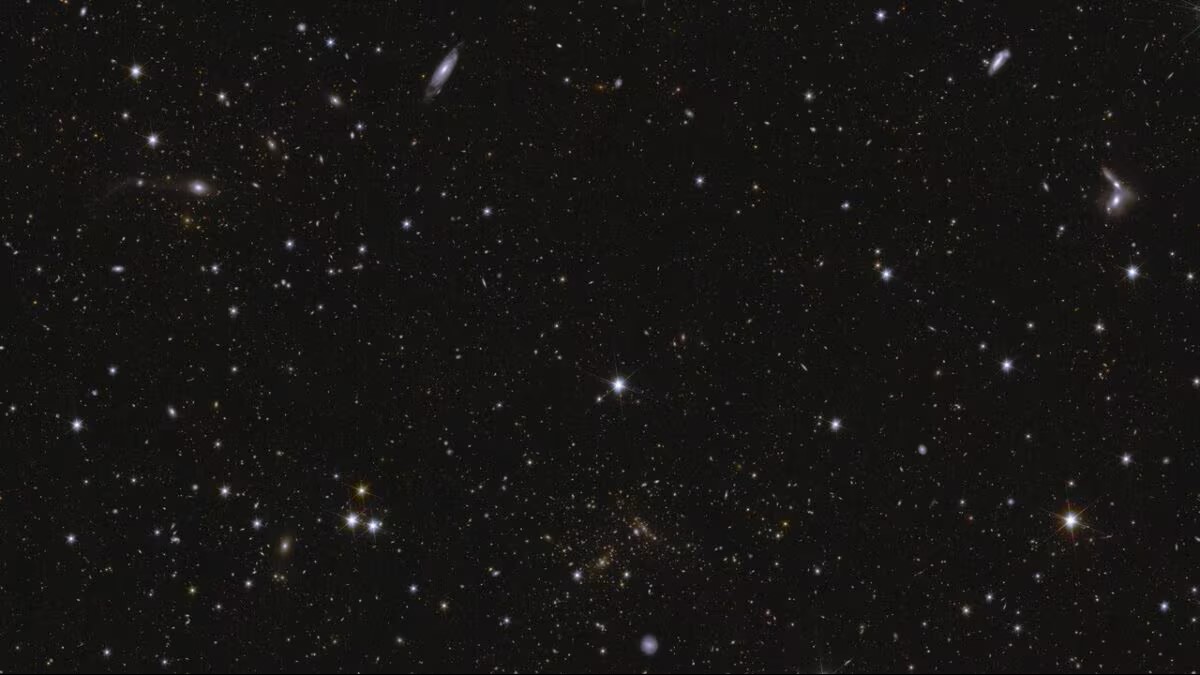
Euclid Finds Most Distant Quasar, Revealing a Billion-Sun Growth Problem
A black hole with roughly a billion times the sun’s mass was already powering a brilliant quasar when the universe was only several hundred million years old. Researchers using the European Space Agency’s Euclid space telescope have identified it as the most distant known quasar and exposed a basic timing conflict in conventional estimates of black-hole growth.
The result, announced September 1, comes from observations of 31 quasars dating to 600 million to 800 million years after the Big Bang, when the universe was about 5% of its current age. Xiaohui Fan, a University of Arizona astronomy professor involved in the international research team, said the record quasar also corresponds to the most distant very massive black hole currently known.
The black hole appears older than its available growth time
Quasars are extraordinarily bright galactic cores powered by matter falling toward massive black holes. Although black holes emit no light directly, surrounding gas can heat up and radiate as it moves through an accretion disk. Fan said quasars can shine 1,000 to 10,000 times more brightly than the Milky Way, making them powerful markers of otherwise extremely remote objects.
The difficulty is not simply that the early black holes were large. It is that they became large so quickly. Fan said a conventional model beginning with a black-hole seed created by the collapse of a massive star could require a billion years or more to produce a black hole with a billion solar masses. The observed quasars existed when the universe was substantially younger than that estimate.
That mismatch does not establish how the black holes formed. It instead narrows the problem that growth models must solve: either the initial seeds were more massive, growth proceeded more quickly than the conventional estimate allows, or other processes contributed. Direct observations of the relevant formation mechanisms remain elusive, so the Euclid result should not be read as proof of any one alternative.
There is another measurement constraint. Astronomers infer black-hole properties from the light and spectra of the surrounding quasar, rather than observing the black hole itself. Mass and accretion estimates therefore retain some dependence on astrophysical models. The robust result is that Euclid has located a population of exceptionally early, luminous quasars, including the current distance record; the precise growth history remains unresolved.
Euclid trades close-up detail for survey speed
The discovery plays directly to Euclid’s wide-field survey design. Its instruments observe visible and near-infrared light, and Fan described the telescope as carrying a 600-million-pixel camera. Operating above Earth’s atmosphere gives it sharper, more stable imaging than ground-based sky surveys and lets researchers search large areas efficiently for faint, distant objects.
Euclid is not optimized to resolve the same fine detail as a larger observatory such as the James Webb Space Telescope. Its advantage is coverage. ESA says a single Euclid observation records an area of sky more than 100 times larger than Webb’s Near-Infrared Camera can image at once. The mission is designed to map roughly one-third of the sky over six years.
That distinction matters for early-quasar research. A telescope that surveys quickly can identify rare candidates across a broad field and build a larger, more consistently selected sample. More targeted instruments can then provide detailed follow-up observations. Euclid’s 31-object result demonstrates that a mission built primarily to map dark matter, dark energy and the large-scale structure of the universe can also function as a high-output discovery platform for early black holes.
The sample may also help researchers determine whether these luminous objects were extraordinary exceptions or signs of a broader early population. Selection naturally favors the brightest quasars, so the 31 detections cannot by themselves show how common less luminous black holes were. They do, however, give astronomers more objects against which to test growth models than a single record holder could provide.
Fan said the distant quasars have properties and light spectra surprisingly similar to much closer quasars. Young galaxies can differ markedly from mature systems such as the Milky Way, yet these early galactic cores already resemble their later counterparts. As more Euclid data arrive, Fan expects the survey to find quasars at still greater distances. Each new record will reduce the time available for growth and make the billion-solar-mass clock harder to reconcile.
| More aerospace and engineering stories, right in your MSN feed. Follow AMI on MSN |
By David Whitaker — Associate editor for AMI’s aerospace and drone systems desk, translating flight systems, aircraft programs, spaceflight, and UAV developments into accessible technical stories.