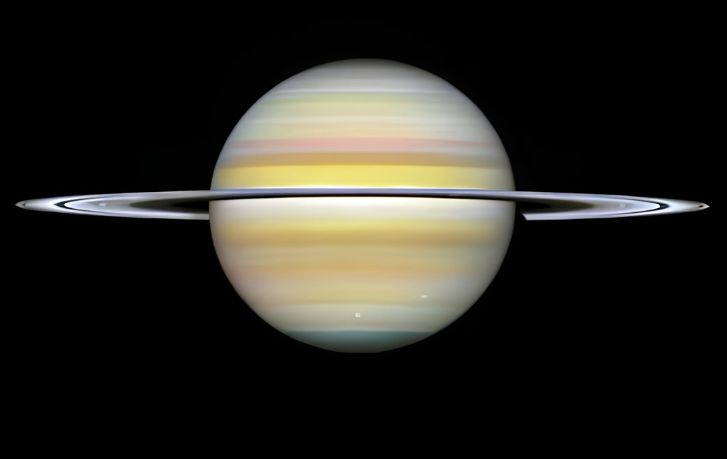
Hubble Confirms 104,250-Mile Saturn Decagon Wider Than Earth
Saturn now has two immense geometric weather patterns, but they are not twins. The Hubble Space Telescope has confirmed a 10-sided atmospheric wave spanning 104,250 miles (167,820 kilometers) around the planet’s south pole far wider than Earth and more than five times the reported width of Saturn’s famous northern hexagon.
The difference is not just size or the number of sides. The roughly 20,000-mile-wide northern hexagon has remained observable for more than four decades, while the southern decagon appears to have emerged recently and is still evolving. Researchers do not yet know what formed it or whether it will settle into a similarly durable configuration.
Announced on September 2, the finding came from a combination of ground-based astronomy and Hubble’s long-running observations. Agustín Sánchez-Lavega and amateur astronomers Trevor Barry and Jean-Paul Oger first noticed a subtle, undulating southern band in ground-based images submitted to the Planetary Virtual Observatory Laboratory in 2024. Higher-resolution Hubble data then established that the feature was already present in 2023 and became more clearly defined afterward, according to NASA’s account of the discovery.
A much larger counterpart with a shorter record
Both polar formations are waves embedded within powerful Saturnian jet streams. The newly characterized decagon is centered near 63 degrees south latitude and extends through multiple atmospheric layers. Hubble observes Saturn through different filters that probe different altitudes, and the wave’s apparent position shifts slightly between those wavelengths. That indicates a vertically extended structure rather than a simple outline confined to one visible cloud deck.
The northern hexagon provides a striking contrast. Voyager spacecraft first detected that six-sided jet-stream pattern during their Saturn encounters in 1980 and 1981. Cassini later observed it in greater detail during its 2004-2017 mission, establishing a long record of a roughly symmetric formation that remained active through changing seasons.
No comparable southern structure had passed the same test. Sánchez-Lavega’s team had searched Hubble imagery dating to 1990, while Cassini images showed no evidence of a long-lived southern counterpart. That history makes the decagon’s apparent arrival significant: scientists may be observing the development of a giant polygonal wave rather than rediscovering a permanent feature hidden by poor viewing conditions.
Saturn’s seasonal geometry helped make that comparison possible. As the planet’s changing orientation gradually returned its southern polar region to view from Earth, ground observers could detect the initial disturbance. Hubble then supplied sharper images over complete Saturn rotations without the atmospheric blurring that affects Earth-based telescopes.
Why repeated observations matter
The confirmation demonstrates the value of Hubble’s Outer Planet Atmospheres Legacy program, which has photographed the outer planets annually for more than a decade. A single image might have recorded an unusual band without establishing its geometry or development. Observations spread across 2023, 2024 and 2025 instead showed a feature growing more distinct over time.
That continuity is particularly important after Cassini. The spacecraft provided close-range observations from Saturn orbit, but its mission ended in 2017. Hubble cannot reproduce every advantage of an orbiting planetary probe, yet its stable observing program can identify slow atmospheric changes and direct other observatories toward features that warrant closer study.
The decagon also changes the comparison scientists can make. Saturn’s northern hexagon is no longer the planet’s only known large, regular-sided jet pattern. Sánchez-Lavega said the southern finding suggests the hexagon “is not as extraordinary as previously thought.” That does not mean the two structures share the same cause, stability or life span; it means researchers now have a second natural example against which atmospheric models can be tested.
The next requirement is time. Additional Hubble observations, possible work with the James Webb Space Telescope and computer modeling could determine whether the decagon stabilizes, weakens or keeps changing. As study co-author Amy Simon put it, the unresolved issue is why the pattern appeared now after earlier searches found nothing. Saturn’s northern hexagon has survived decades of observation. The southern decagon has only begun that test.
| More aerospace and engineering stories, right in your MSN feed. Follow AMI on MSN |
By David Whitaker — Associate editor for AMI’s aerospace and drone systems desk, translating flight systems, aircraft programs, spaceflight, and UAV developments into accessible technical stories.