Ukraine Accelerates Interceptor Production as Jet-Powered Shahed Drones Get Harder to Stop
Ukraine has interceptor-drone prototypes, but faster jet-powered Shahed attacks are increasing the pressure to turn those prototypes into effective and affordable defenses that can be manufactured in useful numbers. The immediate constraint is no longer simply whether a high-speed interceptor can fly. It is whether developers can mature the design, demonstrate adequate performance and establish repeatable production quickly enough to meet a growing air-defense requirement.

At a Sept. 3 meeting of Ukraine’s Supreme Commander-in-Chief’s Staff, officials set tasks and deadlines intended to accelerate production processes for high-speed interceptor drones. The meeting also addressed bringing more businesses into the production, supply and configuration of certain air-defense systems. The manufacturers, production targets, deadlines and prototype performance figures were not disclosed.
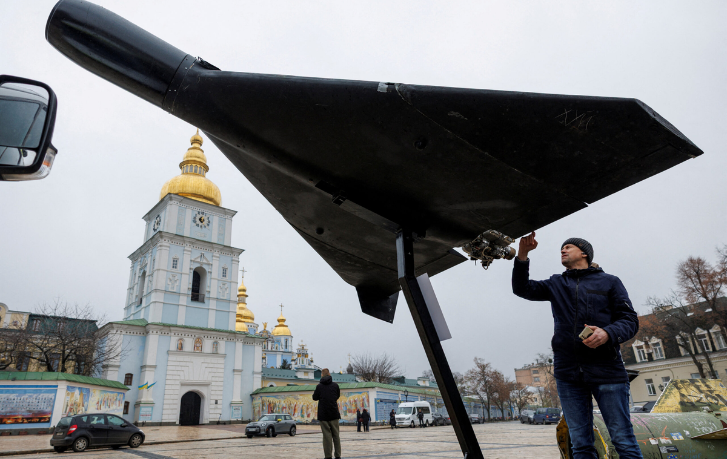
The push follows a reported increase in Russia’s use of jet-powered attack drones. Ukrainian Air Force spokesman Yurii Ihnat said five times as many were used in July as in June. Aviation expert Valerii Romanenko separately told Radio NV that Ukraine’s Shahed interception rate had declined from 90% to 76%, which he attributed to the faster models. He estimated that jet-powered Shaheds can travel at 300 to 450 kilometers per hour, compared with approximately 180 kilometers per hour for conventional versions. Those speeds and interception rates are attributed assessments, not independently verified performance findings.
Speed compresses the entire defensive process
A faster incoming aircraft reduces the time available for detection, identification, assignment and interception. That does not establish why any individual interception succeeds or fails, but it explains why simply having an interceptor prototype is insufficient. The complete system must perform reliably as a chain, including sensing, control, communications, launch preparation and the interceptor aircraft itself.
Higher speed also imposes design tradeoffs. Propulsion, aerodynamic control, onboard power, structural loads and guidance performance must remain compatible across the intended operating envelope. Manufacturers then have to reproduce that performance consistently rather than demonstrate it only with a small number of development aircraft. Ukraine says work is still underway to bring its prototypes to the required effectiveness level, indicating that design maturity remains part of the challenge alongside output.
One system has already progressed beyond the prototype-only stage. Ukraine’s Defense Ministry said the Defense Forces added the Ukrainian jet-powered Alexa Spatium interceptor to their arsenal on Aug. 21. A published description of the system, citing the ministry, identifies a composite airframe and a remotely prepared, catapult-launched configuration. It also says the aircraft measures approximately 1.5 by 1.7 meters. No production quantity, unit cost or independently verified operational-effectiveness figure was provided.
Manufacturing scale is a separate test
Moving from prototypes to sustained production requires more than adding assembly workers. Suppliers must deliver compatible propulsion units, composite structures, electronics and other components with controlled quality and predictable lead times. Configuration management also becomes important when several businesses participate: changes intended to improve one production batch must not create incompatible hardware, software or maintenance requirements elsewhere in the fleet.
That helps explain the Staff meeting’s focus on involving additional companies not only in production but also in supply and configuration. A broader industrial base can increase capacity and reduce dependence on one production line. It can also introduce variation unless specifications, acceptance testing and change control remain disciplined. The central industrial question is therefore how quickly Ukraine can expand output without allowing reliability or consistency to fall behind.
Cost adds another boundary. Ukrainian officials describe the objective as obtaining sufficient quantities of high-quality, high-speed interceptor drones and lower-cost missiles. That wording reflects the economics of repeated drone attacks: an interceptor can be technically capable yet remain difficult to field in adequate numbers if its components, manufacturing process or support burden are too expensive.
No public production goal or completion date currently shows how close Ukraine is to that balance. The next meaningful milestone will be evidence that manufacturers can move beyond individual prototypes and early fielded systems to repeatable output with demonstrated effectiveness and an affordable interception cost. Until those figures emerge, the Sept. 3 decision confirms urgency and industrial expansion but not yet the scale of the resulting defense.
| More aerospace and engineering stories, right in your MSN feed. Follow AMI on MSN |
By Stephen Wallace — Editor for AMI’s aerospace integration and unmanned mobility coverage, focused on drone manufacturing, VTOL systems, autonomous networks, and air-ground mobility links.