


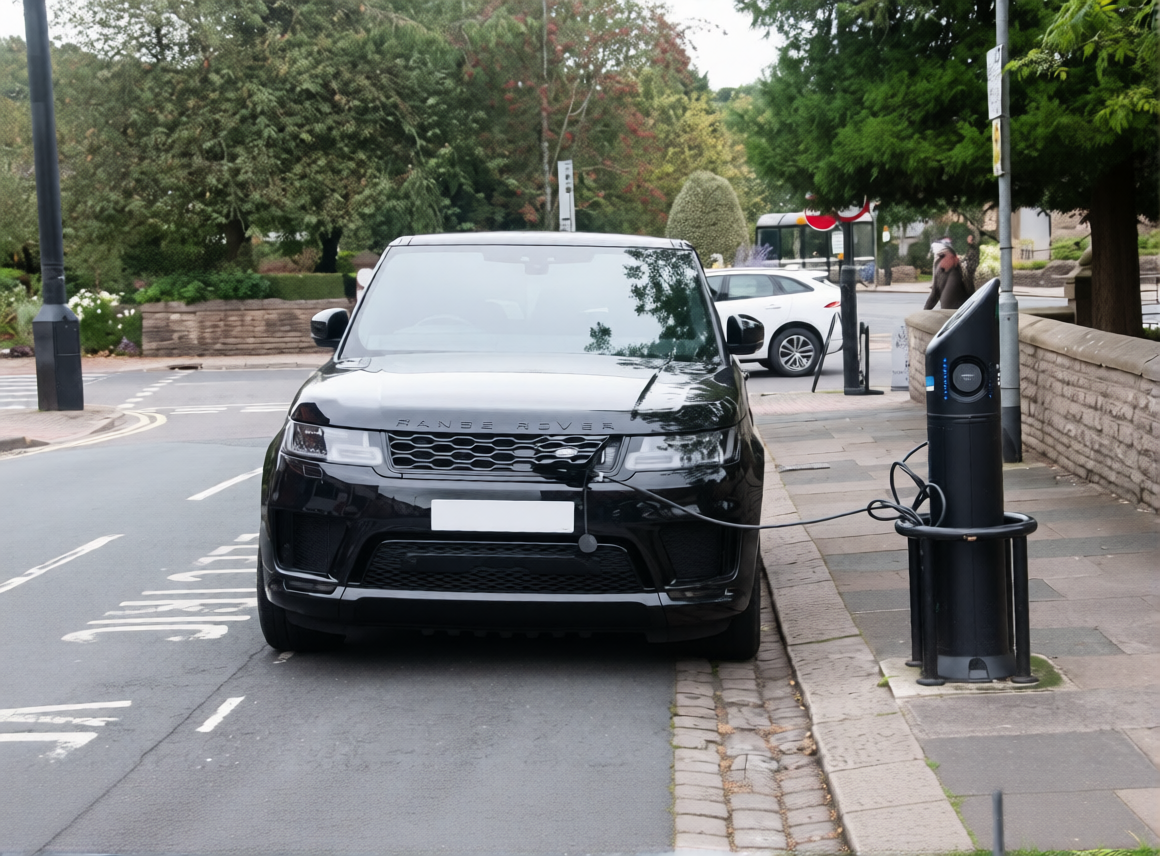
Range Rover Electric Claims 22-Minute Charging and Traction Control 100 Times Quicker
The Range Rover Electric’s traction system starts with a control advantage inherent to electric propulsion: its computers can alter motor speed without waiting for an engine, transmission and braking system to coordinate a response. Range Rover says its Integrated Traction Management operates within 50 milliseconds and manages slip 100 times quicker than the combustion-powered equivalent. That speed is intended to preserve controllability on loose surfaces rather than simply improve straight-line acceleration.

The traction software works with permanent-magnet motors at the front and rear. Together, the drive units produce 542 horsepower and 627 pound-feet of torque, supporting a claimed zero-to-60-mph time of 4.3 seconds. Intelligent Driveline Dynamics can vary the distribution of rear torque to prevent traction loss, while a single-pedal mode is designed to provide more precise low-speed control. Range Rover says the electric SUV can complete a rolling climb on slopes as steep as 45 degrees.
The important engineering distinction is response time. A combustion vehicle typically has to coordinate requested engine torque with gearing and brake intervention. An electric drive unit can change motor output directly, giving the controller a shorter path between detecting slip and adjusting torque. Range Rover’s 50-millisecond and 100-times-quicker figures are manufacturer claims, however, not results from an independent comparative test.
A battery designed around voltage and packaging
The traction system draws from a usable 118.5-kilowatt-hour battery operating at 800 volts. Its 344 prismatic cells are arranged into modules, with cell contacts positioned on the sides instead of the tops to reduce pack height. That matters in a vehicle adapted from a flexible architecture also used for combustion and plug-in-hybrid models, where preserving cabin dimensions and familiar exterior proportions constrains battery packaging.
The silicon carbide power electronics are contained in a separate housing above the battery. That housing is shaped to occupy space associated with a conventional transmission tunnel. Separating the electronics from the cell enclosure adds another packaging interface, but it allows JLR to use an existing structural volume while keeping the battery lower.
The 800-volt system supports a claimed 10-to-80-percent charging time of 22 minutes on a 350-kilowatt DC charger. More unusually, the pack can divide electrically into two 400-volt sections when connected to a 400-volt charger, avoiding the need to route charging power through a separate voltage-conversion stage. That split arrangement broadens charger compatibility without surrendering the lower current and high charging potential of an 800-volt propulsion architecture.
For U.S. drivers, the vehicle has a native North American Charging Standard port and access to compatible Tesla Superchargers. Range Rover’s U.S. product page lists up to 333 miles of estimated real-world range under the EPA framework, but actual range will depend on conditions and the final vehicle configuration. The published charging time also assumes a station capable of sustaining the required output and a battery at a suitable temperature and state of charge.
Refinement extends into production controls
Removing an engine does not automatically create a quiet luxury vehicle. Once combustion noise disappears, wind disturbance, tire noise and small structural vibrations become more noticeable. Range Rover reports a seven-decibel sound-level reduction compared with the combustion model, supported by acoustic window glass and aerodynamic development.
Some of the less visible work occurs on the production line. Glass alignment is scanned to maintain a flush exterior surface, and completed vehicles receive end-of-line wind-noise checks. Engineers also reinforced the door structure because the exterior mirror had to be mounted on the door to accommodate the frameless-window and A-pillar geometry. That reinforcement adds material and cost, but stabilizing the mirror limits small movements that can transmit vibration into the body.
A low-speed drive on JLR’s off-road course in Gaydon, England, indicated that the powertrain can deliver controlled progress over uneven terrain. It did not independently validate high-speed wind noise, the seven-decibel reduction or sustained fast-charging performance. Those claims will require instrumented testing in production vehicles.
U.S. pricing starts at $138,000 before applicable destination charges. At that level, the unresolved questions are measurable ones: whether customer vehicles reproduce the promised charging curve, how close they come to the 333-mile estimate, and whether the added structural and production controls maintain refinement after years of door use, weather exposure and off-road vibration.
| More aerospace and engineering stories, right in your MSN feed. Follow AMI on MSN |
By Robert McKinney — Editor-in-Chief for AMI’s automotive and mobility coverage, with a mechanical engineering background and a decade reporting on powertrain systems, EV innovation, and global vehicle manufacturing.


