Elroy Air Demonstrates Chaparral Cargo Handling Without Runways or Endpoint Crews
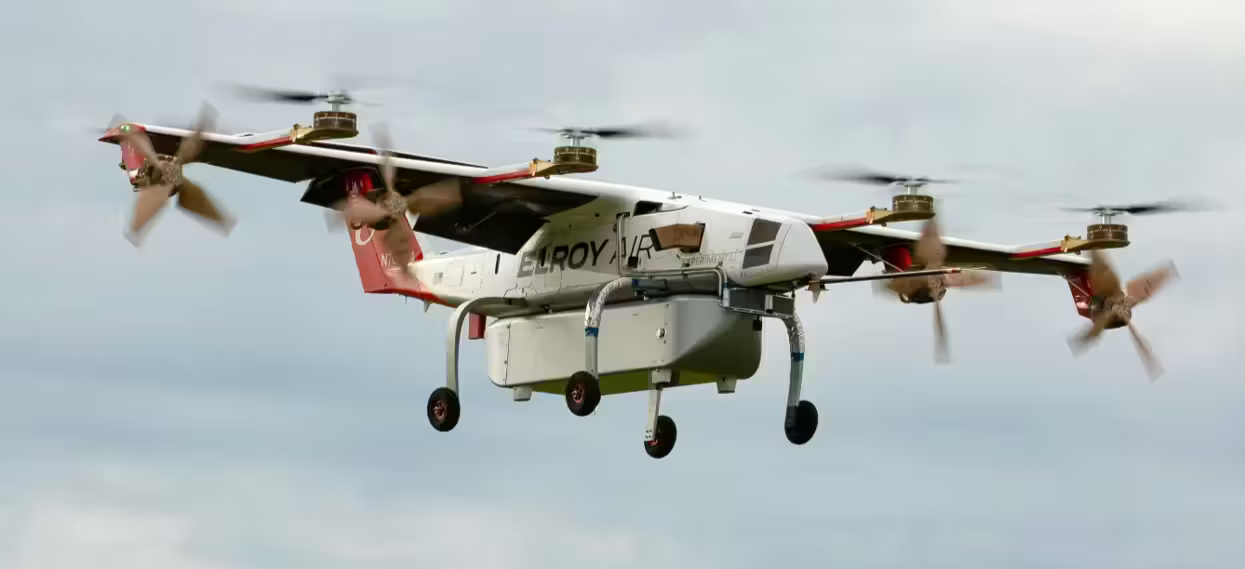
The defining mechanism in Elroy Air’s Chaparral is not simply autonomous flight. It is the aircraft’s ability to collect, secure, transport and release a cargo pod without conventional loading equipment or personnel handling the freight at either endpoint. Elroy Air demonstrated those unattended cargo-delivery modes for the U.S. Army on August 12, 2026.

That combination closes a significant gap in uncrewed logistics. A cargo drone may fly without an onboard pilot, but it still depends on ground crews if people must load and unload it. Chaparral instead carries a detachable pod beneath its fuselage and uses a robotic handling system to pick up, secure and release that pod autonomously. Vertical takeoff and landing removes the separate requirement for a runway.
Vertical lift and cruise serve different phases
Chaparral uses six lift propellers for takeoff, landing and other vertical-flight phases. A single pusher propeller provides thrust in forward flight. This distributed arrangement lets the aircraft rise from a site without runway infrastructure and then transition to wing-supported cruise, rather than relying on its lift propellers throughout the trip.
The aircraft’s hybrid-electric powertrain is intended to extend range beyond what a purely battery-powered design could provide. Electric propulsion can support the multiple independently driven propellers needed for vertical lift, while the hybrid architecture addresses the energy-storage constraint that limits many battery-only cargo aircraft. The tradeoff is a more complex aircraft with both electrical and fuel-based powertrain elements to integrate, monitor and maintain.
Elroy Air describes the design purpose as carrying cargo without a crew onboard, and without traditional airport infrastructure. For Army logistics, the potential benefit is reduced human exposure: supplies can move without putting pilots or truck crews aboard the delivery platform. The August demonstration confirmed unattended handling as a system function, but it did not establish operational fielding.
Range and payload claims remain design figures
The account of the Army demonstration gives a design target of roughly 300 pounds carried over about 300 miles. It does not say that the August event achieved that payload and distance, either separately or at the same time. Elroy Air subsequently published higher claimed specifications more than 500 pounds of payload and up to 450 miles of range but its September announcement likewise did not document a flight combining those maximum values.
That distinction matters because maximum payload and maximum range are generally boundary specifications, not necessarily one simultaneous operating point. The August disclosure did not provide the test payload, route distance, energy use, weather conditions or Army evaluation criteria. Without those results, the event supports a conclusion about integrated autonomous cargo handling, not validation of the aircraft’s full performance envelope.
The Army awarded Elroy Air a $46.1 million development and evaluation contract on August 17, with an initial $5.1 million obligation reported for fiscal 2026. The work is intended to support further testing and development. It should not be read as an Army production purchase, fielding decision or declaration that Chaparral is operationally ready. No production quantity or military service-entry date has been reported.
FAA flights add an airspace-integration test
Later in August, Chaparral also completed hybrid-electric cargo demonstrations at Houma-Terrebonne Airport in Louisiana. The Federal Aviation Administration identified the activity as the first remotely piloted aircraft test flight under its electric vertical-takeoff-and-landing Integration Pilot Program. Elroy Air later said the week included autonomous flights without a pilot aboard, conducted under air traffic control oversight.
Those Louisiana flights address a different integration problem from robotic pod handling. Unattended loading can reduce dependence on endpoint personnel, but routine U.S. operations also require procedures for air traffic coordination, operator responsibility and safe interaction with conventional aircraft. The FAA says it will use data from the demonstrations to identify gaps and improve procedures for integrating advanced aircraft into the National Airspace System.
Manufacturing is another boundary between demonstration and deployment. Kratos is identified as Chaparral’s exclusive U.S. manufacturer, with production planned at its Sacramento, California, facility. Elroy Air has said the first production aircraft is planned for late 2026, but that remains a company schedule rather than a confirmed Army delivery or operational milestone.
Chaparral has now shown the key mechanical sequence that distinguishes an unattended logistics aircraft from a pilotless transporter: autonomously taking custody of cargo and releasing it after flight. The next consequential evidence will be measured payload-and-range results, repeatability across operating conditions and the regulatory procedures needed to move that capability beyond controlled demonstrations.
| More aerospace and engineering stories, right in your MSN feed. Follow AMI on MSN |
By Stephen Wallace — Editor for AMI’s aerospace integration and unmanned mobility coverage, focused on drone manufacturing, VTOL systems, autonomous networks, and air-ground mobility links.