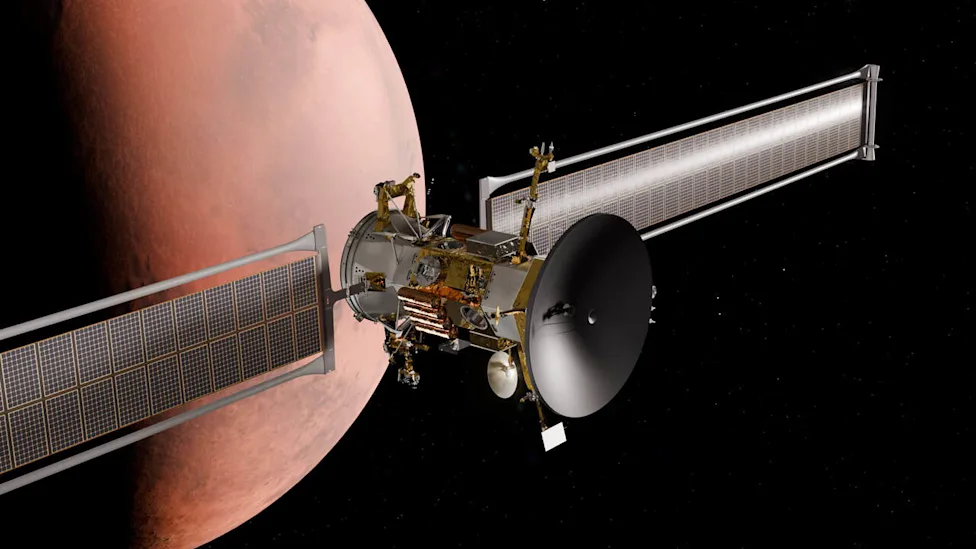
NASA Awards Blue Origin $700 Million Mars Relay Contract for Not-Yet-Operational Platform
NASA has committed up to $700 million to a dedicated Mars communications orbiter, but the schedule rests on a spacecraft platform that has not yet completed an operational mission. Under the firm-fixed-price contract announced September 1, Blue Origin must design, develop, integrate, launch and operate NASA’s Mars Telecommunications Network.
The contract requires delivery of the spacecraft no later than December 31, 2028. NASA expects the network to be operating around Mars by 2030, relaying science data, imagery, navigation information and mission communications between Earth and spacecraft on or near the planet. That leaves a defined delivery window for turning Blue Origin’s Blue Ring platform into a complete interplanetary service.
Mars communications currently depend on science orbiters
NASA already moves substantial Mars traffic through orbit, but the relay function is carried largely by spacecraft built to conduct scientific research. Mars Odyssey, launched in 2001, and the Mars Reconnaissance Orbiter, launched in 2005, handle much of the communication with the Curiosity and Perseverance rovers. The European Space Agency’s Mars Express and Trace Gas Orbiter also provide support.
Those spacecraft divide their resources between science and relay duties. A purpose-built communications orbiter changes that operating model: its principal job would be maintaining the data and navigation links required by current and future missions rather than balancing communications against its own research program.
That distinction matters as mission data volumes grow. A rover or lander can carry sophisticated instruments, but the practical scientific return also depends on how much information can be sent home and how promptly commands can be delivered. Dedicated relay capacity can reduce dependence on scheduling opportunities aboard multipurpose orbiters while giving mission planners a communications system designed around network service from the outset.
Blue Ring maturity is the central schedule issue
Blue Origin plans to build the Mars orbiter around Blue Ring, a spacecraft platform combining solar-electric and chemical propulsion. A prototype reached space during the first New Glenn launch in January 2025, but Blue Ring has not flown an operational mission.
That does not establish that the platform cannot meet NASA’s requirements. It does mean the company must mature the underlying vehicle while completing the Mars-specific spacecraft, communications payload, integration work and operating system needed for service at another planet. The contract covers more than delivery of flight hardware: Blue Origin is also responsible for launch and operation.
The mixed propulsion architecture provides two different propulsion tools at a high level. Solar-electric propulsion is associated with efficient operation over long periods, while chemical propulsion can provide a different balance of thrust and maneuver response. For this program, however, the decisive measure will not be the platform’s advertised versatility. It will be whether the integrated spacecraft can be delivered by the end of 2028 and placed into reliable service around Mars by 2030.
No launch vehicle has been confirmed in the available program information. New Glenn is a possible carrier, and it launched the Blue Ring prototype, but treating it as the selected rocket would get ahead of NASA’s announcement. Launch selection and integration remain important because the spacecraft, its carrier and the departure schedule must ultimately work as one mission plan.
A fixed-price award puts the focus on delivered capability
Congress provided $700 million for a Mars telecommunications orbiter in a July 2025 budget reconciliation bill. NASA established spacecraft requirements in February 2026, requested proposals in May and selected Blue Origin in September. The resulting contract has a maximum potential value of approximately $700 million.
For taxpayers, the relevant bargain is specific: public funding is intended to purchase a functioning communications and navigation service, not simply a spacecraft platform. A firm-fixed-price structure can limit the government’s exposure to some development-cost growth, but it does not remove technical or schedule risk. If milestones slip, NASA still faces the operational consequence of waiting longer for dedicated relay capacity while its established Mars orbiters continue to age.
The affected users extend beyond NASA’s network managers. Rover and orbiter teams depend on relay availability to return science and operate their spacecraft, while future missions would need communications access designed into their plans. At the same time, Blue Origin must reconcile those service expectations with the maturation of Blue Ring and a delivery deadline only a little more than two years after contract award.
The first hard accountability point is therefore December 31, 2028. By then, Blue Origin is required to deliver the Mars telecommunications spacecraft; by 2030, NASA expects a working relay around Mars. Meeting both dates would convert Blue Ring from a prototype-backed concept into infrastructure carrying the communications load for an expanding Mars program.
| More aerospace and engineering stories, right in your MSN feed. Follow AMI on MSN |
By David Whitaker — Associate editor for AMI’s aerospace and drone systems desk, translating flight systems, aircraft programs, spaceflight, and UAV developments into accessible technical stories.