China Adds Four Huge Hangars, Taxiways to Expand Lop Nur Testing
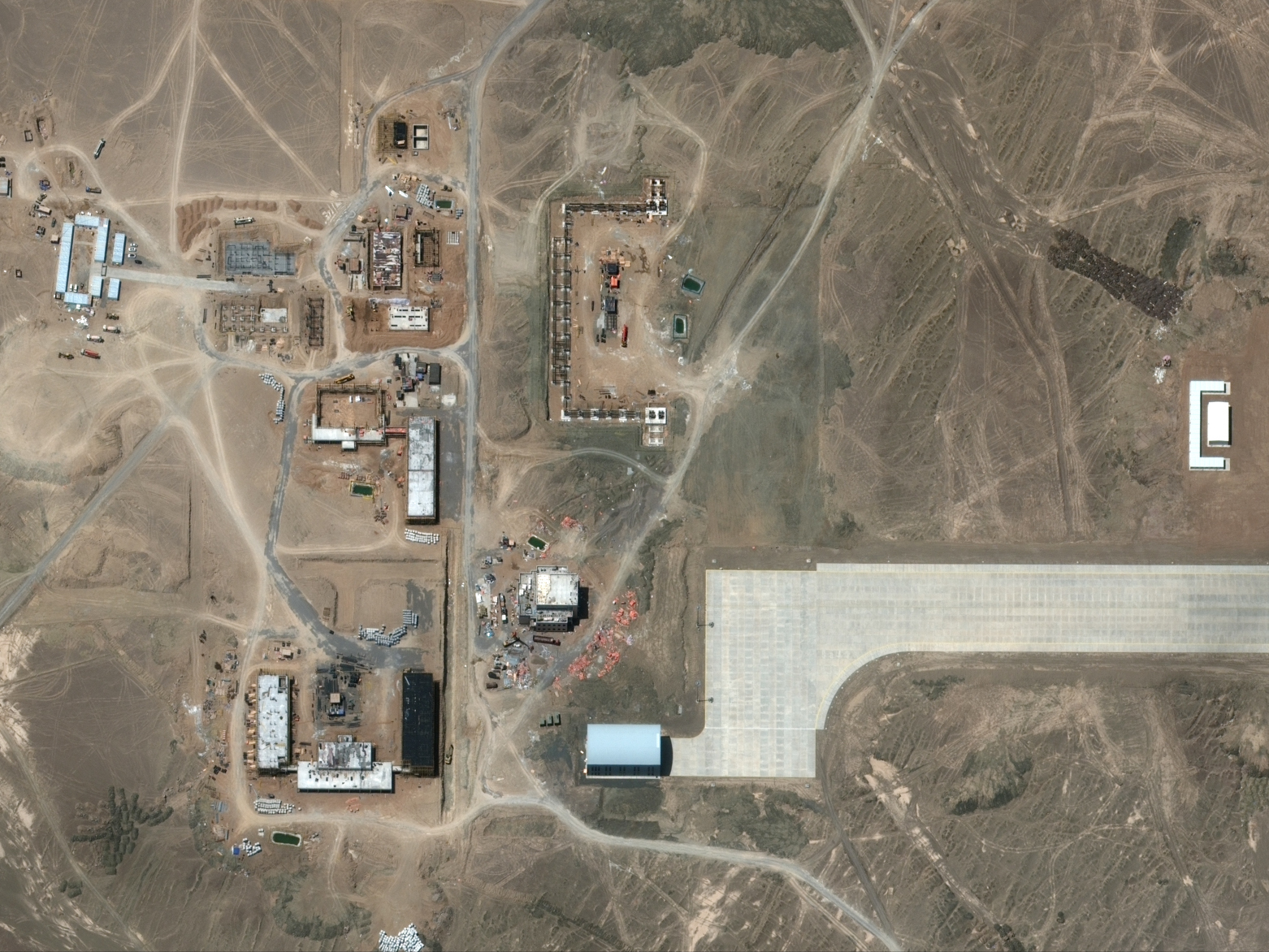
China is substantially enlarging its remote Lop Nur flight-test base with four large hangars, parallel ground-movement routes and other support construction that could accommodate bigger experimental aircraft and a higher volume of testing. Planet Labs satellite imagery analyzed by TWZ shows work continuing across the Xinjiang installation as of August 27, 2026.
The visible expansion is significant because Lop Nur has already hosted China’s J-36 and J-XDS next-generation fighter prototypes. What remains unknown is which aircraft will use the new buildings. Their dimensions have prompted speculation about larger programs, including the still-unrevealed H-20 stealth bomber, but the imagery does not confirm an H-20 connection.
Hangar size is only part of the story
Geo-intelligence researcher Damien Symon estimated that three hangars grouped on the base’s southern ramp measure approximately 80 by 40 meters, or 262 by 131 feet. A fourth large hangar stands farther south and has different dimensions. All four have access to the expanding southern taxiway system.
Those measurements establish that the buildings can provide enclosed space for unusually wide aircraft, but dimensions alone cannot identify an intended occupant. Hangar requirements also depend on clearance around the airframe, maintenance equipment, doors, internal work areas and how many aircraft a building is designed to support. The defensible conclusion is therefore about capacity: Lop Nur is gaining more protected space for maintaining and handling large test articles.
That matters at a flight-test center, where aircraft may spend substantial time undergoing inspections, instrumentation changes and engineering work between flights. Additional enclosed bays can let teams work on more than one aircraft or test configuration without competing for the same limited shelter. They also provide room for programs that may not fit comfortably inside facilities built around conventional tactical aircraft.
New taxiways could remove a runway bottleneck
The southern construction includes a route running parallel to the runway and connecting it with the central apron and main hangar area. This could allow aircraft to move between operating and maintenance areas without repeatedly traveling along the runway itself.
Separating ground movement from runway use is an important capacity improvement. A runway occupied by an aircraft taxiing in the opposite direction cannot simultaneously support another takeoff or landing. A parallel route does not prove that Lop Nur will immediately conduct more flights, but it provides the layout needed to handle aircraft movements with fewer runway conflicts.
Work is also underway on a northern taxiway linking the central area with the runway’s northern section. Nearby construction includes additional hangars, an apron extension and a circular pad approximately 400 feet across. The pad could support aircraft turnarounds or engine runs, although its function has not been confirmed.
Possible fuel-storage infrastructure is another potentially important addition, but its identification is also unconfirmed. If the structures are fuel facilities, they could reduce a basic logistics constraint by supporting more frequent sorties and longer periods of sustained flight activity. Fuel capacity, maintenance space and ground access collectively determine how intensively a test base can operate; a long runway by itself does not.
A six-year transformation
Lop Nur had a roughly 3.1-mile runway but comparatively little supporting infrastructure in 2020. Its central apron underwent a major expansion in 2023, more hangars appeared in 2025, and the pace of construction increased from May 2025 through 2026. The J-36 and J-XDS were observed at the installation in 2025, establishing its role in advanced combat-aircraft testing.
The latest work extends that evolution from a sparse runway site toward a more complete flight-test complex. Wide hangars add sheltered engineering space, parallel taxiways improve aircraft circulation, and possible fuel facilities could support a more sustained operating tempo. Each element is useful independently, but together they indicate a broader increase in test capacity.
The H-20 remains the most prominent unresolved possibility because it has not made a confirmed public appearance and the new hangars may be large enough for an aircraft in its general class. That is still speculation, not identification. Two large flying-wing drones have instead been observed at the separate Malan test facility elsewhere in Xinjiang, underscoring why building shape cannot establish which program will arrive at Lop Nur.
The next decisive evidence will not be another estimate based solely on hangar width. It will be a confirmed aircraft presence or operational activity connecting a specific program to the expanded facilities. Until then, the construction supports a narrower but substantial conclusion: China is preparing Lop Nur to shelter larger experimental aircraft and sustain more complex flight testing than the base could handle only a few years ago.
| More aerospace and engineering stories, right in your MSN feed. Follow AMI on MSN |
By David Whitaker — Associate editor for AMI’s aerospace and drone systems desk, translating flight systems, aircraft programs, spaceflight, and UAV developments into accessible technical stories.