


Mars’ Southern Interior May Be Up to 400 Degrees Celsius Hotter Than Its North
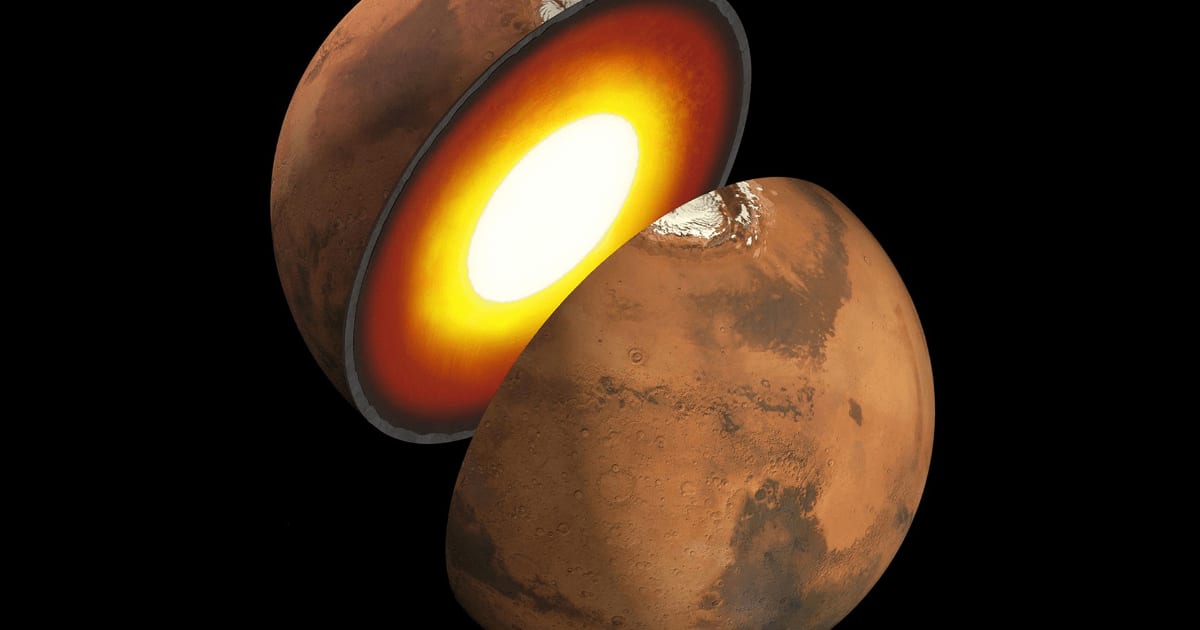
Between 200 and 400 degrees Celsius: That is the estimated temperature gap separating Mars’ southern interior from its northern interior. The result does not mean the southern surface is uniformly hotter. Instead, a study published in Nature inferred a deep thermal asymmetry by measuring how Mars responds to the Sun’s changing gravitational pull.
The three-dimensional model challenges a standard simplification in planetary science the assumption that a planet’s interior is broadly symmetric around its center. The Martian structure inferred by the researchers deviated from that symmetric scenario by about 300 percent, indicating that one-dimensional models can miss substantial lateral differences.
Three orbiters became gravity sensors
The team did not measure the interior’s temperature directly. Researchers led by Alexander Berne, a University of Arizona postdoctoral associate and Caltech alumnus, reprocessed approximately 16 years of Earth-based radio tracking from Mars Global Surveyor, Mars Odyssey and Mars Reconnaissance Orbiter.
Those records capture minute changes in each spacecraft’s velocity. After accounting for non-gravitational forces on the orbiters, the researchers compared observed and predicted velocity changes to reconstruct variations in the gravity field around Mars.
The key was separating the annual signal. Mars follows an elliptical orbit and rotates on an axis tilted relative to the Sun. Consequently, the strength and orientation of solar tidal forcing vary during the Martian year. Mars deforms slightly in response, and the resulting changes in gravity carry information about the mechanical properties of the material below its crust.
The method, called tidal tomography, works somewhat like medical tomography in its objective: combine many indirect measurements to infer hidden three-dimensional structure. It had previously been used to investigate Earth and the Moon, but this was its first application to Mars.
Extracting the signal required more than stacking old tracking records. The analysis modeled the orbiters as multi-panel spacecraft and corrected for atmospheric loading, thermospheric drag, solar effects and other non-gravitational accelerations. The researchers concentrated on annual gravity variations because higher-frequency tidal signatures are more susceptible to residual spacecraft-force errors.
Why the temperature estimate remains an inference
The gravity measurements constrain variations in the interior’s effective stiffness, or shear modulus. The team then modeled how temperature and composition could produce those mechanical differences. Its interpretation points to a southern interior approximately 200 to 400 degrees Celsius hotter than the north.
That distinction matters: gravity tracking measures a planet’s response, not temperature itself. Converting the response into a thermal model requires assumptions about material behavior and composition. The researchers tested several modeling choices and continued to recover the broad north-south pattern, but the result remains an inferred interior temperature contrast rather than a direct reading.
Its cause is also unresolved. Possibilities include a giant impact associated with heating in the north, convection within the southern mantle or thick geological structures that slowed heat loss. None has been established as the explanation, and the analysis does not reduce Mars’ history to a single event.
The asymmetry could nevertheless connect several parts of Martian science. Researchers suggest it may help investigations of magnetic anomalies preserved in southern iron-bearing minerals. It could also inform models of basin formation and hydrology, including the development of depressions that may once have held water. Those are potential implications to test, not confirmed consequences of the temperature difference.
Old navigation data gain a second scientific life
For mission designers, the important result extends beyond Mars’ internal temperature. Routine radiometric tracking collected to determine spacecraft orbits can also function as a long-duration planetary-science instrument. Combining records from three orbiters exposed a three-dimensional feature that a conventional symmetric model did not capture.
More gravity observations could tighten the model and help future missions decide which measurements are needed to distinguish thermal effects from compositional ones. Berne described such interior inferences as a blueprint for designing future exploration, but no particular Mars mission has been redesigned or approved because of this study.
The practical constraint is time: the annual tidal signature becomes useful when measurements are accumulated across many years and carefully separated from atmospheric and spacecraft effects. Mars Global Surveyor, Mars Odyssey and Mars Reconnaissance Orbiter supplied that baseline. Their tracking histories now suggest that Mars is not merely divided between northern plains and southern highlands at the surface the divide may extend deep into the planet.
| More aerospace and engineering stories, right in your MSN feed. Follow AMI on MSN |
By David Whitaker — Associate editor for AMI’s aerospace and drone systems desk, translating flight systems, aircraft programs, spaceflight, and UAV developments into accessible technical stories.



