Impossible Objects Raises $40 Million to Support 10,000 Drone Bodies Monthly
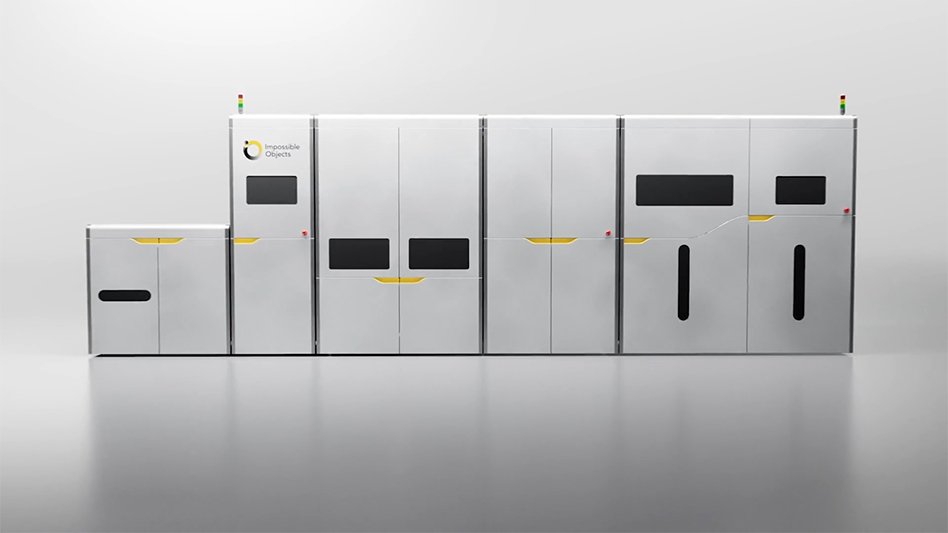
$40 million is the amount Impossible Objects has raised to move its carbon-fiber additive-manufacturing technology further into industrial production. The Illinois company said in its September 11 funding announcement that the Series B round, led by Inflection Equity, will increase production of its manufacturing systems, expand customer deployments and build the service organization needed to support them.
The most striking figure attached to that expansion is a stated capacity of up to 10,000 drone bodies per month at the U.S. Army’s Rock Island Arsenal. That number describes what the Composite-Based Additive Manufacturing process can support, according to Impossible Objects. It is not a confirmed monthly production result and that distinction is important because only five orders for the company’s latest CBAM 25 system have been reported since its early-2025 launch.
Tool-less production is the central proposition
The CBAM 25 is intended to manufacture strong, lightweight composite parts without the costly dedicated tooling used in conventional processes such as injection molding. Removing that tooling requirement can shorten the path from a digital design to a physical component, particularly when designs change or production is spread across multiple sites.
For drone manufacturing, that flexibility matters because an airframe body or structural section may need to be produced in quantity without committing first to a fixed mold or another long-lead production tool. It also creates a possible route from prototype-scale additive manufacturing toward repeatable production of wings, fuselage structures and other composite components.
Impossible Objects says the CBAM 25 processes as many as 25 layers per minute. It describes that rate as 15 times faster than competing production additive technologies. The company also says its process can make parts reaching 200 megapascals in strength up to four times the strength of components made through rival additive methods while limiting shrinkage and warpage.
Those are manufacturer comparisons, not independently documented production results in the available material. They establish the performance targets behind the investment, but they do not by themselves show sustained factory throughput, machine availability, part acceptance rates or output across different geometries. A maximum layer rate also is not the same measurement as completed, inspected drone bodies leaving a production line each month.
Five orders mark an early installed base
Since introducing the CBAM 25, Impossible Objects has taken five orders and begun placing systems with customers and research organizations. Named organizations include the U.S. Air Force, the National Institute for Aviation Research, the Oregon Manufacturing Innovation Center and Rochester Institute of Technology.
These placements move the system beyond a laboratory-only proposition, but they also show how early the commercial expansion remains. An installed machine must be supported with material supply, process control, maintenance, trained operators and repeatable quality checks before stated capacity becomes dependable output. The new financing therefore covers more than manufacturing additional printers: it also supports deployments and the service and commercial organization required for a growing installed base.
That support layer is especially significant for aerospace and defense users. Lightweight composite structures must be produced consistently, not simply quickly. Tool-less manufacturing can reduce the cost and delay associated with dedicated fixtures, but it shifts attention toward control of the digital process, materials and machine-to-machine repeatability.
Government work broadens the manufacturing test
Impossible Objects has separately secured $20 million through U.S. government contracts and awards. The supported work includes long-range drones, lightweight wing and fuselage structures, embedded wiring and additively manufactured composite components. Those projects give the company several routes for demonstrating whether the same manufacturing approach can handle different structural and integration demands.
The Series B round does not prove the CBAM 25’s speed, strength or monthly drone-output claims. It funds the production equipment, customer installations and support structure needed to test those claims at a larger industrial scale. The next meaningful measure will be whether the growing installed base converts a stated ceiling of 10,000 drone bodies per month into sustained, accepted production not merely whether the machine can process 25 layers in a minute.
| More aerospace and engineering stories, right in your MSN feed. Follow AMI on MSN |
By Stephen Wallace — Editor for AMI’s aerospace integration and unmanned mobility coverage, focused on drone manufacturing, VTOL systems, autonomous networks, and air-ground mobility links.