NTSB Rejects 11 FAA Safety Responses After Potomac Collision Killed 67
The Federal Aviation Administration has tightened airplane-helicopter separation procedures and started reviewing helicopter routes, but the National Transportation Safety Board says those actions do not adequately resolve 11 of 33 safety recommendations issued after the Potomac midair collision that killed 67 people.
The NTSB’s September 15 assessment leaves a central technology question unsettled: whether aircraft should be required to carry ADS-B In, a cockpit capability that provides crews with information about nearby traffic. The board says the FAA has given no indication that it will begin drafting such a requirement.
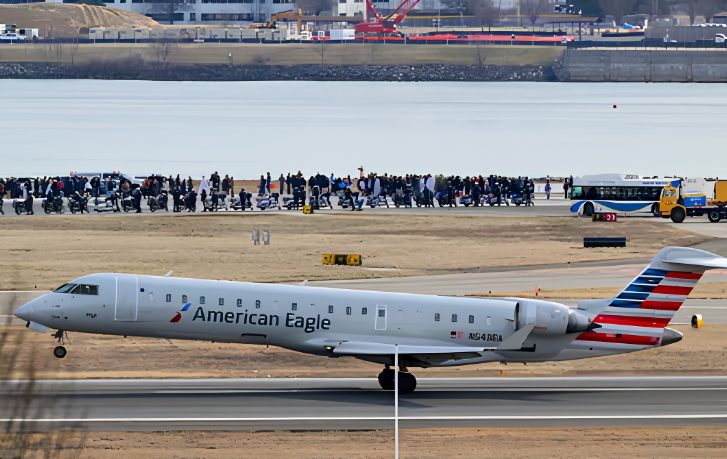
The January 2025 collision involved an American Airlines regional jet and a U.S. Army Black Hawk helicopter near Ronald Reagan Washington National Airport. It was the deadliest U.S. aviation accident in more than two decades. The NTSB’s investigation attributed the collision to systemic FAA shortcomings, including separation safeguards, analysis of safety data and the placement of helicopter routes near commercial traffic.
Procedural separation addresses one layer of risk
The FAA has not left its procedures unchanged. It said it completed helicopter-route assessments in four cities, began reviews in six other major metropolitan areas and instructed controllers to provide physical separation between airplanes and helicopters.
FAA Administrator Bryan Bedford described the separation change more specifically in congressional testimony. He said the agency suspended the procedural use of visual separation between helicopters and airplanes in Class B, Class C and terminal radar airspace. Controllers must instead maintain radar-based positive separation standards.
That is a consequential human-factors change. Visual separation depends on people acquiring and correctly interpreting traffic in a complex scene, while positive separation places the spacing obligation within the controller and surveillance system. The change therefore reduces reliance on pilots’ eyesight as the primary safeguard in congested terminal environments.
It does not, however, resolve every recommendation concerning route design, equipment and oversight. The NTSB’s rejection of 11 responses indicates that procedural instructions alone do not satisfy the board’s requested safety actions. Route reviews also remain incomplete beyond the four cities where assessments have been finished.
ADS-B In would add information inside the cockpit
ADS-B has two distinct functions relevant to the dispute. ADS-B Out broadcasts an aircraft’s position and other information. ADS-B In receives traffic information and can present nearby aircraft or traffic advisories to a crew. Current law does not generally require aircraft to carry the receiving capability.
NTSB Chair Jennifer Homendy said ADS-B In could have warned the regional-jet pilot 59 seconds before impact and the helicopter crew 48 seconds before impact. Those estimates explain why the technology is prominent in the board’s recommendations: it could provide crews with another source of traffic awareness when separation is deteriorating.
That finding should not be read as proof that ADS-B In would certainly have prevented the collision. Receiving information is not the same as guaranteeing that a crew will detect, understand and act on it successfully. Display design, alert presentation, workload, equipment configuration and the time available to respond all shape the operational benefit. The NTSB’s figures establish a potential warning interval, not a guaranteed outcome.
From a systems perspective, the proposed mandate would add a cockpit layer to controller instructions, surveillance and route separation. Independent safety layers matter because no single procedure, person or display is expected to manage every conflict under every operating condition. The unresolved policy issue is whether the benefit of that additional layer justifies making the equipment compulsory across affected operations.
Authority exists, but the regulatory path remains open
Bedford has said the FAA has authority to impose ADS-B regulations without congressional action, although he would prefer explicit legislative direction. That distinction matters: the absence of completed legislation does not by itself prevent the agency from starting a rulemaking, but legislation could define the requirement, affected aircraft and associated oversight more directly.
Congress has considered broader changes. The House approved a comprehensive aviation-safety package by a 396-10 vote in April. The Senate unanimously passed the ROTOR Act in December, but the proposal subsequently fell one vote short of the two-thirds majority needed under expedited House rules. A related ROTOR Act listing on Congress.gov describes proposed ADS-B In requirements, tighter limits on certain government-flight exceptions and expanded audits and coordination.
Until either the FAA begins a rulemaking or Congress completes legislation, ADS-B In remains a recommended collision-awareness layer rather than a general mandate. The immediate separation instructions change how controllers manage airplane-helicopter encounters today; the 11 unacceptable responses show that the NTSB considers the larger equipment, route and oversight architecture unfinished.
| More aerospace and engineering stories, right in your MSN feed. Follow AMI on MSN |
By Thomas Caldwell — AMI’s senior editor for mechanical and mobility engineering, covering vehicle electronics, systems integration, electrification, chassis systems, propulsion, and safety policy.