Volkswagen Offers $12,500 on Remaining ID.4s After Ending US Production
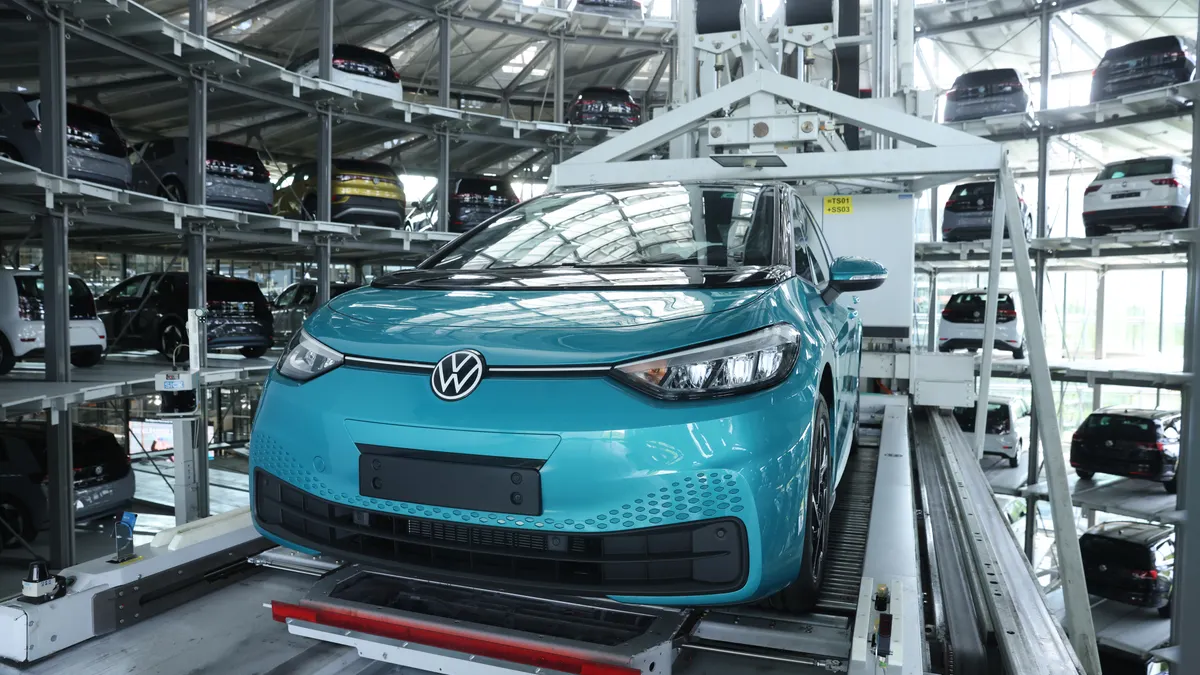
Volkswagen is putting a $12,500 customer incentive on its remaining new 2025 ID.4 electric SUVs only five months after ending the model’s production in Tennessee. The unusually large offer follows an $800 million factory electrification investment, a steep decline in ID.4 sales and Volkswagen’s decision to redirect its Chattanooga plant toward a higher volume gasoline SUV.

The 2025 ID.4 Customer Bonus is available to private customers purchasing or leasing through participating U.S. dealers. Fleet transactions are excluded, and the offer runs through November 2, 2026. Volkswagen describes the remaining inventory as “very limited,” so the headline amount applies to a shrinking pool of older model year vehicles rather than every ID.4 on a dealer lot.
That distinction matters because 2026 ID.4s receive a smaller $6,000 customer bonus. The $12,500 figure is specifically a clearance mechanism for the remaining 2025 inventory. Volkswagen is also offering $2,000 on the Taos and $3,000 on the Tiguan, making the older ID.4 incentive notably larger than its current offers on those gasoline powered utility vehicles.
A factory strategy reversed after less than four years
Chattanooga began series production of the ID.4 in July 2022. Volkswagen’s $800 million electrification program added dedicated vehicle production and battery pack assembly facilities, giving the company a domestically built electric SUV for the U.S. market.
Volkswagen stopped building the ID.4 there in mid April 2026, leaving the company without a U.S. produced electric vehicle. The plant is now being repositioned around the gas powered, second generation Atlas. Volkswagen said Chattanooga would focus on “higher volume models that support sustained growth in North America.”
The shift does not mean that the electrification investment itself determines the size of today’s discount. Vehicle incentives can reflect several commercial considerations, and Volkswagen has not identified a specific internal inventory problem. What is confirmed is the sequence: local ID.4 production ended, remaining 2025 vehicles became scarce, and the company attached a five figure bonus to move those units through participating dealers.
Demand fell after incentives and eligibility changed
Sales data provide the clearest context for Volkswagen’s production decision. U.S. ID.4 sales reached 12,470 vehicles in the third quarter of 2025, up 176% from a year earlier. They then fell to 338 in the first quarter of 2026, a year over year decline of 95.6%. First half 2026 sales totaled 2,205, down 77.2% from 9,655 during the same period in 2025.
The federal incentive environment changed during this period. The $7,500 federal electric vehicle tax credit expired at the end of September 2025. The ID.4 had already stopped qualifying for the purchase credit in January 2025 because of battery sourcing rules, although Volkswagen had passed the lease version to customers as lease cash.
Those changes illustrate how electric vehicle demand can depend on more than the vehicle’s hardware. Battery sourcing affects incentive eligibility; eligibility affects the effective transaction cost; and transaction cost can influence sales volume and factory utilization. When those elements move out of alignment, an automaker may have to adjust pricing, production and plant allocation together.
Volkswagen characterized the Chattanooga decision as “a strategic shift” amid an electric vehicle market that it said remained unpredictable. From a manufacturing perspective, assigning the plant to the Atlas concentrates capacity on a product Volkswagen expects to sell at greater volume. For consumers, the immediate consequence is narrower: a large incentive is attached to a limited group of discontinued U.S. built 2025 ID.4s, with dealer participation and a fixed deadline.
Volkswagen says “a future version of ID.4 is currently planned for the North American market,” but it has announced no timetable. Until that plan becomes concrete, the November 2 incentive marks the closing commercial phase for the current 2025 model and the clearest visible consequence of Chattanooga’s return to a gasoline SUV production focus.
| More aerospace and engineering stories, right in your MSN feed. Follow AMI on MSN |
By Thomas Caldwell — AMI’s senior editor for mechanical and mobility engineering, covering vehicle electronics, systems integration, electrification, chassis systems, propulsion, and safety policy.