Lake Powell Inflow Forecast at 36% of Average as Hoover Dam Power Risk Grows
Lake Powell is forecast to receive 3.50 million acre-feet of unregulated inflow during water year 2026 just 36% of average under the most probable forecast issued July 1. The Bureau of Reclamation’s operating update also says the Department of the Interior determined that Powell will release 6.0 million acre-feet in water year 2026, down from the previously projected 7.48 million acre-feet.

Those figures matter downstream because releases from Lake Powell pass through Glen Canyon Dam and supply the Colorado River system above Lake Mead. A smaller release is therefore material to Lake Mead’s projected decline and the risk that Hoover Dam will lose access to much of its generating capacity. That power reduction has not happened: reservoir elevations change daily, and the critical Lake Mead levels remain model projections that can be revised in later studies.
The investigation begins upstream
The weak inflow forecast explains why the two-reservoir system has so little operating margin. Reclamation reported that June inflow to Lake Powell was only 306,000 acre-feet, or 12% of average, while 508,000 acre-feet was released through Glen Canyon Dam that month. At the end of June, Powell held 5.60 million acre-feet, equal to 24% of its live storage capacity.
Under the July forecast, Powell was projected to end water year 2026 near an elevation of 3,516.18 feet, with approximately 5.05 million acre-feet in storage, or 22% of capacity. The agency’s 6.0-million-acre-foot release determination operates within the Mid-Elevation Release Tier and reflects federal rules coordinating Lake Powell and Lake Mead. It replaces the 7.48-million-acre-foot release projected under the earlier operating calculation.
The inflow number is exceptionally low but not unprecedented. Reclamation identifies 2002 as the lowest water year in the cited record, at 2.64 million acre-feet, or 28% of average. Water year 2021 also produced 3.50 million acre-feet, matching the current 2026 forecast at 36% of average. The wider basin entered water year 2026 with 21.8 million acre-feet in total system storage, or 37% of capacity, down from 43% one year earlier.
Why a few feet matter at Hoover Dam
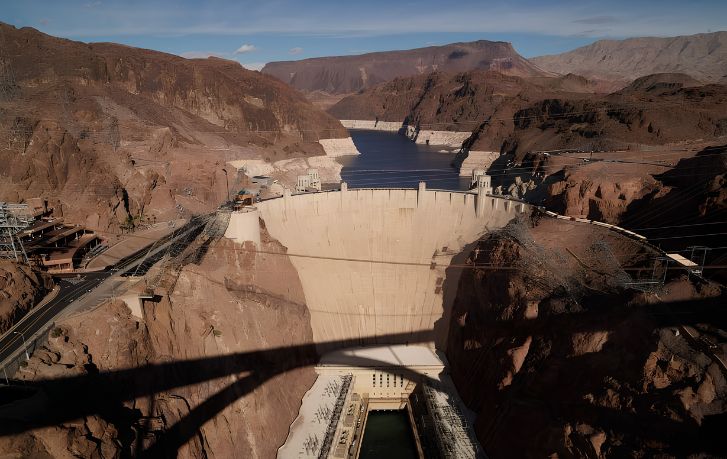
The September 24-Month Study reportedly projects Lake Mead at 1,035.16 feet at the end of October and 1,034.88 feet at the end of November. That narrow crossing is important because 12 of Hoover Dam’s 17 turbines face an operating boundary near 1,035 feet. At lower elevation, reduced hydraulic head can permit vapor bubbles to form and collapse against turbine surfaces, producing damaging cavitation in units designed for higher water pressure.
Reclamation’s updated assessment reportedly estimates about 382 megawatts of usable Hoover output below that boundary, compared with an earlier estimate of 1,302 megawatts. For context, Hoover Dam’s historical generating capacity is listed as 2,074 megawatts. The exact amount available at any point would still depend on reservoir elevation, equipment availability and operating guidance; the forecast is not a completed generation loss.
The engineering issue is not simply that less water produces proportionally less electricity. Near the operating boundary, the mechanical limits of the older turbine designs can remove entire units from service. Five existing wide-head turbines can reportedly operate near a Lake Mead elevation of 950 feet without excessive damage, giving those machines a much broader usable range than the 12 older units.
Replacement capacity has no published installation date
Reclamation approved $52 million in May to replace as many as three older turbines with wide-head designs. The agency expects those replacements could restore at least 160 megawatts of capacity under low-reservoir conditions. No installation schedule has been published, however, leaving a significant integration question: approval and funding do not provide additional operating margin until the new machinery is installed, commissioned and available for service.
Grid analysts expect other generating resources to replace unavailable Hoover power if the forecast loss occurs, but at higher cost. Hoover’s value also extends beyond its energy total because hydropower can adjust output to help balance electricity supply and demand. Replacing that flexible function may require a combination of resources rather than a simple one-for-one energy substitution.
The next decisive facts will be updated Lake Mead readings, later 24-Month Study projections, any revised turbine-operating guidance and a published schedule for the wide-head replacements. Until then, the system faces a clear timing mismatch: Lake Mead is forecast to approach the older turbines’ operating limit within months, while approved replacement units still have no stated installation date.
| More aerospace and engineering stories, right in your MSN feed. Follow AMI on MSN |
By Thomas Caldwell — AMI’s senior editor for mechanical and mobility engineering, covering vehicle electronics, systems integration, electrification, chassis systems, propulsion, and safety policy.