Airbus A350F Flies Two Years Late, Starting Nine-Month Approval Campaign
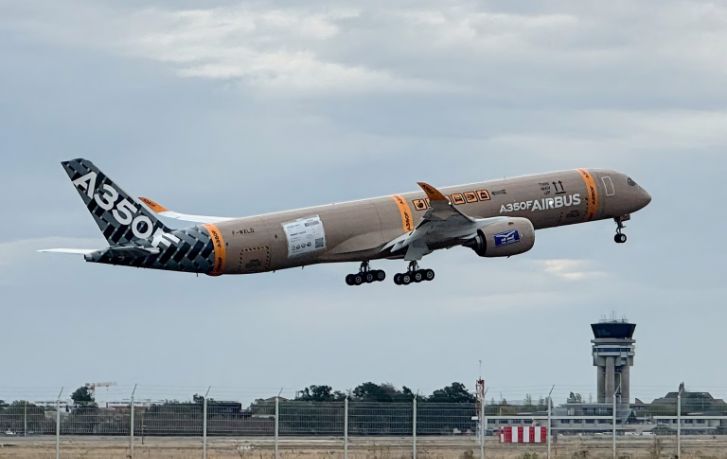
The Airbus A350F has finally flown, but the delayed cargo aircraft is not yet close to carrying revenue freight. Its maiden flight came two years behind the program’s original schedule, shifting attention immediately from takeoff to whether Airbus can complete approval work and make its first delivery by the end of 2027.
On September 29, the first test aircraft departed Toulouse with a five-person flight-test crew and completed a four-hour, 10-minute mission. According to Airbus’s official first-flight announcement, it reached 25,000 feet before returning, opening a flight-test campaign expected to run for more than nine months.
A first flight validates the starting point
The initial mission was designed to establish basic airworthiness, assess fundamental flying qualities and check whether core systems behaved as predicted. Airbus said the crew evaluated handling, engine behavior, pressurization, communications and navigation while comparing the aircraft’s actual response with aerodynamic and structural models developed before flight.
That matters because the A350F shares the broader A350 platform but is not simply a passenger jet with an empty cabin. Its freighter-specific fuselage configuration, large main-deck cargo door, cargo floor and loading systems create structural, aerodynamic and systems requirements that must be demonstrated in their completed form.
The first flight therefore cleared an essential threshold, not the aircraft as a whole. Airbus’s more detailed campaign plan calls for roughly 400 flight hours across two test aircraft over about 10 months. The company’s shorter description of “over nine months” and its 10-month campaign outline describe approximately the same certification window.
Two aircraft divide the certification workload
The first aircraft, MSN700, will concentrate on handling qualities, performance and autopilot testing. It carries dedicated instrumentation that records thousands of parameters and transmits telemetry to engineering teams on the ground.
The second aircraft, MSN701, has completed final assembly and is undergoing ground testing before painting. Airbus plans to use it for systems work including air conditioning, water and waste systems, smoke detection, and hot- and cold-weather trials. Dividing the work allows complementary test programs to proceed, but certification still depends on the combined findings supporting European Union Aviation Safety Agency type approval.
This is the critical distinction behind the milestone. A successful first sortie confirms that the campaign can proceed; it does not establish compliance across the aircraft’s full operating envelope, systems suite or cargo mission. Those demonstrations, documentation reviews and any resulting changes must be completed before delivery.
The revised delivery target leaves limited schedule margin
Airbus plans the first customer delivery by the end of 2027. A campaign lasting approximately nine to 10 months would nominally conclude in mid-2027, leaving a period for remaining approval and delivery preparation. The available information does not establish how much contingency Airbus has built into that sequence.
The two-year delay makes that margin consequential for customers. Airbus has recorded 115 orders from 14 disclosed customers as of the end of August 2026, but it has not selected which airline will receive the first aircraft. A350F project head Julien Poyou said Singapore Airlines and CMA CGM are the two candidates under consideration.
The absence of a named launch operator is not itself evidence of another delay. It does, however, leave an important delivery detail unresolved while certification begins. Entry into airline service requires more than type approval: the first aircraft must also be completed in its customer configuration and prepared for that operator’s processes.
Production must follow certification
Airbus intends to raise combined A350 passenger and freighter production to 12 aircraft per month beginning in 2028. Because both versions share a platform, Airbus says operators can gain flexibility in pilot deployment and maintenance. Platform commonality can also support manufacturing continuity, but passenger and freighter aircraft will draw on the same planned family production rate.
The order book gives Airbus a substantial industrial commitment to manage. The reported total includes Atlas Air’s 20-aircraft order. Airbus also claims up to 59% of the large-freighter market, although that manufacturer figure depends on how the market and competing orders are counted and should not be treated as an independently verified share.
The A350F has now moved from a delayed development aircraft on the ground to an active certification program in the air. The next decisive measure will not be another ceremonial milestone, but whether two test aircraft can complete roughly 400 flight hours, secure type certification and preserve enough time for the first customer delivery before 2027 ends.
| More aerospace and engineering stories, right in your MSN feed. Follow AMI on MSN |
By Thomas Caldwell — AMI’s senior editor for mechanical and mobility engineering, covering vehicle electronics, systems integration, electrification, chassis systems, propulsion, and safety policy.