U.S. Patriot and High-Altitude Missile Interceptor Inventories Fall Sharply
Two estimates define the immediate U.S. missile-defense problem: roughly 759 to 827 Patriot interceptors and about 250 Terminal High Altitude Area Defense, or THAAD, interceptors may remain after heavy use during the Iran conflict.

The Center for Strategic and International Studies calculated those figures from the Defense Department’s fiscal 2027 budget and other publicly released information. Its estimated prewar baselines were about 2,300 Patriot interceptors and 452 THAAD interceptors. That would put the remaining Patriot inventory at roughly one-third of its earlier level, while the estimated THAAD inventory has fallen by about 45%.
These are independent estimates, not an official Pentagon inventory disclosure. The Defense Department disputes broader reports of munitions shortages. Chief Pentagon Spokesperson Sean Parnell said claims of U.S. shortages are false and that the military has everything required to conduct strikes when directed. That denial does not publicly resolve the narrower question raised by the CSIS estimates: how much capacity remains in two defensive interceptor families that have limited substitutes.
Why these interceptors matter more than a general munitions count
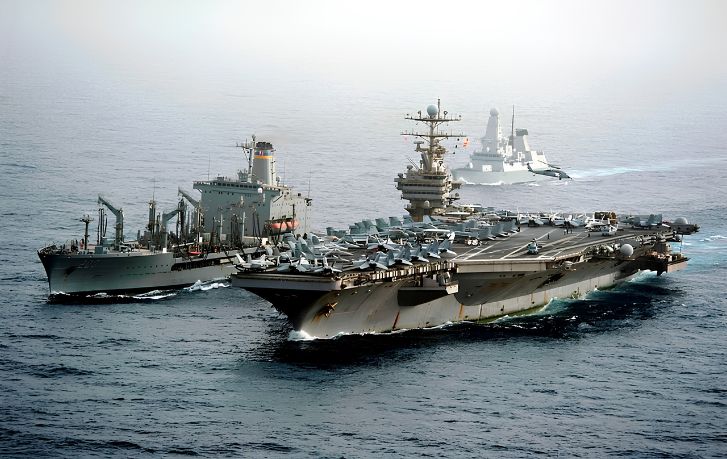
Patriot and THAAD are not interchangeable with every other weapon in the arsenal. Both have been used to protect U.S. bases in the Middle East and support allies facing Iranian missile and drone attacks, but their central value here is defense against ballistic missiles.
Mark Cancian, a CSIS senior adviser, drew a distinction between strike weapons and missile-defense interceptors. Depleted long-range strike missiles can sometimes be replaced by shorter-range weapons, though doing so may require forces to operate closer to a target and accept greater risk. For Patriot and THAAD’s ballistic-missile defense functions, he said, there are no comparable alternatives.
That lack of substitution changes the operational consequence of depletion. A smaller defensive inventory does not automatically mean a defended base becomes unprotected, and public figures do not reveal deployment plans or engagement decisions. It does mean commanders have less inventory margin if attacks continue, intensify or spread to additional locations.
NBC News previously reported that U.S. and Gulf forces have already had to accept more risk by allowing projectiles assessed as not threatening personnel or assets to pass without interception. That is an allocation response to scarcity: conserve specialized interceptors for threats judged most consequential. It is not evidence that every unengaged object would otherwise have been intercepted, but it illustrates how inventory depth can shape defensive choices.
Production plans are large, but replenishment is not immediate
The fiscal 2027 budget reflects the scale of the attempted industrial response. According to the Congressional Research Service’s review of the request, the Defense Department sought $12.56 billion in mandatory funding for 2,936 Patriot Advanced Capability-3 Missile Segment Enhancement interceptors, plus $1.40 billion in discretionary funding for 267 more. It also requested $10.53 billion in mandatory funding associated with 830 THAAD interceptors and $1.96 billion in discretionary funding for 27.
Requested quantities, however, are not the same as missiles delivered to operational units. Congress must act on funding, contracts must be executed, suppliers must expand output, and complete interceptors still have to pass manufacturing and acceptance requirements. Missile production depends on specialized propulsion, guidance, electronics and other components whose capacity cannot be expanded simply by increasing an appropriation.
The Patriot supply chain is already being widened. Lockheed Martin announced a framework to raise annual production of the advanced Patriot interceptor from 600 to 2,000, while L3Harris received a seven-year, $4.7 billion award for propulsion systems and related hardware. Two new L3Harris facilities intended to support that production are expected to become operational in 2027.
Germany and the United States have also agreed to expand shared production, positioning Germany as another manufacturing hub when U.S. capacity is overwhelmed. Germany already produces older-generation Patriot interceptors through MBDA, and production of the newer variant was scheduled to begin there in 2026. That diversification can increase resilience and total output, but it cannot instantly replace rounds already expended.
The Pentagon denial and the estimates measure different things
The Pentagon’s statement addresses whether the military can perform assigned missions. The CSIS analysis estimates the depth of particular inventories. Those propositions can coexist for a period: a force may retain enough weapons for current orders while having substantially less endurance for a longer or expanded conflict.
Publicly available numbers cannot settle how many interceptors are immediately usable, committed to allies, reserved for other regions, awaiting maintenance or scheduled for delivery. Those variables are central to readiness and generally are not disclosed in detail. The estimates should therefore be treated as a warning based on budget data, not a precise real-time count.
The harder industrial question is whether production can recover faster than operational demand consumes the available margin. New plants, multinational production and unusually large fiscal 2027 requests point toward a substantial expansion. Until that output reaches fielded units, the estimated 759 to 827 Patriot interceptors and roughly 250 THAAD interceptors remain the clearest public measure of a defense capacity with few direct replacements.
| More aerospace and engineering stories, right in your MSN feed. Follow AMI on MSN |
By David Whitaker — Associate editor for AMI’s aerospace and drone systems desk, translating flight systems, aircraft programs, spaceflight, and UAV developments into accessible technical stories.