


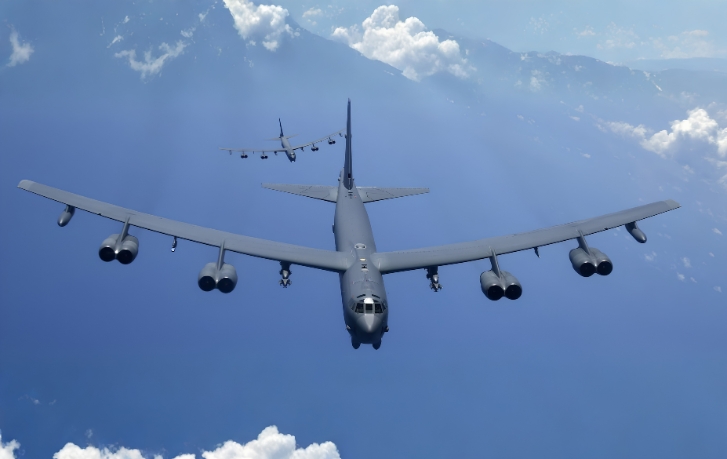
B-52’s Nearly $21 Billion Rebuild Faces Problems Across 10 Major Upgrades
The U.S. Air Force is trying to preserve the B-52 into the 2050s without allowing the rebuild itself to consume too much of the fleet’s money, maintenance capacity and aircraft availability. The Government Accountability Office estimates that 13 major modernization efforts will cost nearly $21 billion, while 10 already face some combination of cost growth, schedule slippage or performance difficulties.

The central tension is not whether newer engines and radar would improve the bomber. It is whether the Air Force can install, test and support those systems while continuing to maintain an aircraft that entered service in 1955. The engine and radar programs account for $18.3 billion more than 88 percent of the projected investment and both have increased in cost by more than 30 percent and slipped by more than three years from their early schedules.
Most of the money rebuilds propulsion and sensors
The engine program replaces the B-52H’s TF33 engines with Rolls-Royce F130s, but this is not a simple engine swap. It also requires new generators, struts, electrical equipment and cockpit hardware. Wind-tunnel testing in 2023 found distorted inlet airflow that could have caused a fan stall in flight. Engineers redesigned the inlet and validated it in 2025, retiring a specific technical risk before the design advanced.
The engine program completed its critical design review in 2026. The Air Force subsequently advanced the effort into development and authorized low-rate production for the separate radar program, according to its September 2026 modernization update. Two aircraft are scheduled to receive both engine and radar modifications before later testing at Edwards Air Force Base.
The radar effort replaces the APQ-166 with an active electronically scanned array system. Its estimated cost rose above $2.9 billion, initial operational capability moved to fiscal 2030, and five original performance requirements were removed as the Air Force pursued a minimum viable configuration. That approach can keep a delayed program moving, but it also means the delivered baseline will provide less than originally specified.
Other projects cover communications, cryptographic equipment, data links, training, flight recording and future weapon integration. Together, the work is meant to retain the B-52’s airframe and payload while rebuilding much of its propulsion, electrical and mission-system architecture.
Overlapping tests and production raise the stakes
Developmental engine flight testing and production are both planned to begin around fiscal 2029. GAO warned that this overlap could commit production hardware before a fully integrated B-52J completes critical flight testing. Concurrency can save calendar time when designs perform as expected; when testing uncovers changes, it can force modifications into aircraft or components already being built.
Configuration control adds another burden. The Air Force may have to manage as many as 31 B-52 configurations between 2024 and 2036 as aircraft move through different combinations of upgrades. Each configuration can carry distinct parts, technical data, training and maintenance requirements. That complexity matters because availability depends not only on whether an upgrade works, but also on whether maintainers can support every version passing through the fleet.
The workload is substantial. Installing the engine package is estimated to require more than 23,000 labor hours per aircraft, on top of roughly 40,000 hours for regular depot maintenance. Radar installation could add another 10,000 to 15,000 hours. GAO concluded that existing depot capacity cannot sustain the planned repair rate while absorbing all the modernization work without more facilities, personnel and parts or reduced throughput.
Radar testing also suffered a serious disruption when a supporting B-52 crashed shortly after takeoff from Edwards on June 15, 2026, killing all eight people aboard. The cause remains under investigation. No finding currently attributes the accident to the radar modification, and the loss should not be treated as evidence of a technical defect in that system. Its established program consequence is the interruption and reorganization of test support.
The B-52J and B-21 have different jobs
The rebuilt B-52 is not intended to substitute directly for the B-21. The B-52J is planned to provide large weapons capacity and persistence from safer launch positions, including conventional and nuclear stand-off roles. The B-21 is being developed to penetrate defended airspace. That division explains why the Air Force sees value in retaining both: one emphasizes payload and endurance, while the other addresses access to more demanding environments.
The nearly $21 billion investment could therefore preserve substantial bomber capacity into the 2050s, but new hardware alone will not deliver that capacity. Depot labor, test sequencing, configuration management and aircraft availability will determine how much usable force emerges from the rebuild. A fiscal 2027 New Heavy Bomber study is expected to examine future long-range strike requirements, continuing B-52 costs and possible follow-on configurations just as the Air Force confronts how much maintenance infrastructure its oldest bomber will require to reach its planned retirement horizon.
| More aerospace and engineering stories, right in your MSN feed. Follow AMI on MSN |
By David Whitaker — Associate editor for AMI’s aerospace and drone systems desk, translating flight systems, aircraft programs, spaceflight, and UAV developments into accessible technical stories.


