


Hormuz Oil Flows Fall 27% as Tanker Attacks Reach Qatar
The Persian Gulf’s improvised oil-transport network works as a relay. Shuttle tankers carry crude from Gulf terminals through the Strait of Hormuz, transfer it to other vessels waiting outside the strait and return for another load. Protected movements and pipelines that bypass Hormuz have added further capacity. Together, those measures helped restore regional crude exports toward prewar levels but they also created a longer, more complex logistics chain that depends on several links continuing to function.

That chain is now under greater strain. Preliminary Kpler tracking data show oil flows through Hormuz and associated transfers outside the strait fell 27% in the week ended Oct. 4 compared with the previous week’s wartime high. The estimate could be revised higher, so it should not be read as a final measure of lost supply. Even so, the decline coincides with attacks spreading beyond the narrow waterway and deeper into the Persian Gulf.
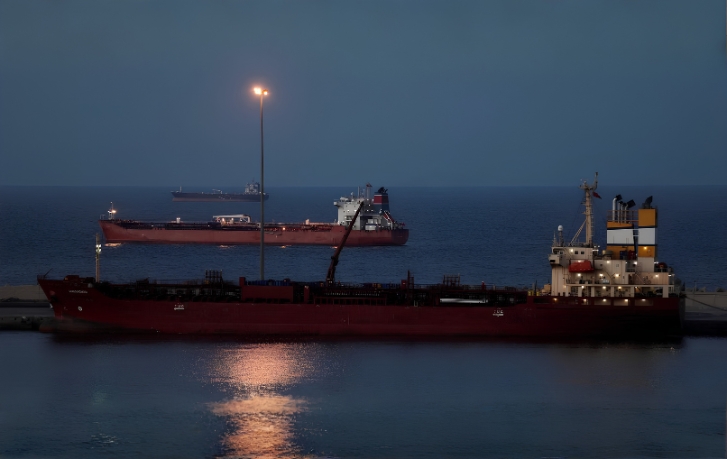
Late Wednesday, the oil and chemical tanker Acers was struck by several projectiles north of Qatar. Maritime intelligence firm Vanguard identified the vessel, while the U.K. Maritime Trade Operations agency reported casualties. The number and condition of those affected were not specified in the available information. Responsibility for the attack has not been confirmed.
The location is consequential because the export workaround does not begin and end at Hormuz. Tankers must first load at Gulf terminals and move across interior waters before reaching the strait. An attack north of Qatar therefore raises concern about operations on the Gulf side of the relay, not only during the passage through Hormuz or the transfer outside it.
A workaround with an efficiency cost
Ship-to-ship transfers reduce the distance that individual shuttle vessels spend on longer international voyages, but the system requires more ships and more handling than a conventional end-to-end delivery. Cargo must be carried through Hormuz, positioned near another tanker and transferred before continuing toward its destination. That adds scheduling dependencies and concentrates demand for suitable vessels, crews and protected transit arrangements.
The system’s importance was demonstrated in August, when more than 70% of crude crossing Hormuz changed tankers off the United Arab Emirates or Oman, according to Kpler data previously reported by CNBC. The arrangement supported a substantial export recovery, but energy analyst Bob McNally described the combined reliance on military protection, transfers and higher tanker rates as financially unsustainable over the long term.
By late September, crude moving through Hormuz had reached a seven-day average of 13.5 million barrels per day, matching the cited prewar baseline. The recovery was incomplete, however: refined-product shipments remained far below their prewar level. That distinction matters because a high crude total can obscure constraints in fuels such as diesel and other finished products that directly support trucking, industry and transportation.
Pipelines provide another layer of redundancy because they can move some oil without passing through Hormuz. Saudi Arabia resumed exports from both its Gulf and Red Sea coasts after partially repairing its East-West Pipeline following an attack last month. Yet pipelines and coastal terminals are not interchangeable with unlimited tanker capacity. They can divert part of the flow, but the broader export system still depends heavily on marine transportation.
Flow data and prices show the wider consequence
Kpler recorded 10 tankers struck inside the Strait of Hormuz from Sept. 28 through Oct. 4, the highest weekly total this year and above the previous high of six. A broader count from the Joint Maritime Information Center found that nearly 20 commercial ships, mostly tankers, had come under attack during the preceding month across Hormuz, the Persian Gulf and waters off Oman.
Those figures do not establish responsibility for the Acers incident, nor do they prove that every reduction in tracked flow resulted directly from an attack. Vessel movements can vary from week to week, and the latest 27% estimate remains preliminary. They do show, however, that the network’s operating environment deteriorated as throughput declined from its wartime peak.
The market response was immediate: Brent crude rose about 5% Thursday to more than $105 a barrel. Oil prices reflect many factors, but reduced tanker throughput in a corridor that normally handles a major share of global energy trade can tighten available supply and raise transport and insurance costs. Those pressures can eventually reach consumers through fuel, freight and other transportation expenses.
The export recovery demonstrated that escorts, shuttle tankers, offshore transfers and bypass pipelines can preserve substantial capacity when the direct route is disrupted. The attack north of Qatar presents a harder systems problem: redundancy around one choke point offers less protection if disruption expands to the connecting network that makes the workaround possible.
| More aerospace and engineering stories, right in your MSN feed. Follow AMI on MSN |
By Thomas Caldwell — AMI’s senior editor for mechanical and mobility engineering, covering vehicle electronics, systems integration, electrification, chassis systems, propulsion, and safety policy.



