


ExxonMobil Tests Lighter Fracking Particles in 100-Plus Wells, Reports Up to 20% More Oil
Sand pumped into a hydraulically fractured well has two competing jobs: it must travel through a branching fracture network, then remain strong enough to hold those fractures open. ExxonMobil is testing a lighter alternative made from petroleum coke, a carbon-rich refining byproduct. Because the processed grains settle more slowly in fracturing fluid, they can reach farther from the well before forming a load-bearing proppant pack.
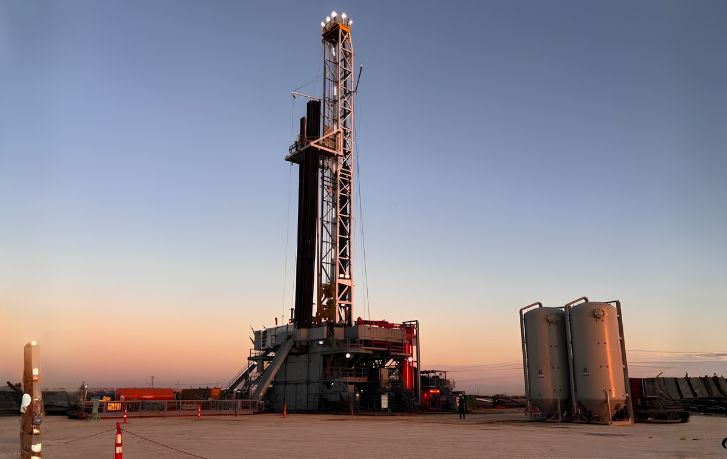
That materials change has moved beyond laboratory work. ExxonMobil reportedly used its petroleum-coke proppant in more than 100 Permian Basin wells across West Texas and southeastern New Mexico. The company reports crude-production gains ranging from 7% to 20% against baseline offset wells, according to an industry assessment published by the Journal of Petroleum Technology. The upper figure is a result from some tests, not an established average across the deployment.
Why lower density can change fracture coverage
Conventional sand has a particle density of about 2.65 grams per cubic centimeter. ExxonMobil’s patent documentation describes resin-coated petroleum-coke particles with density at or below 1.7 grams per cubic centimeter. Closing that density gap with the carrier fluid reduces the particles’ settling rate, helping them remain suspended longer and move into more remote parts of a fracture system.
The intended benefit is greater propped area. Hydraulic pressure creates fractures in low-permeability rock, but those openings can close after pumping stops. Proppant particles lodge inside and preserve flow paths through which oil can reach the well. If ordinary sand settles before reaching distant branches, some created fracture area may contribute little to production. ExxonMobil engineers reported that the lighter material reached deeper into fracture networks and increased propped area by 20% to 40% during work presented in 2025.
Low density alone is not sufficient, however. A particle that travels well but crushes under formation stress can generate fine debris and reduce the conductivity of the proppant pack. The disclosed design uses a resin coating to add compressive strength, inhibit degradation and limit particle flowback. This illustrates the central engineering compromise: transport favors lighter particles, while long-term fracture support requires adequate strength and conductivity.
Field scale matters, but comparison quality matters more
Testing in more than 100 wells is significant because shale performance is strongly influenced by geology, well spacing, horizontal-well design and completion parameters. A material that performs well in one controlled trial may not deliver the same result across different formations or operating conditions. A broader field deployment offers more opportunities to evaluate repeatability, but the well count by itself does not establish causation.
The disclosed results do not include a complete well-by-well dataset, test conditions or treatment costs. Those gaps matter because a fair comparison requires treated and baseline wells with sufficiently similar geology, lateral length, completion design and production time. Production also needs to be evaluated over a meaningful period: a strong early uplift does not automatically establish a larger lifetime recovery.
Outside analyses have reportedly supported ExxonMobil’s performance claims, but the public information described so far is not enough to determine how consistent the gains are across the full group. Wider technical confidence would require transparent distributions rather than a maximum resultshowing median performance, the range of outcomes, treatment design and how comparisons were normalized.
The economic test extends beyond added barrels
Specialty lightweight proppants have faced resistance because premium materials can cost more than locally sourced sand. Petroleum coke may offer a different supply pathway because it is produced as a refining byproduct, but processing, resin coating, transportation and field handling still add costs. The relevant measure is therefore not production uplift alone. Operators must compare the value of incremental recovered oil with the full added completion cost and any effect on pumping, equipment wear or long-term well performance.
ExxonMobil has said it used the material in roughly a quarter of its wells over the preceding year and expected to treat half of its new wells in 2026. That planned expansion will create a larger operating record. It also raises the standard of proof: the decisive result will be whether the reported gains persist across more wells, different Permian formations and longer production periods while remaining economical.
U.S. oil production has reached a record 13.6 million barrels per day, but the petroleum-coke tests should not be credited with causing that national result. Their narrower significance is more concrete: a refining byproduct may help operators reach fracture sections that sand does not reliably support. Whether that becomes a broadly useful recovery tool will depend not on the 20% maximum, but on repeatable, cost-adjusted performance across the growing field dataset.
| More aerospace and engineering stories, right in your MSN feed. Follow AMI on MSN |
By Thomas Caldwell — AMI’s senior editor for mechanical and mobility engineering, covering vehicle electronics, systems integration, electrification, chassis systems, propulsion, and safety policy.



