Reported Ukrainian Drone Wave Disrupts 300 to 370 Moscow Flights
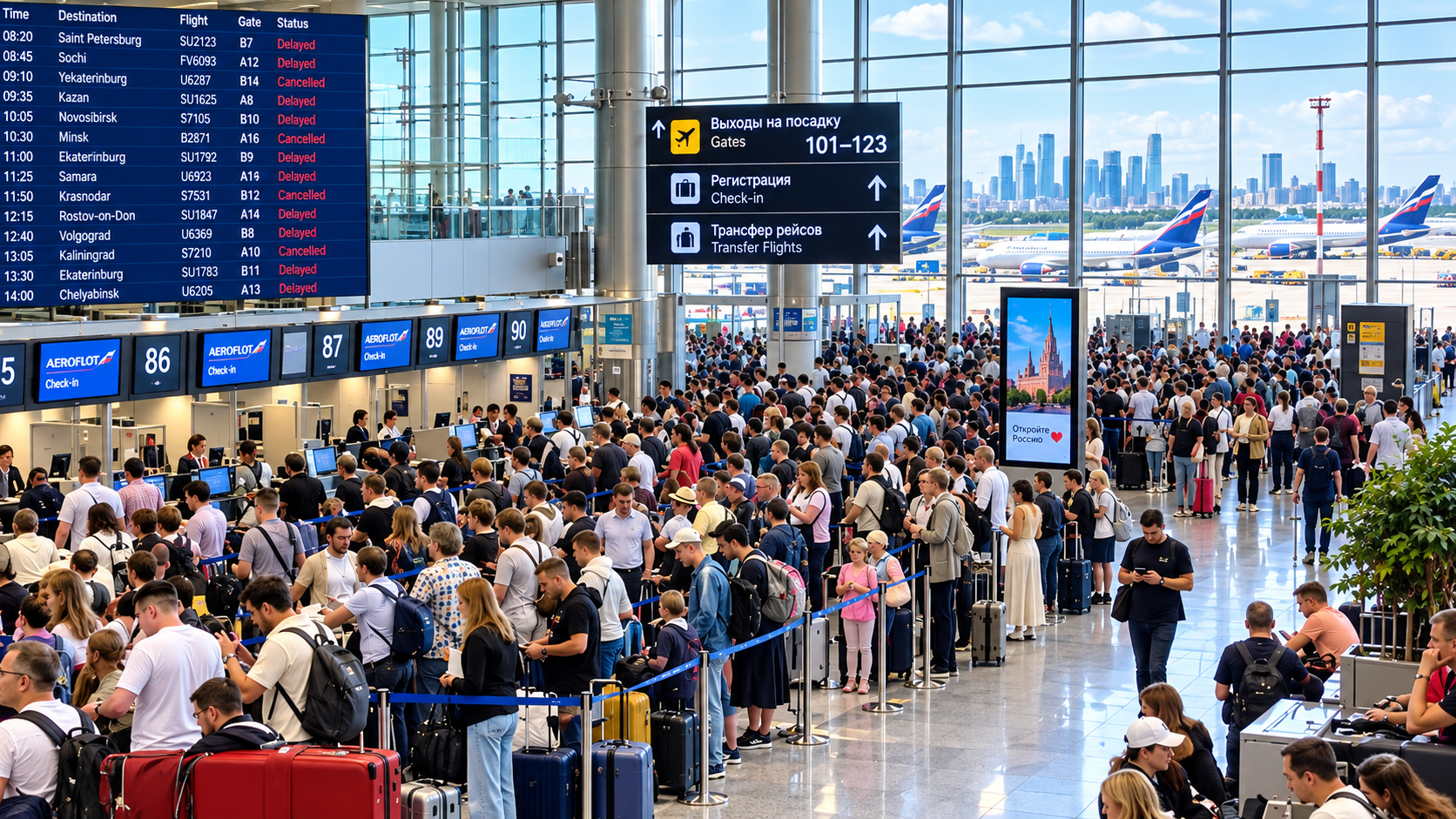
A reported Ukrainian drone wave prompted temporary restrictions at Moscow’s major airports early Saturday, Oct. 10, disrupting an estimated 300 to 370 commercial flights. Russia’s federal air transport agency, Rosaviatsiya, lifted the flight suspensions at 8:50 a.m. local time, but reopening the airspace did not immediately clear the accumulated delays and cancellations.
Vnukovo and Sheremetyevo reportedly experienced the most severe disruption, with additional delays at Domodedovo. Ukrainian monitoring channel Exilenova+ estimated that approximately 300 scheduled flights were canceled or substantially delayed, while Russian regional outlet MSK1 reported at least 370 delayed flights. No independently verified final total or airport-by-airport breakdown was available, and no direct strike on airport infrastructure was reported.
Moscow Mayor Sergey Sobyanin claimed that Russian air defenses intercepted 403 unmanned aircraft directed toward the capital region between 8:30 p.m. Friday and 8:30 a.m. Saturday. He said 25 were intercepted in the immediate airspace approaching Moscow and most of the others farther away. Those figures remain attributed official claims rather than independently confirmed totals.
Why reopening does not restore the timetable
An airport restriction stops or slows the flow of aircraft, but lifting it only removes the initial constraint. It does not put diverted aircraft back at their intended gates, restore missed departure slots or reconnect passengers whose original itineraries have already broken down.
The recovery problem is especially demanding when several airports serving the same metropolitan area are restricted at once. Airlines normally build daily schedules around linked aircraft rotations: an arriving jet is assigned another departure, sometimes after a short turnaround. If the inbound service is delayed, diverted or canceled, the aircraft may be unavailable for several later flights even though those flights were scheduled after the airspace reopened.
Airport capacity also returns progressively rather than instantaneously. Delayed departures compete with regularly scheduled services for gates, ground crews and runway access. Incoming aircraft that were held elsewhere can add another wave of demand. Airlines must then decide which services can still operate and which should be delayed further or canceled to stabilize the remaining schedule.
Crew limits narrow the recovery options
Aircraft are only one part of the constraint. Flight and cabin crews work within duty and rest requirements, so several hours of delay can leave a crew unable to complete a later assignment. An airline may use reserve personnel, but doing so reduces the backup coverage available for subsequent disruptions.
The International Air Transport Association has described how one crew member approaching a duty limit can trigger reserve use, disturb aircraft rotations and reduce recovery choices across a network. Its discussion of connected crew and operations management explains why fixing the most immediate flight does not necessarily protect the rest of the schedule. Controllers need a shared view of crews, aircraft, passengers and downstream assignments to avoid shifting the disruption elsewhere.
That operational chain reaction explains why passengers can continue seeing changing departure times after authorities announce that restrictions have ended. A reopened runway means flights may resume; it does not mean every necessary aircraft, crew, gate and passenger connection is again in the correct place.
Large claims require careful attribution
The claimed total of 403 unmanned aircraft indicates the scale Moscow officials said they were managing, but it cannot be treated as a verified measure of the wave or of interception performance. Nor does one official count establish production capacity, readiness or the effectiveness of either side’s systems. Those judgments would require independently confirmed totals and consistent data over time.
The civilian consequence is clearer than the contested drone count: precautionary restrictions affected a multi-airport network, and airlines were still revising schedules after the suspensions ended. The next useful measure is not simply when the airspace reopened, but when aircraft rotations, crew assignments and departure boards returned to their planned operating pattern a recovery milestone not yet established.
| More aerospace and engineering stories, right in your MSN feed. Follow AMI on MSN |
By Stephen Wallace — Editor for AMI’s aerospace integration and unmanned mobility coverage, focused on drone manufacturing, VTOL systems, autonomous networks, and air-ground mobility links.