


California High-Speed Rail’s 2033 Schedule at Risk After Legislative Setbacks
Only one of the California High-Speed Rail Authority’s essential 2026 policy proposals became law, leaving much of its plan for completing the Merced-to-Bakersfield line by 2033 without the legislative support it expected. As CalMatters detailed, Senate Bill 1425 was the sole enacted measure. It allows the authority to issue permits when utilities, local governments or private developers want to build on authority-controlled land.

That permitting authority is narrower than the unresolved proposals involving stable revenue, utility relocation, faster environmental and court reviews, and greater spending flexibility. The distinction matters because the 2033 schedule relied heavily on lawmakers approving the authority’s priorities almost immediately an assumption the Office of Inspector General characterized as “overly optimistic” in its July review of the business plan.
The legislative outcome creates a governance bottleneck rather than an immediate, quantifiable delay. It is not yet clear how many months or years the failed proposals could add. But the schedule’s underlying assumption has weakened: management identified policy changes as necessary to protect cost and timing, while most of those changes never became enacted tools.
Utility conflicts become construction and cost problems
Utility relocation illustrates why this is more than a procedural dispute. Overhead power lines, water pipes, communications equipment and other infrastructure can occupy the same corridor needed for guideway, bridges or related work. Authority Chief Executive Ian Choudri said in August that some utilities identified in 2017 remained in the construction path and that the authority lacked power to compel relocation or impose a deadline.
The authority’s own change-order log documents recurring costs associated with utilities, third-party railroad requirements, drainage changes, agency standards and construction resequencing. Individual entries do not establish a systemwide overrun, but collectively they show how an unresolved interface can move from a planning concern into redesign, contractor compensation, standby time or premium-time work.
SB 1425 can improve administration where another entity seeks access to authority land. It does not, however, give the authority the broader utility-relocation powers it sought. That leaves an important asymmetry: the authority can permit outside construction on its property, but it still lacks the requested mechanism to force infrastructure out of the railway’s path on a binding timetable.
Funding proposals raised competing public-cost claims
The authority also floated access to sales and property-tax revenue generated within a half-mile of the line. Local officials objected that such a mechanism could divert money used for road repairs and social services. That opposition exposes a basic fairness issue: stabilizing a statewide rail program could shift financial pressure onto the communities hosting its stations and construction.
Another measure, Senate Bill 1411, would have lifted a $500 million cap on certain climate-fund spending outside the Merced-to-Bakersfield segment. Supporters argued that early engineering, design and land acquisition near the Bay Area and Southern California could attract private participation. Legislative staff warned that moving money outward would conflict with the existing policy of concentrating those funds in the Central Valley. The bill was shelved.
The project is scheduled to receive $1 billion annually from California’s Cap-and-Invest program through 2045, but new climate rules could reduce carbon-market revenue by half. That does not establish the precise amount the railway will lose, yet it adds another variable to a program already described as being funded through a highly changeable stream. Federal officials also withdrew about $4 billion in unspent grants in July 2025 and roughly $175 million more the following month.
Physical progress does not remove policy dependencies
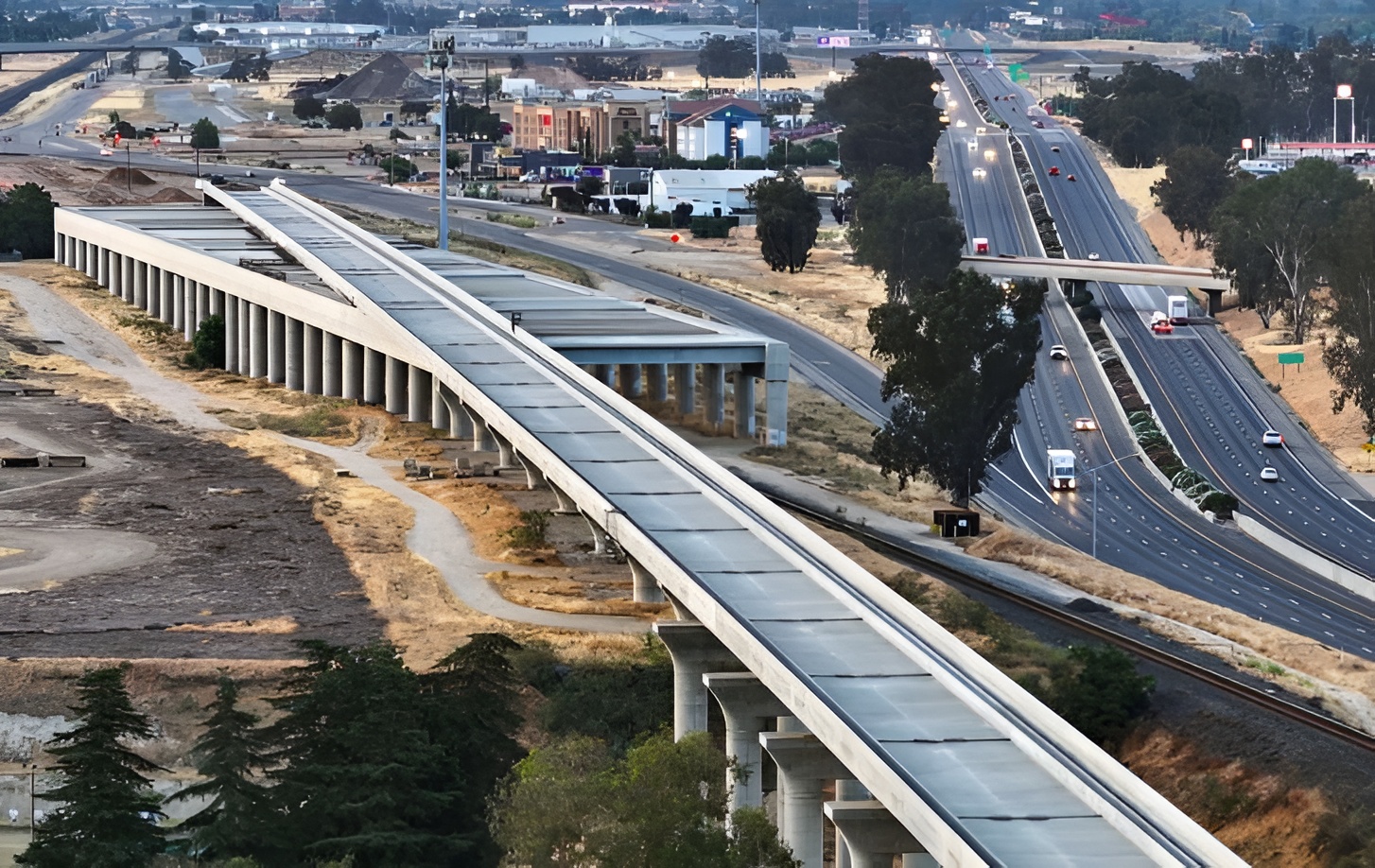
Construction is continuing. The authority reported in October that 66 structures had been completed along the first 119 miles in the Central Valley. That is tangible progress, but bridges and grade separations do not by themselves resolve funding continuity, utility access, property disputes or the timing of approvals needed to connect construction packages into an operating railway.
The broader public stakes remain substantial. The latest reported program range is $126 billion to $231 billion, and the complete roughly 500-mile San Francisco-to-Los Angeles phase is projected for 2040. It is intended to make that trip in less than three hours. Prospective passengers still lack settled answers about fares and ridership, while some affected farmers have been instructed to remove wells or plantings to clear land for construction.
The authority says it plans to pursue similar legislative concepts next year and provide updated costs and schedules in March. That update now has a specific test to meet: whether the 2033 Central Valley date can be supported without the rapid legislative action on which the existing schedule depended.
| More aerospace and engineering stories, right in your MSN feed. Follow AMI on MSN |
By Thomas Caldwell — AMI’s senior editor for mechanical and mobility engineering, covering vehicle electronics, systems integration, electrification, chassis systems, propulsion, and safety policy.



