



Navy Clears Boeing MQ-25 Tanker Production; 76 Planned, Service in 2029
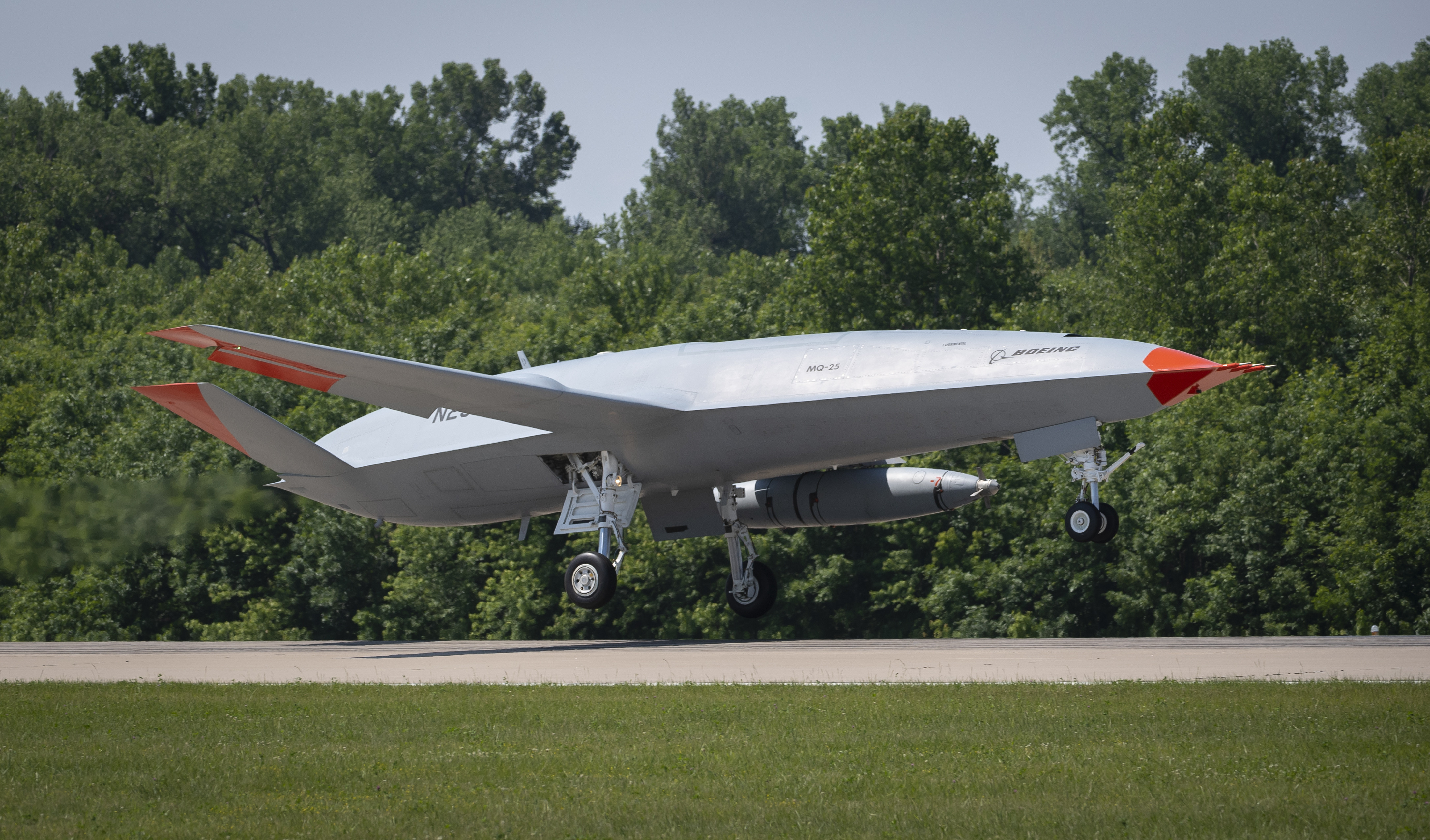
The U.S. Navy has moved Boeing’s pilotless MQ-25A Stingray tanker into production, but the aircraft is not expected to enter operational service until early 2029. That gap defines the program’s current position: the Navy has committed to a 76-aircraft fleet intended to release Super Hornet fighters from refueling duty, while integration and carrier testing remain unfinished.

The Navy awarded Boeing a $562 million fixed-price incentive contract for the first low-rate production lot after the MQ-25 passed its formal Milestone C review. The contract funds three aircraft and advance purchases of long-lead components for three more. Initial deliveries from the first lot are expected in 2029.
Passing Milestone C is a production decision, not an operational deployment. It indicates that the program has cleared the review required to move beyond development and begin limited manufacturing. The aircraft still must complete flight, systems-integration and carrier-related testing before the Navy can rely on it as part of a deployed air wing.
That distinction matters because the MQ-25’s initial operational capability target has moved substantially. The original target was 2024; the current target is the second quarter of fiscal 2029. A Pentagon acquisition assessment attributed program delays to technical risks and a Boeing labor strike. The first production deliveries are now scheduled for the same general period in which the Navy expects to establish an initial operational capability.
Why a tanker drone changes the carrier air wing
Aircraft carriers currently use some F/A-18E/F Super Hornets as “buddy tankers,” carrying external refueling equipment to transfer fuel to other aircraft. The arrangement gives the carrier its own airborne-refueling capability, but every Super Hornet assigned to that work is a fighter unavailable for strike missions or combat air patrols.
The MQ-25 is designed to absorb part of that workload. It is expected to carry about 15,000 pounds of transferable fuel and use a Cobham probe and drogue refueling store, a system also fitted to the Super Hornet. Planned receiving aircraft include the F/A-18, the carrier-based F-35C and the E-2D Advanced Hawkeye.
The practical benefit is therefore less about replacing a crew in one aircraft than changing how the carrier allocates a limited number of flight-deck assets. Moving routine tanker sorties to the Stingray could return more Super Hornets to their primary missions while reducing tanker-related use of those fighters. The Navy also expects the tanker to extend the carrier air wing’s operating reach.
The aircraft is unmanned, but it is not independent of people. It can manage navigation, propulsion and flight functions autonomously under human supervision, while remote operators retain the ability to intervene. Building confidence in that control arrangement will require more than demonstrating stable flight. The system must work reliably alongside crewed aircraft, shipboard operators, deck crews and established carrier procedures.
A 76-aircraft plan starts with small production lots
The Navy’s program of record covers 76 MQ-25s: nine test aircraft and 67 production aircraft. Three were acquired in fiscal 2026, while the fiscal 2027 budget provides $771.177 million for three additional aircraft and added production capacity. Low-rate manufacturing allows the Navy and Boeing to begin building aircraft while testing continues, but it also limits exposure before the design and production system mature.
Boeing is assembling the Stingray at a 300,000-square-foot facility at MidAmerica St. Louis Airport in Mascoutah, Illinois. The MQ-25 uses a Rolls-Royce AE 3007N turbofan engine. Boeing was selected for the program in 2018, and its company-owned T-1 demonstrator first flew in 2019 before completing an aerial-refueling test in 2021.
Ground testing of the Navy-owned aircraft began in July 2025. On April 25, 2026, Boeing’s first Navy-owned MQ-25 completed a flight lasting more than two hours, exercising flight controls, navigation and autonomous systems. Its next major step is a move to Naval Air Station Patuxent River for additional integration testing ahead of eventual carrier operations.
The production clearance gives the MQ-25 a defined manufacturing path and puts money behind the Navy’s 76-aircraft plan. The harder threshold is still ahead: proving that an unmanned tanker can operate dependably within the tightly coordinated carrier environment. Until that work is complete, the Super Hornets the Stingray is meant to relieve will continue carrying the tanker burden.
| More aerospace and engineering stories, right in your MSN feed. Follow AMI on MSN |
By Stephen Wallace — Editor for AMI’s aerospace integration and unmanned mobility coverage, focused on drone manufacturing, VTOL systems, autonomous networks, and air-ground mobility links.